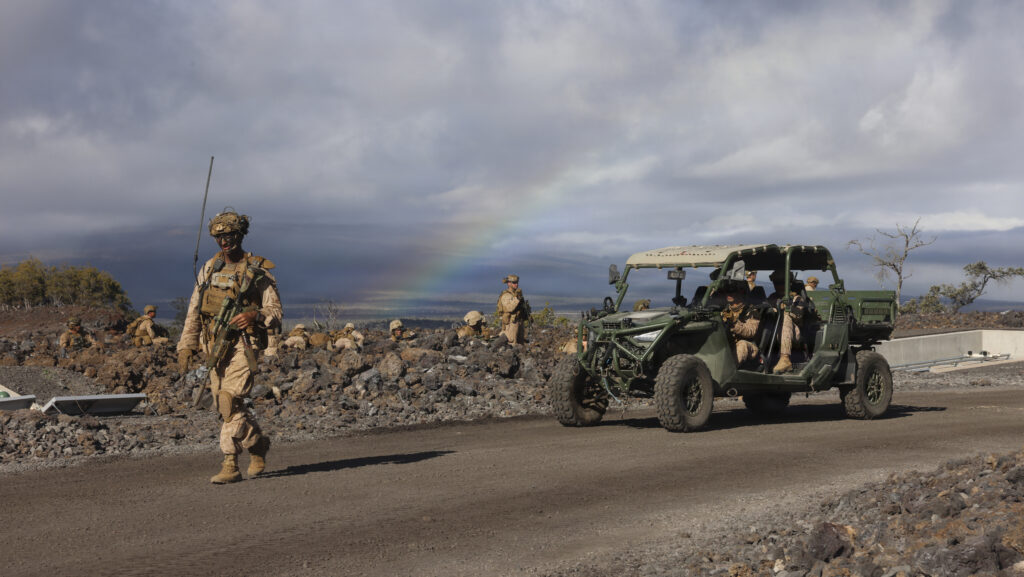
DETROIT — Months after the Army said it was restructuring its Unmanned Systems (UxS) autonomy program, a service official said today that the Army is swapping out Infantry Squad Vehicles (ISVs) for Polaris’ MRZR platforms.
“The important thing here is continuing what the RACER program started, which was like, ‘What’s the best you can do in off-road autonomy?”’ Michael Rose, the chief technology officer for CPE Mission Autonomy said. RACER is a former DARPA program that developed autonomy software stacks enabling Army and Marine Corps unmanned ground vehicles to maneuver on off-road terrain.
Rose explained that now CPE Mission Autonomy has created an “environment” where multiple companies can use the same “base platform,” as the MRZRs to test their autonomy stacks on, so the service can “get a true head-to-head comparison of where the industry is right now,” he continued. (The UxS ISV competition also had one “base platform.”)
As Breaking Defense reported last fall, the Army scrapped its earlier plans to spruce up ISVs with off-road driving autonomy software provided by Forterra, Overland AI and Scout AI through prototype contracts. Instead, “[b]ased on the changing technology environment,” the Army decided to allow UxS software vendors to select their “preferred robotic platforms rather than using the Infantry Squad Vehicle (ISV) as a surrogate,” a spokesperson told Breaking Defense at the time. But today Rose told Breaking Defense on the sidelines of the GVSETS Conference that the service has completely ended using ISVs and is now solely using MRZRs to test off-road autonomy.
A spokesperson from Polaris confirmed to Breaking Defense today that the company has provided 12 MRZR Alphas to the Army for the initiative.
Though Rose declined to comment on why the Army shifted away from ISVs, Breaking Defense previously reported that there were potential challenges with the service’s initial UxS plan. An industry source at the time said there were “underlying deficiencies” in the program, like potential safety risks and the low price point of the UxS contract awards — all three companies were given a total of $15.5 million to integrate their software with the ISVs — making an ISV a less ideal choice.
Following publication, Rose clarified to Breaking Defense that “the focus of the UxS program is off-road autonomy rather than the particular platform.” He added that the ISV, the MRZR and other platforms could be “potential landing zones” for “advanced autonomy capabilities” down the line.
“The goal is not to compete with industry in areas they have already invested billions into and are great at,” Rose said. “Rather, the Army’s S and T investments in robotics and autonomy are focused on areas that are military specific and require unique investments.”
Rose did not comment on which companies are involved in providing the autonomy software for the MRZRs, and Breaking Defense reported in December that Army CTO Alex Miller said the service was evaluating other companies besides Forterra, Overland AI, and Scout AI, including those from the service’s FUZE shop. All three companies confirmed to Breaking Defense today that they are still participating in the UxS program.
Rose also declined to comment on any upcoming acquisition decisions or price points for the revamped UxS program.
Updated 8/14/2026 at 9:38 am ET to include additional comments from Rose.
Breaking Defense Video