
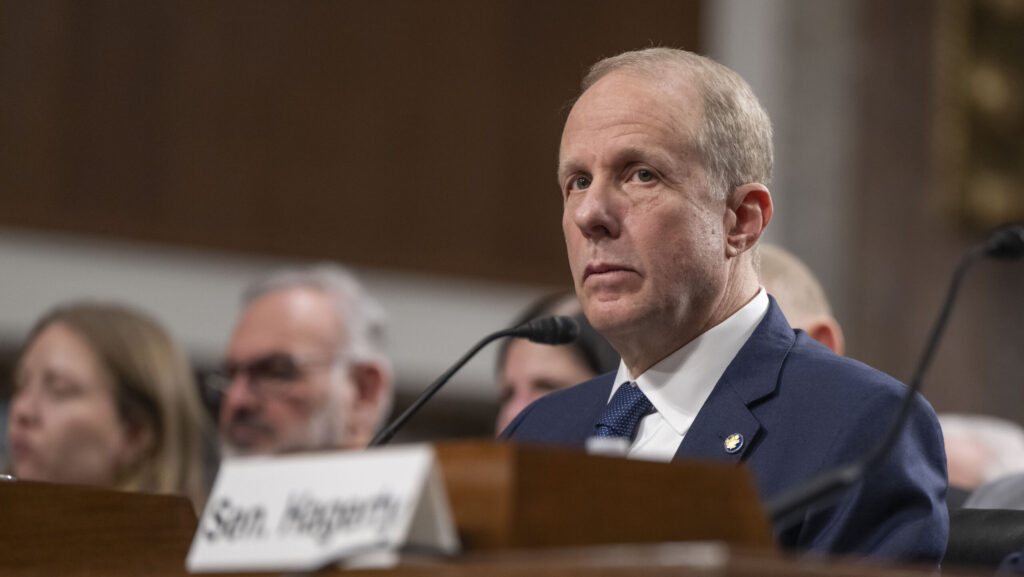
WASHINGTON — As the US military attempts to put its industrial base on a wartime production footing, Deputy Defense Secretary Stephen Feinberg has requested that large firms send their board members to the Pentagon to receive briefings from department leaders, industry sources told Breaking Defense.
While it’s not uncommon for top Defense Department leaders to have a direct line to defense CEOs — and Feinberg is reportedly in regular communication with top executives — it’s highly unusual for members of a company’s board of directors to be called into the Pentagon for an in-person meeting.
Sources said the initial request came from Feinberg, though it is unclear which defense companies have actually sent board members to the Pentagon. A department official, speaking on background, told Breaking Defense that some board members have met with officials through the Business Operators for National Defense (BOND), a new organization set up by the Pentagon in February.
“These discussions centered on connecting defense industry leaders face-to-face with their government customer and addressing procurement modernization and production scaling,” the official told Breaking Defense. “Our industry partners must have a clear understanding of the global strategic competition, particularly as our adversaries target aggressive production timelines. Ultimately, the warfighter and the taxpayer stand to gain when we foster a more responsive, collaborative, and mission-aligned defense industrial base.”
Asked last month by Breaking Defense about the department’s request, Honeywell Aerospace CEO Jim Currier said that a meeting with the Pentagon and his board members will “definitely happen” in the future, but said that the timing of the request — during which the legacy Honeywell company was transitioning into multiple companies — caused a delay.
“My conversation with DoW and with DepSec Feinberg has been specifically: ‘Trust me, you don’t want the Honeywell board to come here and have this conversation with you because fact of the matter is, they’re not going to be the same people that you’re going to be talking to'” following the standup of a new board, he said during a July interview. ‘”And so everything that you’re trying to imprint on them about the urgency and the need and what the threat is, is going to be a wasted exercise.'” (A company spokesperson declined to offer an updated status on if that meeting happened.)
Three other industry sources, speaking on background, confirmed that companies had gotten the message that Feinberg wanted board members to come into the building. Two of those sources added that the goal of the requested meeting was a desire to educate board members on the gravity of the threats facing the United States — a topic that would only permit board members with security clearances to attend the session.


Biodefense is force protection: Ready today, prepared for tomorrow
A decorated combat aviator and biotech CEO advocates preparing for novel viral threats before the next crisis.
“The Pentagon wants to make sure the boards understand the severity of the threat,” one of the sources said.
Byron Callan, an analyst with Capital Alpha Partners, said he wasn’t aware of previous Pentagon leaders ever meeting with board members, but that he’s not surprised that Feinberg — with his private equity background — would see benefit from direct contact with individuals who are integral to the management of the major defense primes.
“I don’t have a problem with it. I think it’s actually a good thing that they’re engaging at that level,” he said.
Callan added that he expects that any discussions would be a “two-way street,” where board members are also able to lay out questions or concerns.
“Will it make a big difference? I suppose time will tell,” he said. “At the end of the day, these companies, as much as they may be patriotic, they still have to earn returns on their investments. They still have to show that they’re mindful of what shareholders are concerned about.”
Feinberg’s Focus On Industry
Feinberg has been at the vanguard of the Pentagon’s efforts to lure defense primes to invest more of their own capital into new factories and facility expansions, working directly with executives to ink multiyear framework agreements to double or even quadruple production of key munitions like the Patriot system’s PAC-3 interceptor or Tomahawk cruise missile.
Those deals, however, are subject to Congress passing the fiscal 2027 budget, including a $350 billion reconciliation package that contains $47 billion in munitions funding.
At the same time, the White House has put pressure on publicly traded firms to minimize share buybacks and dividends — resulting in most defense primes putting a temporary halt to share buybacks and vowing to increase capital expenditures. An executive order signed off in January tasked the Pentagon to ensure that future contracts include clauses that would restrict companies from being able to issue dividends or buy back stock if companies failed to perform.
In one of Feinberg’s rare public statements since being confirmed for the No. 2 Pentagon job in January 2025, he made the case that the department and defense companies need to work together to streamline bureaucracy and speed up procurement — and that firms who chose to fall behind will be left behind.
“Our contractors need to change and do better,” he said in November to a crowd of defense executives ahead of Defense Secretary Pete Hegseth’s speech on acquisition reform. “The contractors that are willing to change with us will prosper and grow. Those who don’t and resist it will be gone.”
Meanwhile, the deputy continues to push industry to move faster. In a recent memo, first reported by the Washington Post, Feinberg gave industry officials 21 days to submit plans on “more aggressive delivery schedules” for critical capabilities.
That includes pushing companies to spend more internal funding: “Address how we will collaborate as partners and demonstrate your willingness to put skin in the game,” Feinberg wrote, according to the Post.