
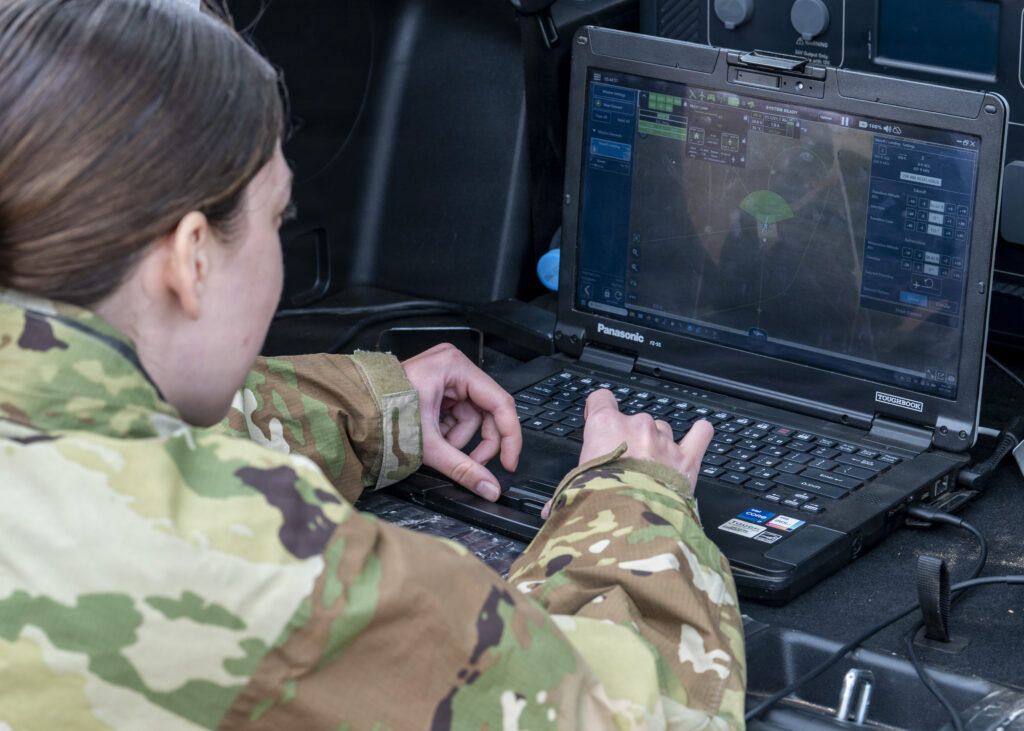
Artificial intelligence (AI) chat functions have swiftly changed the way we acquire information today. Now the next iteration has arrived in the form of agentic AI, which is already having profound effects on both tactical and strategic operations.
As language models rapidly scale, often via easily accessible open-source models, they hand both friendly forces and adversaries a powerful new toolkit for rapid cyber operations and automated decision-making. Garrett Berntsen, Chief AI Officer at Accenture Federal Services and former Deputy Chief Data and Artificial Intelligence Officer for Scaled Capabilities, discusses how defense leaders can look beyond the hype and build an agile, software-abundant force for 2035.
Breaking Defense: Defense leaders have used AI for years, but agentic AI is fast becoming a dominant focal point. What is driving this urgency around agentic AI across the department right now?

Berntsen: Two massive drivers are at play: open-source proliferation and battlefield realities. Historically, cutting-edge technology was locked behind classified programs. Today, powerful frontier models are often open-sourced within months. That means adversarial actors or a teenager in a basement will soon have tools capable of synthesizing vulnerabilities into potent cyberweapons. Our adversaries aren’t just processing data faster, they are acting faster. Defensively, we are on a ticking clock to harden our systems using these same capabilities.
In the physical domain, look at Ukraine. We’re seeing the shift to low-cost weapon systems that are rapidly trending toward full autonomy.
The urgency comes down to math; human-in-the-loop decision chains can’t physically keep pace with swarm attacks or rapid electronic warfare adaptation. The reality is that if we don’t prepare to delegate autonomous workflow execution to machines, we are likely to lose our speed advantage in the long run.
As these systems become more capable it just increases the need to have a human in the lead, doesn’t it?
During my time as an Army officer in Afghanistan, the rules of engagement (ROE) dictated a spectrum of actions based on the threat environment. In the military, you’re trained in the rules of engagement because they are there to help keep you safe while also operating ethically and proportionally.
On D-Day, the ROE was vastly different than on a counter-insurgency patrol in Kandahar. We must establish a similar, dynamic sliding scale for AI autonomy. You cannot deploy autonomous systems in highly restrictive environments without appropriate human oversight. However, in a near-peer, global conflict against an adversary employing full autonomy, our ROE must adapt to protect American and allied lives. There is no one-size-fits-all policy; our operational frameworks must be as agile as the technology itself, ensuring human command always aligns with mission risk.
How do you structure control mechanisms, so commanders retain authority without bottlenecking the system?
Control shouldn’t be treated as a binary on/off switch. It requires a dynamic, sliding scale of autonomy governed by clear rules of engagement.
In low-risk, operational support environments, you can grant high autonomy with humans auditing outcomes after the fact. Think of how that plays out in examples like supply chain logistics, contract analysis, or route planning. In high-risk tactical environments involving kinetic strikes or critical targeting, the system operates under a human-on-the-loop or strict human-in-the-loop constraint where the agent presents fully verified courses of action, but a commander holds sole authorization.
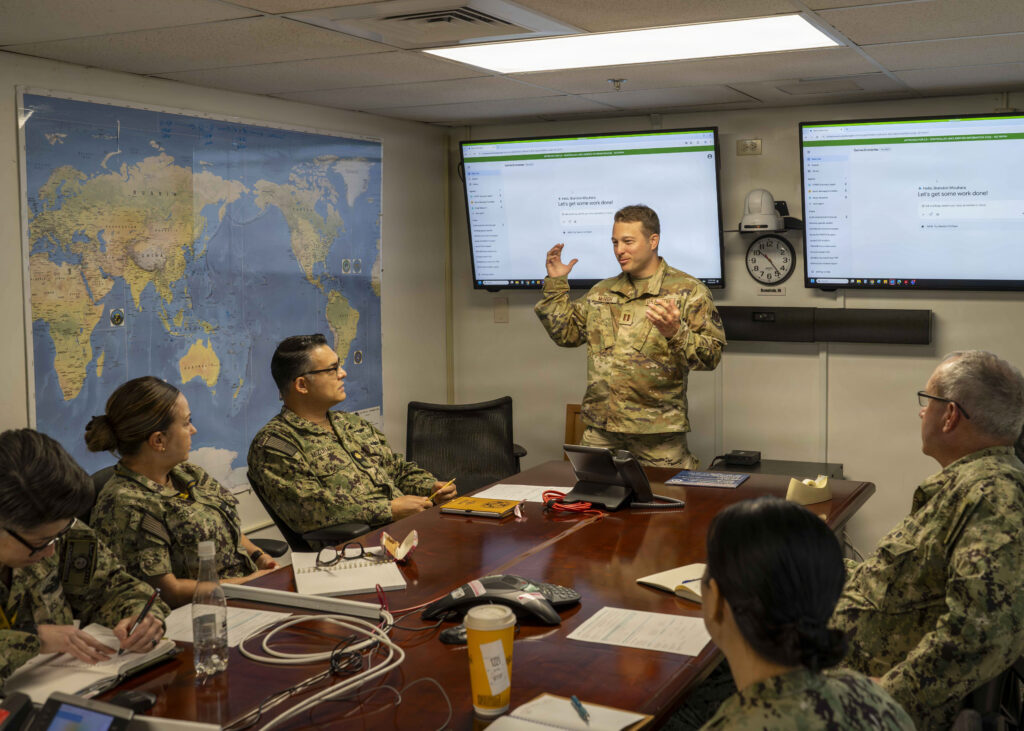
The goal of agentic AI isn’t to replace human judgment; it’s to clear away the cognitive noise so that when the human makes a decision, it is based on synthesized, real-time ground truth rather than overwhelming data overload.
One of the major advantages of AI is its ability to quickly process and analyze information. Does that speed create challenges where humans can’t keep up? If so, how do you work around that?
When speed exceeds human capacity, the answer isn’t to force humans to work faster, it’s to fundamentally re-engineer the business process. We help clients stop using AI to merely optimize outdated workflows. If an agentic system can instantly process intelligence or generate reports, human operators are freed to do what AI cannot: negotiate, strategize, and build partnerships. We challenge organizations to ask whether a legacy process is even necessary anymore and strengthen the points where human judgment is truly required.
What lessons can we learn from earlier defense modernization efforts to apply new technologies. How do we avoid that with agentic AI?
That is one of the risks with defense technology. If you take a 12-step paper-based approval process and build 12 AI agents to automate each step, you haven’t modernized – you’ve just digitized an outdated process.
Real transformation requires re-engineering the workflow from scratch around machine capabilities. You have to ask: If we designed this mission process today with the tools we have right now, what would it look like? Often, a 12-step process shrinks down to a single automated workflow with one human checkpoint.
What does this mean for how government and industry work differently to move these capabilities out of pilot programs and into the hands of warfighters at scale?
Department leaders should challenge industry partners because they know that a commercial prototype in a sandbox is very different from deploying secure, edge-ready capabilities across classified defense networks. Government, on the whole, needs to move away from rigid, multi-year feature specifications and lean into outcome-based, rapid-iteration contracting.
We need an ecosystem approach – taking commercial frontier models, wrapping them in defense-grade security and domain-specific knowledge, and embedding engineers alongside operators to continuously evolve the solutions. When engineers and operators share the same feedback loop, we can move much faster as a living, strategic capability.
Looking ahead, what does the military force of 2035 look like in an agentic, highly autonomous battlespace?
If I’ve learned anything over my career, it’s that predicting 10 years out takes a lot of strategic humility! But looking toward 2035, I see three major shifts will define the future force.
First, we’ll have a much clearer line between what we purely automate and what remains uniquely human. The critical, high-stakes tactical decision-making will stay uniquely human. But the operational support – logistics, administrative paperwork, routine intelligence sorting – will be heavily automated and augmented by software agents.
Second, the entire economics of defense software is going to fundamentally change. Right now, government procurement follows a multi-year cycle – you write requirements, request funding a year later, build for two years, and then maintain that system forever. With agentic coding, the cost to build software drops dramatically, giving us a world of software abundance. We won’t need to treat software as a permanent asset. You build a capability for a specific mission problem, and if it stops being useful, you just turn it off and tear it down.
The third big shift is pushing software skills directly to the front lines. If software is key to mission success, we can’t lock those capabilities behind headquarters or program offices. Imagine a future where an infantry platoon has a software NCO or Warrant Officer embedded right there with them. If they hit a unique tactical problem in the field, they don’t call back to headquarters to ask if someone can build them an app. They build the digital capability on the spot, execute the mission, and tear it down. That distributed, agile capability is what a modern force truly looks like.