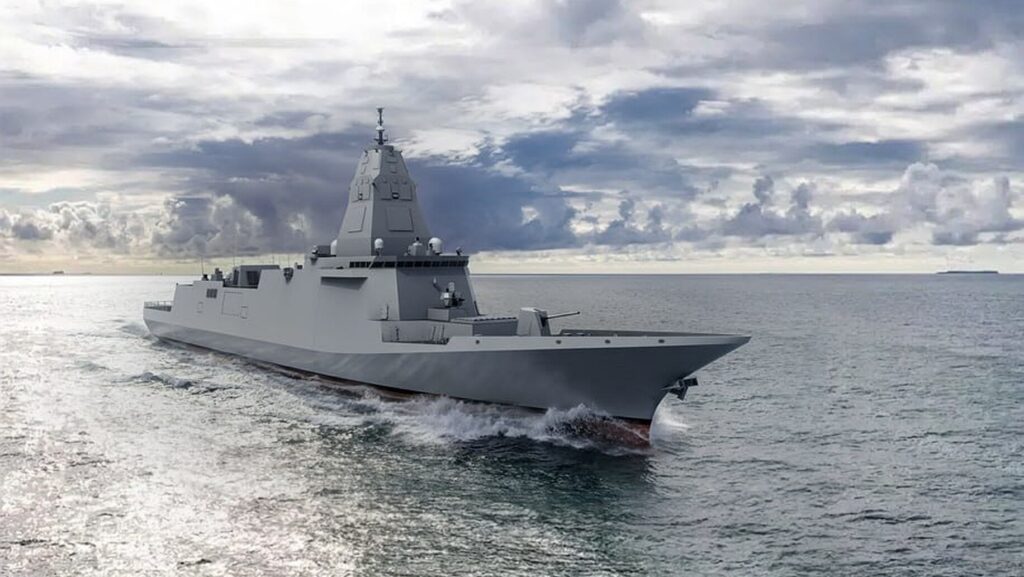
SINGAPORE — GE Aerospace has announced that its LM2500+G4 marine gas turbine engine will power new destroyers for South Korea’s Navy.
The company said in a press release on Tuesday that it will supply 12 LM2500+G4 engines for six KDDX-class ships being built for the Republic of Korea Navy (RoKN). No contract value was announced, and South Korea’s defense ministry has not responded to questions from Breaking Defense.
“The LM2500+G4’s integration with KDDX’s full electric propulsion configuration offers the ships superior operational flexibility and fuel economy, power for future growth, and optimal survivability/redundancy,” said GE’s release, adding that the engine would meet the power demands of the KDDX-class.
Asha Belarski, vice president and general manager of GE Aerospace’s marine engines and systems division, said that transitioning to a full electric propulsion system is a step towards the next generation of naval propulsion.
“We are honored to be a part of this project incorporating the latest advancements in shipbuilding. The selection of GE Aerospace’s LM2500+G4 technology strengthens our strong collaborations in Korea and demonstrates our commitment to local manufacturing,” Belarski said in a statement.
GE noted in its release that the RoKN has procured 163 GE Aerospace marine gas turbines for 95 ships. Hanwha Aerospace, its South Korean partner, will manufacture various engine components locally along with assembling, testing, and providing service support.
Hanwha’s shipbuilding arm has already been announced as the preferred bidder for the KDDX, with Hanwha Ocean announcing in early July that it was chosen by South Korea’s Defense Acquisition Program Administration (DAPA) over rival Hyundai’s offer.
The company said it was still negotiating terms with the South Korean government for the contract. If clinched, the deal would see Hanwha Ocean carry out detailed design and construction of the lead ship of the class.
Each KDDX is expected to displace 7,000 tons with the entire program expected to cost 7.8 trillion won ($5.75 billion)
Breaking Defense Video