
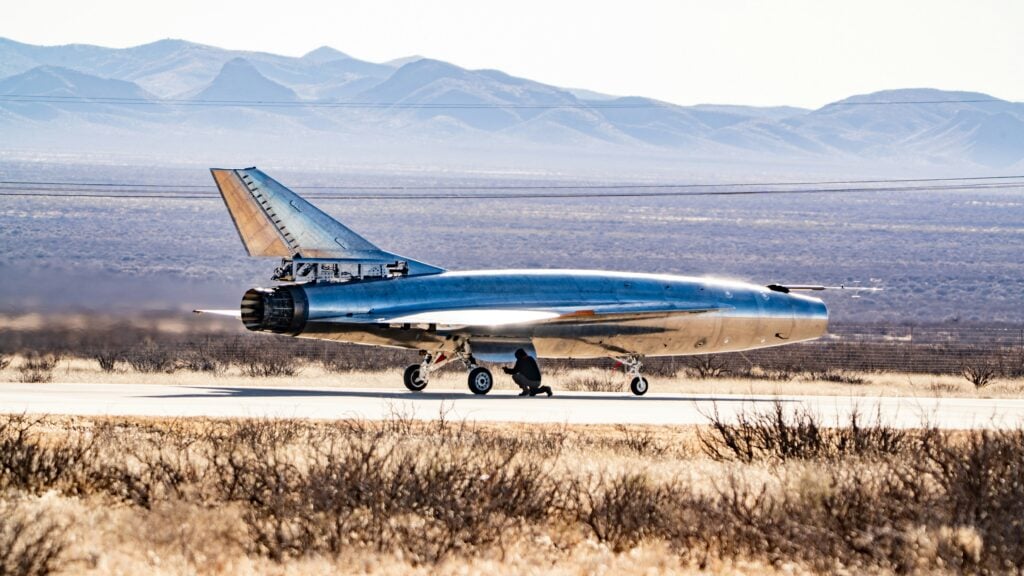
WASHINGTON — Aircraft startup Hermeus’s Mk 2 Quarterhorse high-speed drone will be equipped with autonomy software provided by defense tech firm Anduril, the two companies exclusively told Breaking Defense.
Under the new teaming arrangement, Anduril’s mission autonomy suite, Lattice, will be paired with the Quarterhorse for flight testing that will kickoff next year. The Quarterhorse is being developed with funding from the Pentagon’s Defense Innovation Unit, with a goal to fly the aircraft at speeds as fast as Mach 3.
“As we evaluated a bunch of solutions, we viewed Anduril as the natural partner,” Hermeus CEO Zach Shore said in an interview ahead of the announcement.
Hermeus is developing the Quarterhorse iteratively through a series of flight tests, which to this point have been remotely controlled. “We now need to automate a lot of those flight controls,” Shore explained. “I want to be able to push a button, have the aircraft spin up, have the aircraft auto takeoff, all those basic features that allow one person to manage multiple platforms. Irrespective of the mission, just that level of command-and-control and scalability, we needed a partner to help us do that.”
Brett Darcey, Anduril’s general manager and vice president for mission autonomy in air dominance and strike, told Breaking Defense that Anduril will provide an “end-to-end” solution for autonomous operations, from the software needed for flying to the ground control systems used by operators.
“We really want to emphasize the fullness of the stack,” Darcey said during the interview. “This isn’t just a mission autonomy science project. This is really readying the Quarterhorse for live operations in a way that really accelerates here.”
The partnership will carry benefits for Anduril too. While the company’s Lattice solution is currently in the mix for the Air Force’s Collaborative Combat Aircraft program, partnering with Hermeus offers a chance to test out the technology’s performance on a large, high-speed speed platform.
“It’s really about the mission envelope that opens up there,” Darcey said. “This is expanding the addressable market for our mission autonomy solution,” a partnership that Darcey later observed can “increase the diversity of our experience, so that our product is better.”
The two executives declined to comment specifically on dollar amounts associated with the teaming arrangement. “This is a partnership with a contract, with funds exchanged,” Shore said. Darcey, for his part, described the partnership as one “of mutual economic and probably future economic benefit.”
Shore also noted that the partnership can dovetail with ongoing work for the government to develop the Quarterhorse, particularly as it relates to integrating an autonomous solution using a government reference architecture. However, he declined to comment specifically on discussions with government contracts.
“There is tremendous alignment, support, and backing for this effort within the government,” he said.
Shore said there’s “really no horizon” on the partnership, while noting that customers like the Pentagon reserve the ability to integrate the autonomy vendors they want if they decide to acquire the Quarterhorse as a weapon system.
“In a dream scenario, as these aircraft become more real and higher volume, and they’re out there in the world, there’s all sorts of go-to-market opportunities together to team and say, you know, ‘This airplane and this brain,’” he said.