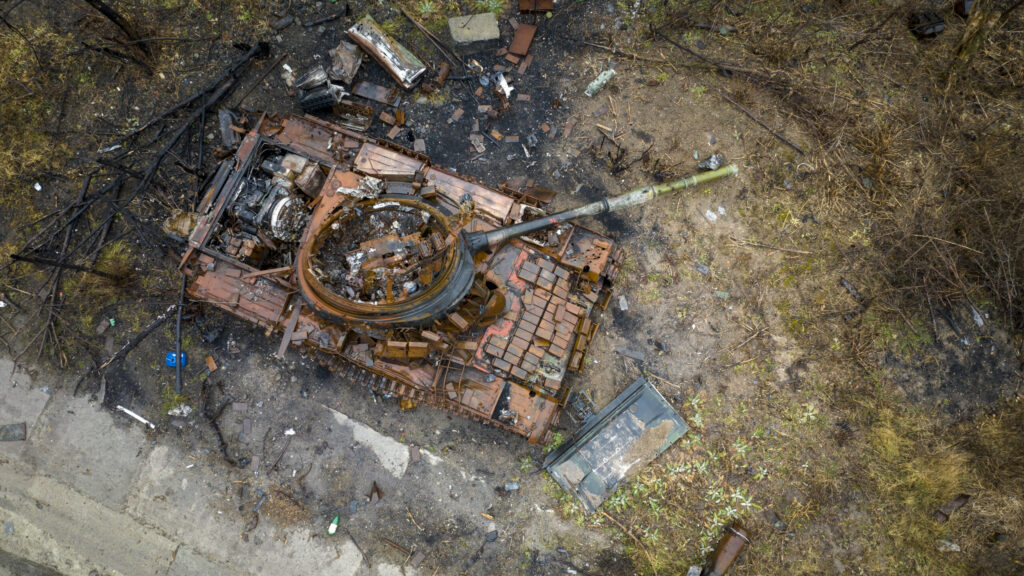
The war in Ukraine exposed a brutal truth about modern armor: A cheap first-person view (FPV) drone can hunt a tank from above, slip past its strongest plates and turn the turret roof into the vehicle’s most dangerous weak point.
Just as Western militaries are reacting, China’s People’s Liberation Army (PLA) has observed how drones and high-angle attacks have battered armored vehicles in recent wars. Now, the PLA, having argued that armored forces face an increasingly three-dimensional drone threat, are racing to rebuild protection for the age of overhead attack.
In early 2025, Chinese state media revealed nascent efforts to confront this new battlefield reality. Footage from a test site run by the military conglomerate Norinco showed a tank fitted with the new GL-6 active protection system (APS) knocking out a descending threat from overhead while simultaneously engaging another from the side. Reporting highlighted the system’s ability to engage both high-angle attacks from above (whether from drones, rockets, missiles or loitering munitions) and near-simultaneous air and ground attacks.
However, Chinese defense commentators appear to see the GL-6 as just one part of a wider layered solution. Norinco’s intelligent combined brigade concept, revealed at the 2024 Zhuhai Airshow, shows another way in which the PLA can confront the drone problem, by creating a networked combat system in which armored vehicles operate alongside reconnaissance drones, electronic warfare assets and counter-drone tools to detect and disrupt incoming threats.
Operationally focused studies point toward the same layered approach. A 2025 article from PLA Army researchers argues that mobile formations facing UAV swarms need a combination of integrated warning, electronic countermeasures, kinetic defenses, camouflage and decoys. Chinese researchers have also worked to improve the sensing, prediction and interception technologies that underpin those concepts. For example, defense researchers have discussed how cheap drones, swarms and precision-guided munitions will push militaries back toward a combination of lower-cost terminal defenses that can better withstand saturation.
All of these studies point to a common theme: “smart armor” is viewed as less a stand-alone technology than a wider effort to make armored survivability more connected, more responsive and better integrated for a battlefield shaped by overhead attack.
The more immediate question for the PLA may not be which protection concept proves most advanced, but which one can reach armored units fast enough to matter. Like forces in Ukraine, the PLA have given serious attention to roof barriers, cage-like covers, localized reinforcement and other add-on measures. That wider protection logic has also influenced how crews manage signature and exposure — recent PLA training has emphasized armored units responding to drones by hiding in roadside depressions, erecting camouflage netting, erasing vehicle tracks and using smoke to mask movement during live tactical drills.
These are simple measures, but they serve the same purpose as roof screens and add-on armor. They buy time, disrupting targeting and forcing an attacker to work through more layers before a strike hits cleanly. A force that combines hard-kill interception with concealment, obscurants and modular physical barriers can complicate the drone kill chain without needing a new vehicle design.
Toward this end, Chinese military writers have increasingly focused on turning battlefield improvisations into sustainable vehicle protection. Scaling such adaptations requires balancing protection with engineering, production, maintenance and logistics. An April 2026 PLA Daily assessment looked at cages, wire barriers, composite screens and other foreign adaptations, and highlighted penalties in visibility, weapon movement and mobility. A September PLA Daily article examined the next step of incorporating these measures seamlessly into operations, describing how Russian manufacturers incorporated physical and electronic anti-drone measures into newly produced tanks after battlefield feedback. Chinese reporting on military protective materials likewise emphasizes lighter composites and modular protection alongside active and electronic defenses.
For US and allied forces, the key question is not whether China has built a flawless shield against FPVs. It is whether PLA armored units can make top-attack shots less easy, less cheap and less certain. Even modest gains would matter.
Chinese military writers themselves acknowledge that no layer offers a complete answer. Earlier this month, PLA researchers highlighted small-target detection, short engagement windows, costly interception and increasingly jam-resistant fiber-optic or autonomous drones as persistent problems. APS, roof protection, camouflage, smoke and local reinforcement can all force anti-armor teams to engage in denser salvos, as well as utilize more complex tactics involving mixed-axis strikes, deception and closer reconnaissance, while making support vehicles and key enablers more attractive targets. Ukraine has already shown that drone-heavy battlefields reward adaptation and saturation over reliance on a single strike. Taiwanese military analysts now read PLA displays of APS-equipped heavy armor in much the same way, as a response to asymmetric tactics centered on drones and anti-tank weapons.
Chinese military reporting does not reveal a finished answer to drone-age anti-armor warfare, but it shows show that the PLA is rethinking how armor survives on the frontlines. The pattern that emerges points toward layered protection that blends active defense, roof adaptation, modular reinforcement, signature management and more intelligent coordination between the vehicle and the broader formation. The key question now is how quickly these ideas move from demonstrations into operational units. If that transition gathers pace, US and partner forces may face armored units that no longer offer easy overhead kills.
The drone age did not end armored warfare. It rewrote the terms of survival, and China appears determined to adapt before that lesson hardens into a battlefield disadvantage.
Tye Graham is a Senior Researcher with BluePath Labs and a retired US Army Foreign Area Officer.