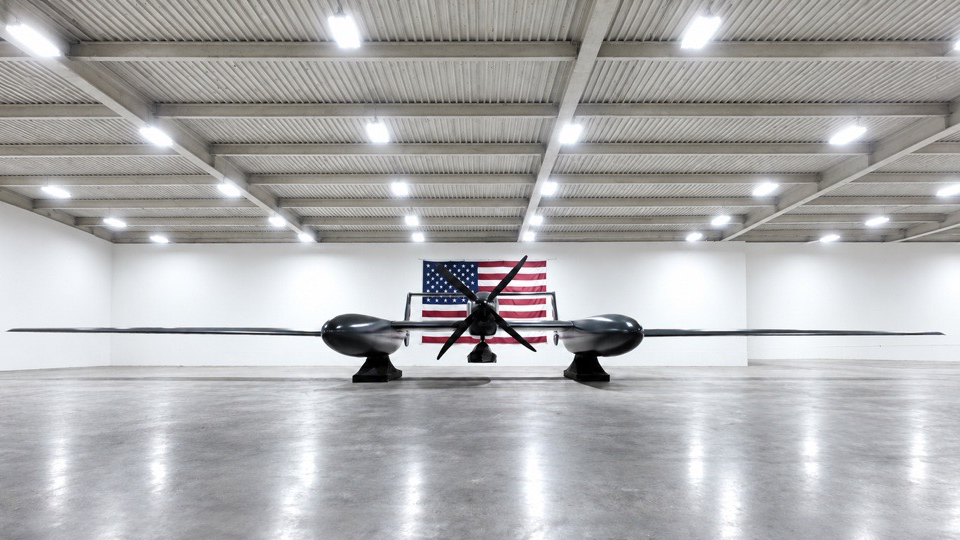
NATIONAL HARBOR, Md. — Startup drone maker Swarm Aero is gunning to replace the MQ-9A Reaper, touting its own dual-hull-style unmanned candidate that company executives say will fulfill the Pentagon’s desired traits for a new high-flying hunter-killer.
Swarm’s Gamera debuted today at the Air and Space Forces Association conference here as a full-scale model. The company says the turboprop aircraft sports a 72-foot wingspan and will boast an unrefueled range of 9,000 nautical miles (10,357 miles), with seven hardpoints to carry key munitions and modularity to satisfy multirole demands.
Unlike the Reaper and most long-range drones in service, Gamera doesn’t have a central fuselage but two parallel, oblong fuselages offset from the center. An executive told Breaking Defense that with the drone, the company made specific tradeoffs to achieve a greater distance.
“What we’ve done cuts against the conventional wisdom, which is that to deliver payload from a long range against critical targets, that you want to wrap that in stealth and wrap that in all sorts of protections,” Oliver Palmer, co-founder and chief revenue officer of Swarm, said in an interview with Breaking Defense ahead of the Gamera’s announcement. “And what we’ve done instead is create a very simple, non-stealthy aircraft that’s optimized for extreme range.”
Swarm is offering up the Gamera for the Pentagon’s Massed Modular Aircraft (MMA) program. Run by the Defense Innovation Unit and the Air Force, the MMA effort is aiming to field a cheaper and more attrition-tolerant replacement for the Reaper, following significant losses of the aircraft amid conflict with Iran. Officials say the MQ-9A can cost up to $50 million depending on its configuration.
The MMA team has set some ambitious targets. Air Force officials in a briefing with reporters Sept. 3 expressed a goal of getting the unit cost of the MMA air vehicle down to $10 million a copy, and said they have now been tasked to accelerate the program’s fielding.
Swarm is not the first to jump at the MMA competition — MQ-9A manufacturer General Atomics has already come forward to reveal its own candidate called Wildfire — and is unlikely to be the last.
But Palmer asserted Swarm “can beat” the Air Force’s cost target and asserted the company will be “very competitive” on pricing. Swarm CEO Peter Kalogiannis added in the interview with Palmer that “there’s no silver bullet” when it comes to getting prices down, emphasizing that it takes “a concerted effort to drive cost out of the system at every design point.”
Palmer and Kalogiannis maintained that the Gamera was built to be highly modular — supporting the Pentagon’s goal to more easily swap payloads and iterate the aircraft’s hardware and software — and that the drone can carry a weapons load necessary to meet the MMA program’s goals. According to the effort’s solicitation released in July, that includes a payload capacity of at least 2,800 pounds.
“We meet the payload at range numbers for the 2,800 [lbs requirement],” Kalogiannis said. “But we can certainly trade range for payload capacity” to carry more and fly shorter distances, or reduce payload to save weight for fuel and fly farther, if the mission demands it.
While one Air Force official previously opined that a winning MMA design largely won’t have “cutting edge” technology, Kalogiannis said that a “mix” of old and new will strike the right balance. The company has partnered with Honeywell to power the aircraft with the TPE331 turboprop engine, though Kalogiannis pointed to other areas “ripe” for innovation like avionics development and composite aerostructure manufacturing.
Swarm is not just focused on the hardware side. The company also has its own autonomy suite called Legion, and was one of three vendors picked for a DIU program to prototype a command-and-control solution for controlling drone swarms under the Replicator program.
Swarm is currently building the Gamera, which has been in the works since 2022, and aims to fly it later next year, Palmer said. Additionally, Palmer said that Swarm’s “years of investment and preparation on manufacturing” have positioned the firm to “be able to volume produce these in a very accelerated timeline.”
Eventually, Swarm additionally hopes to expand into the civil market with applications like logistics and firefighting.
“That’s always been part of our strategy, is expanding into the civil market,” Kalogiannis said. “But,” he added, the Pentagon “is clearly our first customer.”
PHOTOS: AFA 2026

 Gallery



Breaking Defense Video