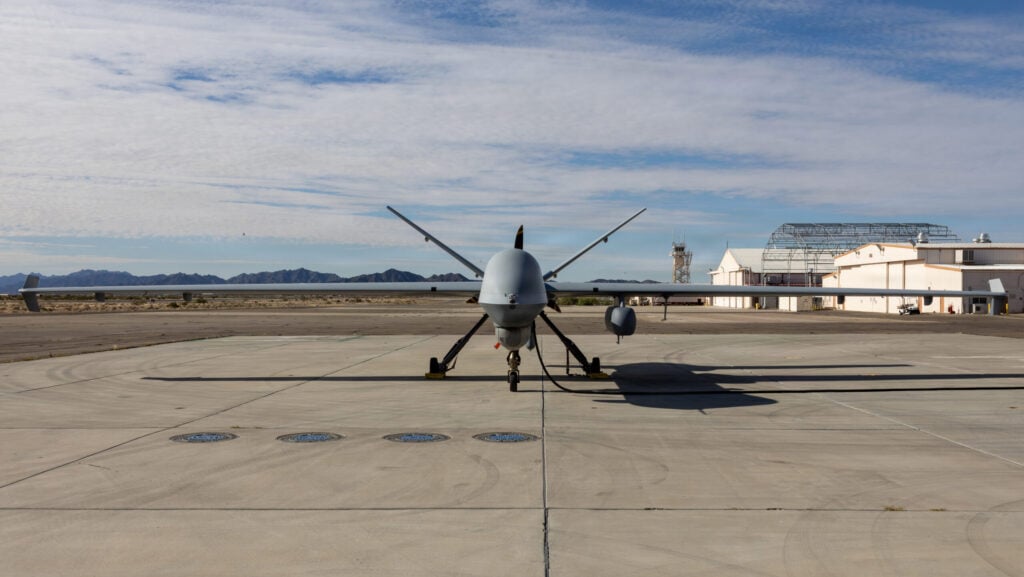
PARIS — The Pentagon is seeking a new hunter-killer drone similar to the MQ-9A Reaper that can be produced in high numbers at low costs within five years, according to a Defense Innovation Unit notice that comes after the US Reaper fleet suffered dozens of combat losses in the month-and-a-half war against Iran.
The notice, released today, said that a “reliance on low-density, high-value” aircraft is “unsustainable” against layered adversary air defenses, and that the US in response must deploy large numbers of drones designed “with the expectation that some will be lost in combat.”
A winning design of the envisioned “Massed Modular Aircraft” (MMA) is expected to fly as a full-scale prototype within 21 months of a contract award, and DIU is aiming to get the aircraft operational by fiscal 2031 — defined as 20 “mission-ready” drones on standby, according to the announcement.
The project comes amid considerable attrition of the General Atomics MQ-9A. Nearly 30 of the drones have reportedly been lost in combat in recent operations against Iran, and military officials have said the drone can cost as much as $50 million depending on its configuration. While they have defended the aircraft’s value, officials have said they need an alternative that’s cheaper and more modular.
The MMA project is not described in the notice as a direct Reaper replacement, but the drone is envisioned to spearhead a wide range of missions, like strike and reconnaissance. The notice also says that MMA drones “must retain the ability to be outfitted with a variety of payloads, including Full Motion Video (FMV) sensors, to execute missions that the MQ-9A performs today.”
General Atomics stopped making new MQ-9A drones in 2025, though there have been calls in recent months to restart production and the firm has previously offered its MQ-9B SkyGuardian. A top executive now tells Breaking Defense the company will compete for the MMA contract.
“Competition brings out the best in General Atomics, and keeps us on our toes,” General Atomics Aeronautical Systems President David Alexander said in a statement to Breaking Defense. “We’re going to respond, and we’re going to offer America something no other company possibly can — a chance to retain its 30-year investment in this technology with a superior product that exceeds the requirements and dramatically reduces risk to success.”
While the MMA project announcement did not list a targeted price or contract value, it did provide some guidance, including by describing “exquisite” drones as those that cost $30 million or more. It also said that one-third of the prototype project’s costs will have to be “paid out of funds provided by sources other than the Federal Government.”
And alongside nudging toward a low price point, DIU’s top priorities are for a winning drone to carry a payload of “at least” 2,800 pounds, an ability to self-deploy 8,000 nautical miles one way, and high degrees of modularity so the government can more easily swap in different payloads and upgrades. “Secondary attributes” include resilient communications, a “tactically relevant” airspeed of at least 200 knots and an ability for an operator to control several drones simultaneously.
DIU intends to issue the contract as an Other Transaction agreement — a process exempt from many regulations for contracting that is meant to encourage participation of nontraditional contractors. If the prototyping goes well, follow-on production contracts could be awarded without further competition. Responses are due by July 23, according to the notice.
Senior reporter Valerie Insinna contributed to this report.