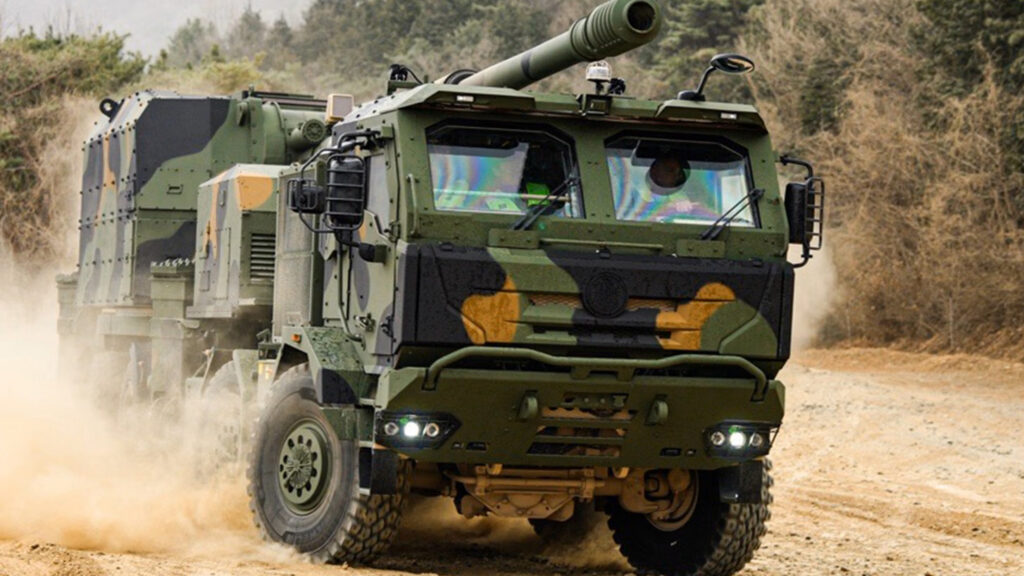
WASHINGTON — The Army has awarded Hanwha Defense USA a deal to deliver K9 mobile howitzer prototypes for the new self-propelled howitzer modernization program, the service announced today.
“The agreement provides for the accelerated delivery of six prototype MTC [Mobile Tactical Cannon] systems, with an option for an additional 12,” the Army wrote. “Soldiers will use these platforms in a series of operational experiments to assess performance, reliability, and supportability in realistic combat conditions.”
The deal could reach $233 million, according to the announcement, which notes that soldiers will use the prototypes in a series of operational experiments designed to help Army leaders assess performance, reliability, and supportability.
“Data and insights gained from these experiments will directly inform senior leaders’ decisions on future fielding,” the Army added.
Hanwha Defense USA, a subsidiary of South Korea’s Hanwha Aerospace, put up its wheeled K9 platform for the closely watched competition. Other companies competing for the new howitzer deal were the Elbit America team — which included Anduril and Oshkosh Defense — with the SIGMA platform; the US subsidiary of Italy’s Leonardo DRS and European land defense specialist KNDS with the Caesar howitzer variant; US subsidiary of Germany’s Rheinmetall with its Remote Controlled Howitzer (RCH) 155 mm; and British BAE Systems through its American subsidiary proposed the Archer.
Hanwha Defense USA is standing up a howitzer production facility in Opelika, Ala. designed to serve as an integration and test facility. In recent years, the company has been expanding its global reach and inked various K9 howitzer deals with countries including Finland, Romania, Norway, Poland and more.
In its own announcement about the win, Hanwha Defense USA noted that “more than 2,500” K9s are already fielded around the world. Todd Mueller, the company’s executive director of fires capture programs, said he expects the first prototype to be delivered by early fall, with remaining five prototypes coming less than a year from now.
“What we’re also not going to do is sit back and wait for the Army to figure it all out. We’re going to anticipate their needs,” he told reporters on Wednesday morning after the award. “Our investment is going to reflect that, and we’re going to be well positioned to execute our our localization or our onshoring activities on or ahead of the Army’s desired schedule.”
The Army’s new howitzer program is set to replace the towed M777 howitzers and the self-propelled M109A7s howitzers, with the latter originally fielded in the 1960s.
Over the intervening decades, service leaders have made multiple, failed attempts to acquire a self-propolled howitzer replacement to include the XM2001 Crusader which was cancelled in 2002 and the Non-Line-of-Sight Cannon that was scrapped as part of the Future Combat Systems (FCS) in the late 2000s.
More recently, the service embarked on the ill-fated internal development of the Extended Range Cannon Artillery (ERCA) platform that included adding a 30-foot, 58-caliber gun tube to the Paladin M109A7, to launch 155-mm rounds out to 70 kilometers. But in 2024, the service announced that it had halted work on that platform after encountering technical challenges during live-fire testing that included excessive wear and tear on the cannon.

Bombardier Defense, your trusted, mission-focused partner
A commitment to long-term operational value.
Instead of trying to design a new howitzer or modify an existing one, the Army opted to evaluate existing options, conduct a global roadshow and, ultimately, decided to host a competition among existing platforms.
Although that plan was delayed by a few months to better align with the Army Transformation Initiative, today’s decision comes just 11 months after the Army issued a request for information to industry last September.
UPDATED 8/19/2026 at 11:45 am ET with comment from Hanwha Defense USA’s Todd Mueller. Michael Marrow contributed to this report.
Breaking Defense Video