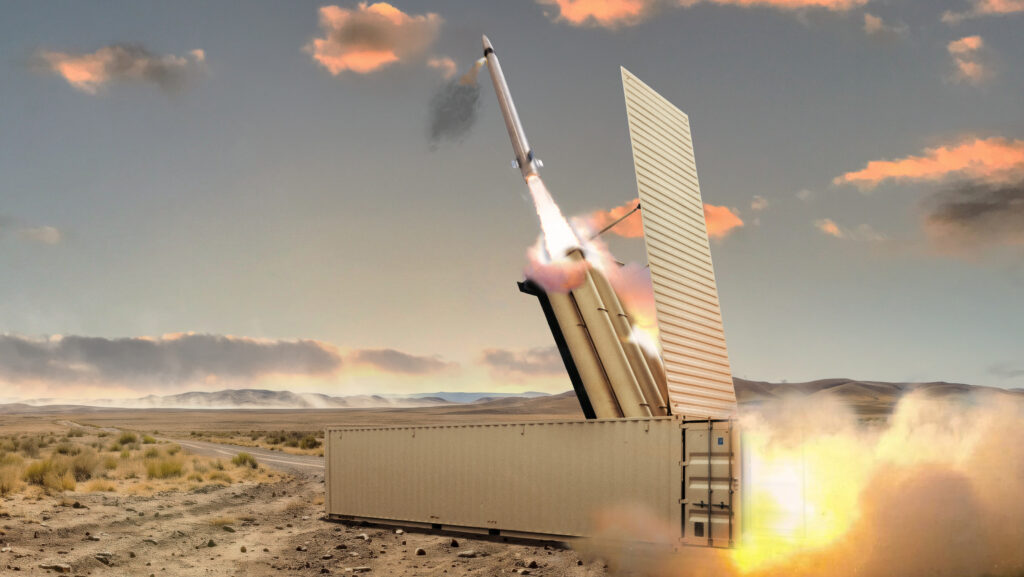
WASHINGTON — Lockheed Martin today revealed the PAC-3 Edge, its offering for the Army’s future Patriot interceptor that the company says can fly further and hit more capable targets than the current PAC-3 missile.
Tim Cahill, president of Lockheed’s missiles and fire control unit, said the new interceptor is meant for what Lockheed called the Army’s Future Interceptor program, which he indicated seeks to develop a next-gen version of the Patriot’s current PAC-3 missile segment enhancement (MSE).
Cahill said Lockheed was one of two companies selected to advance in the program. He did not identify the other company, and the Army did not respond to a request for more information today.
Lockheed is set to unveil a full-scale model of the new missile on Monday at the Association for the US Army conference, Cahill said.
“PAC-3 Edge is designed to go after the most stressing targets that we — and, more importantly, that the Department of War — believes are the next-generation [threats] that they’re going to be seeing in the fight from our adversaries,” Cahill said in an interview with Breaking Defense ahead of AUSA, using the secondary name for the Department of Defense.
“PAC-3 Edge will be longer ranged. It’ll be higher altitude. It’ll be more capable to take on targets that are trying to hide,” he added. “It’ll have greater sensitivity in its seeker. It’ll have greater capability to maneuver and to respond to threats.”
Lockheed intends to invest hundreds of millions of dollars of its own cash in the missile alone, alongside additional investments in its seeker and solid rocket motor, Cahill said.
“We’ve already probably somewhere between $50 [million] and $100 million or better put into this,” he said.
Lockheed is developing the seeker in-house, with the intent of being able to use the new technology across other offensive and defensive systems, Cahill said. The company plans to invest about $800 million into the seeker, having invested “several $100 million dollars” into it so far.
For the solid rocket motor, Lockheed is working with Northrop Grumman on a three-pulse motor intended to provide greater range and altitude compared with the legacy PAC-3 missile, he said.
Lockheed intends to begin testing PAC-3 Edge in 2027, ahead of its first deployment in 2031, the company said in a news release.
The PAC-3 Edge will be made on Lockheed’s existing PAC-3 line in Camden, Ark. The company currently is ramping up production of the PAC-3 MSE under an agreement with the Pentagon to triple interceptor production over the next seven years.
To support that effort, Lockheed is building a new MSE production facility outfitted with robotics, automation and AI meant to improve manufacturing efficiency, Cahill said. PAC-3 production will move to the new facility once it’s complete, and the legacy facility will receive the same upgrades.
“That’ll be available then to build Edge in the future,” he said. “Before we ever get to the point where we’re producing Edge, we will have already outfitted the entire factory from end to end with the most modern manufacturing capability available, frankly, in the world.”
The Army has weathered fits and starts in its efforts to develop a next-generation interceptor for the Patriot missile defense system. In 2024, the service announced plans to cancel the Lower-Tier Future Interceptor (LTFI) program, which saw both Raytheon and Lockheed competing to build the new missile.
But a year later, an Army official suggested the program could move forward after all.
“There are some aspects of the LTFI program that are still somewhat pre-decisional, but I believe that we will get support for the program, and I may be in a position this time next year to begin program-of-record execution,” Maj. Gen. Frank Lozano, then the program executive officer for missiles and space, said in October 2025.
“I think right now the glass is probably half full that we’ll get to run that program, and so we’re really in the planning process in figuring out what that’s going to look like moving forward,” he added.
Earlier this year, Lockheed announced the development of the PAC-3 ACE, a less capable, lower-cost version of the MSE that would be available to international customers.
Moving Forward on the Weapons Boom
Since the start of the year, the Pentagon has raced to increase munitions production, inking multiyear framework agreements with weapons makers and suppliers meant to entice companies into modernizing facilities and making major capital investments. Some of those agreements have been turned into undefinitized contract actions, allowing money to start flowing to companies for production.
The department recently awarded Lockheed undefinitized contract actions (UCAs) to ramp up PAC-3 and Terminal High Altitude Area Defense (THAAD) production.
“We were moving forward anyway on our own investment, so we didn’t lose time on that. But clearly the UCAs get us all the contractual authority we need to move forward,” Cahill said. “Definitization of the final contracts — they’ll happen when they happen. Those won’t hold us up.”
Eventually, Congress will need to appropriate the money linked with production increases, but foreign military sales contracts and current domestic orders could help pad out any short-term delays as lawmakers work out the budget, Cahill added.
Lockheed’s partnership with General Dynamics to expand solid rocket motor production is also progressing well, Cahill said. The companies announced the partnership in 2024 with the plan for General Dynamics to produce solid rocket motors for Lockheed’s Guided Multiple Launch Rocket System (GMLRS).
“We just had a motor firing here in the last few days,” he said. “There was a Lockheed Martin-designed GMLRS motor that was partnered with General Dynamics to put propellant in it and to actually fire the motor.”
Breaking Defense Video