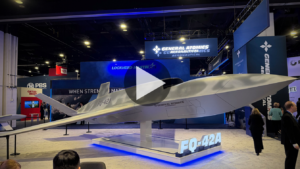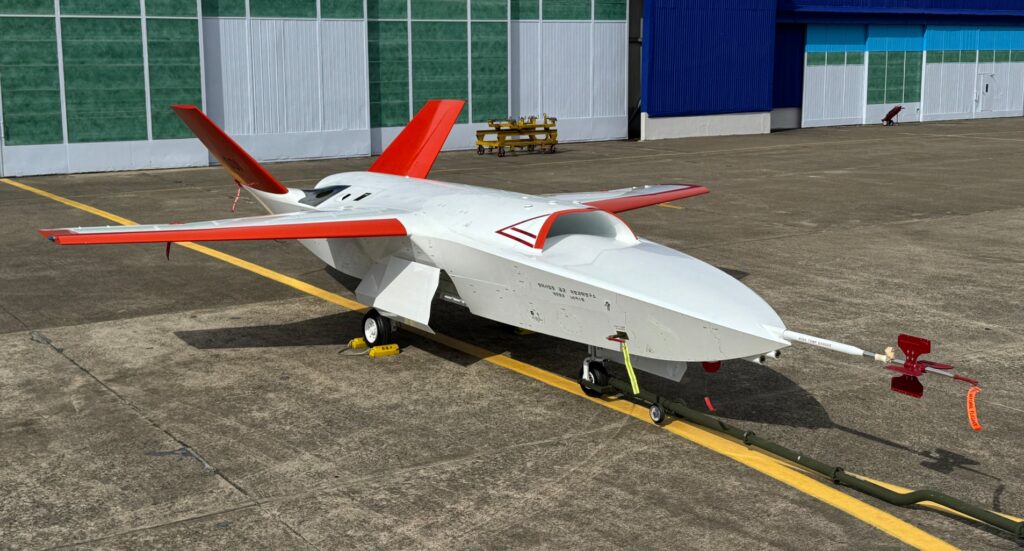
DAEJEON, South Korea — Korean Air Aerospace Division (KE-ASD) is readying its Low Observable Wingman Uncrewed Aerial Vehicle System (LOWUS) loyal wingman drone to make its first flight by the end of this year, the company has announced.
During a visit to KE-ASD’s research and development facility in South Korea at the end of October, executives briefed media on the research and development activities conducted by the specialized aerospace and defense manufacturing business unit of Korean Air airline. That included discussing LOWUS, which the company plans to enter as its contender for South Korea’s upcoming Collaborative Combat Aircraft (CCA) competition.
Like other media outlets, Breaking Defense accepted travel and accommodations from KE-ASD to attend the briefing.
“We delivered our CCA platform last year and will having flight tests at the end of this year,” Director of International Business for KE-ASD Haneul Kim confirmed, adding that that two technology demonstrator aircraft have been handed over to South Korea’s Agency for Defense Development (ADD).
Following the initial trials, LOWUS, which has a length of 10.4 meters (34.1 feet) and a wingspan of 9.4 meters, will enter a full-scale development program that is due to begin in 2029 to meet the anticipated South Korean government’s timeline for the CCA competition. The Korean government has not indicated when the competition will start, but the eventual CCA winner is expected to be deployed alongside manned platforms and later production blocks of the KF-21 fighter.
A 5,500-lbf turbofan engine being developed by the ADD and Hanwha is expected to be ready in 2032 for use with the LOWUS, enabling the CCA to fly at speeds of up to Mach 0.8 and stay aloft for up to three hours. This will replace the Ukrainian AI-222 engine that is powering the initial aircraft.
Jung told reporters that LOWUS will be equipped with an Active Electronically Scanned Array Radar and Electro Optical systems, with its initial mission set being reconnaissance and eventually expanded to include penetrating contested airspace ahead of manned aircraft for strike and other combat missions.
AI Pilot Program
On the software front, ADD has launched a project to develop an AI Pilot that will have AI-enabled air combat technologies, and Jung added that there are plans to retrofit and integrate the system into the LOWUS aircraft currently under development for flight demonstration.
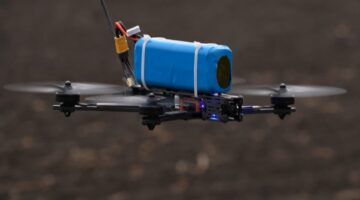
KE-ASD has also invested significant effort into the development of AI-enabled drone swarm software, with the company successfully demonstrating its efforts in September at the 2026 Defense Drone Tech Fair in South Korea.
“A fleet of 22 drones autonomously carried out coordinated reconnaissance, high-maneuver swarm flight and precision strike missions, managed through Korean Air’s proprietary integrated battle management system,” said a KE-ASD social media post about the September demonstration.
Video from the event showed 22 drones moving into two separate swarms, with one acting as decoys to occupy a simulated adversary air defense system while the other swarm conducted an attack against a preset target by crashing into it in rapid succession.
“The system does more than provide voice updates based on a pre-set scenario: it uses AI to assess mission status in real time and communicate relevant updates. It can also retrieve drone status and weather information in response to user queries, making it optimized for operations in the field,” the post added.
KE-ASD’s Senior Manager for Systems Integration Sumno Jung said the technology demonstrators will be used for the flight tests which will then lead to Manned-Unmanned Teaming (MUM-T) trials with an ADD-operated KT-1 turboprop trainer that is scheduled to begin at the end of 2027.
Breaking Defense Video