MILAN — While NATO does not anticipate a Russian naval buildup in the Mediterranean after a recent Ukrainian drone strike near Libya, the operation has raised concerns about the risk of drawing the North African country deeper into the war and threatening the alliance’s southern flank.
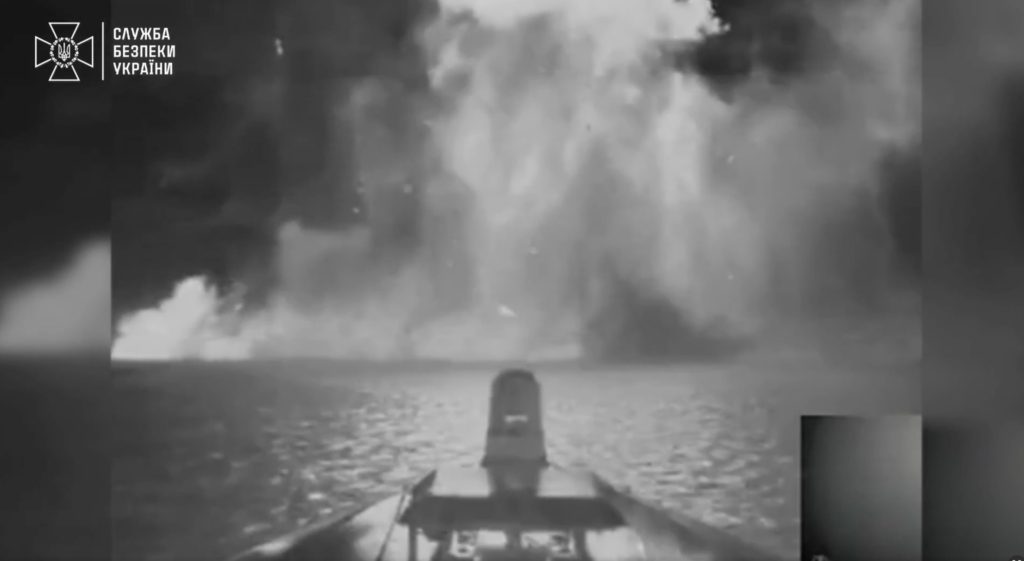
Ukraine used unmanned vessels to strike two Russian ships near the Libyan port of Benghazi along the Mediterranean coast on Sunday, sinking a warship and damaging a cargo vessel, according to the Security Service of Ukraine (SBU). Despite questions about the potential for a wider response from Moscow, NATO “is not expecting a surge or redeployment of further Russian assets in the Mediterranean,” an alliance official told Breaking Defense.
That is largely because the Russian surface fleet “is having serious war-generation issues,” according to the NATO official, who spoke on condition of anonymity.
The alliance is more concerned about the conflict spilling over into other areas and the potential for attacks on commercial shipping, both in the Mediterranean and elsewhere, the official said. Such attacks, they added, have already been seen in the Black Sea, where Russia has targeted “innocent merchant shipping.”
NATO routinely evaluates its force posture and readiness in the [Mediterranean] region, the official added. They noted that on any given day, the average “ratio of NATO deployed assets to those of Russia is 3:1” — meaning that for every one Russian surface ship, there are three allied surface ships underway. That imbalance is even greater in the Mediterranean, where the alliance’s deployed assets outnumber Russia’s by roughly 5-6 to 1, the official added.
Although NATO does not anticipate an immediate shift in the Russian naval presence, questions remain about how Kyiv conducted the operation and what it could mean for the region.
Earlier this year, the Associated Press reported that Libyan officials said Ukrainian forces, most of them drone specialists, had been operating from military facilities in western Libya. The officials, who spoke to the AP on condition of anonymity, identified an air base in Misrata as the main site, along with facilities in Tripoli and the coastal town of Zawiya.


How integrated modeling and simulation accelerates Europe’s defensive edge
Lockheed Martin’s ACES platform delivers a shared virtual battlespace that strengthens readiness, interoperability, and faster decision-making through advanced, integrated modeling and simulation capabilities designed for evolving global threats.
Libyan officials briefed on Sunday’s attack also told the AP that the Russian corvette was struck at the Benghazi Naval Base, claiming that at least four drones were intercepted while two hit the vessel.
The Ukrainian SBU, meanwhile, said the seven naval drones were delivered to a designated location and launched into the water from a “mothership” near the target. The agency did not identify the vessel or specify where the drones were launched, leaving questions about whether the operation originated from Libyan territory.
Deep divisions remain across the North African country following the 2011 overthrow of the Muammar Gaddafi regime and the subsequent civil wars that erupted. The western part of Libya, largely centered around Tripoli, is controlled by the UN-recognized Government of National Unity (GNU), formed in 2021 and led by Prime Minister Abdul Hamid Dbeibeh.
Meanwhile, eastern Libya is controlled by rival authorities aligned with military commander Khalifa Haftar and his Libyan National Army (LNA). The area shares close ties to Moscow, as authorities have allowed Russian naval vessels to use the port of Tobruk as a resupply and refueling hub.
According to Arturo Varvelli, head of the Rome office and senior policy fellow at the European Council on Foreign Relations, it remains unclear whether Ukraine launched its attack from western Libya, as the claim has not yet been independently verified, even by Moscow. However, he warned that the operation could have serious ripple effects for the region and possibly draw the war in Ukraine closer to NATO’s southern flank.
“The United Nations’ mission has already called for an independent investigation, warning against the risk of dragging Libya into foreign conflicts,” Varvalli told Breaking Defense. “This is precisely the greatest strategic danger: that Libya could turn into yet another theater of the war between Russia and Ukraine, just a few hundred kilometers from Italy.”
He referred to statements by Aydar Aganin, Moscow’s ambassador to Libya, who was quoted by Russian state media outlet RT as saying the attack “will not go unanswered” and that Moscow is weighing its options. While Varvelli assesses that an armed retaliation against western Libya is unlikely in the immediate future, an asymmetric response is more probable.
“Eastern authorities have stated that Libya ‘reserves the right to respond by all necessary means’; however, I believe a direct kinetic response against western Libya is unlikely in the short term, as the costs for both sides would be extremely high,” he said.
One potential complication for Moscow is the presence of foreign military personnel in Misrata, where Ukraine’s main base is reportedly located at the Air Force Academy. The coastal city in northwestern Libya is aligned with the UN-backed GNU, and the facility is reportedly shared with Turkish and Italian forces, US Africa Command (AFRICOM) and a British intelligence center.
“An attack by Russia or the Libyan National Army [governed by Haftar] on Misrata would risk striking Turkish, Italian or US personnel present in the area,” Varvelli said. “Asymmetric responses are more likely. … Consequently, any retaliation might more simply be directed against Kyiv.”
Italy has maintained a military presence in the western part of the country since 2018 through its Bilateral Mission of Assistance and Support in Libya (MIASIT).
Vincenzo Camporini, Italy’s former chief of defense general staff, also raised concerns about potential Russian retaliation. In an interview published Monday by Italian media Agenzia Nova, Camporini warned that if Moscow retaliated against western Libya — possibly by encouraging LNA forces to act — it could risk reigniting a civil war inside the country, only this time with greater direct involvement from Russia and Turkey.
On Tuesday, the GNU’s Ministry of Foreign Affairs and International Cooperation stated that Libya’s territory would not be used as a staging ground for attacks and referred to the strike in Benghazi as highlighting “the danger of hosting foreign forces that operate outside the authority of the state.”
Kyiv has also pushed back against suggestions that it is expanding the war beyond Ukraine. Ukrainian Foreign Minister Andrii Sybiha posted on his Telegram channel on Tuesday that “Ukraine is not ‘dragging’ anyone into the war or ‘transferring’ the war anywhere.”
Breaking Defense Video