Global

US arms sales rebound back to $50B in fiscal 2022

“I would say that we have enjoyed a rebound in arm sales,” said Defense Security Cooperation Agency director James Hursch. “I think that there will over the next three years or so … be continuing increases. I'm not sure how steep the slope will be.”

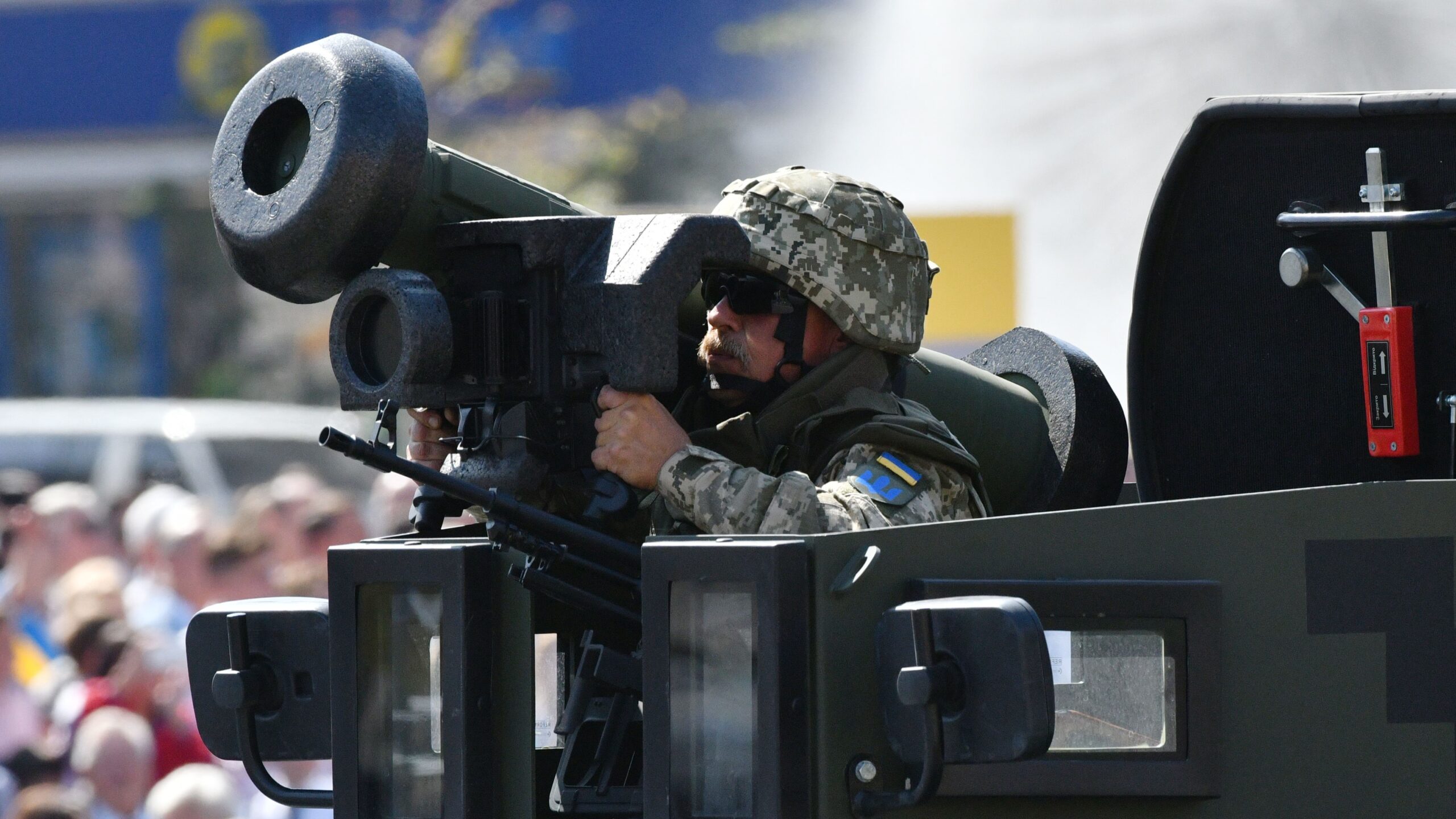
UKRAINE javelin
A Ukrainian serviceman rides atop of an APC with Javelin anti-tank missiles during a military parade in Kiev on August 24, 2018. (Genya Savilov/AFP via Getty Images)

AUSA 2022 — US arms sales to allies and partners bounced back with a total of about $50 billion in sales cases cleared in fiscal 2022, a big jump from the total of about $35 billion last year.

The boost to Foreign Military Sales deals approved by the State Department — roughly $15 billion over FY21’s totals — brings FY22 in line with annual cleared sales from before the COVID-19 pandemic, said Defense Security Cooperation Agency director James Hursch, who announced the total today at the Association for the US Army conference.

“I would say that we have enjoyed a rebound in arm sales,” he said. “I think that there will, over the next three years or so … be continuing increases. I’m not sure how steep the slope will be.”

Because the fiscal year ended on Sept. 30, Hursch was not able to provide a detailed break down of the $50 billion figure, which includes Foreign Military Sales, Foreign Military Financing and other government authorities.

Russia’s invasion of Ukraine and the ongoing conflict has helped spur a greater demand for US weapons, particularly from European nations who find themselves needing to replenish their own munitions stockpiles or have begun rethinking their own defense needs, Hursch said. “They are drawing lessons from the conflict that we see today about the kinds of systems they need to have.”

However, two other major factors also likely influenced sales. First, similar to the increased interest from European countries, there has been a wave of sales from partners in the Indo-Pacific who recognize the threat of China and are moving to recapitalize their legacy systems, Hursch said.

Also, the end of lockdowns associated with the COVID-19 pandemic has allowed US officials to meet more regularly in person with their international counterparts, potentially paving the way for arms deals, he said.

While the DSCA figure is important for understanding arms sale trends, it doesn’t tell the whole story. The sales amount cleared by the State Department and DSCA doesn’t always reflect the actual value of a deal once it is negotiated by a country and a defense contractor later in the process. Also, sometimes the State Department will approve arms sales of equipment that has not been formally requested by a country in order to speed up a potential sale down the road.

For instance, it cleared $85 billion of sales in FY20 — a huge number that dwarfed the $55 billion logged in in FY19 and $56 billion in FY18. However, the FY20 sales figure included two US fighter offerings for a Swiss competition that was still ongoing at the time. Ultimately, Switzerland chose the F-35, leaving the Super Hornet deal on the table despite figuring into year-end totals.

Although Hursch said he believes arms sales will continue to increase over the next couple of years, he offered an additional caveat: FY22’s total includes “some fairly large F-35 sales,” which tend to be high in value and drive up the annual total.

AUSA 2022

AUSA 2022

Over at Rheinmetall's booth sat the hefty Lynx OMFV (Optionally Manned Fighting Vehicle). The company, as its competitors, is hoping to make a strong impression as the Army looks for OMFV proposals later this fall -- the early stage of an almost certainly lucrative long-term contract award. (Breaking Defense/Brendon Smith).
All the way from down under, the Australian firm Defendtex presented some of its modular UAVs. Here visitors can see the Drone155, which the company says can be outfitted with ISR payloads or explosives. (Breaking Defense/Brendon Smith).
The MVPP from Globe Tech stands for Modular Vehicle Protection Platform, a vehicle add-on that can take the brunt of improvised explosive device detonations. (Breaking Defense/Brendon Smith).
AUSA was well attended by international officers and officials as well, and by foreign defense firms. The Korean booth, shown here, featured some products hoping to make a splash in the US military. (Breaking Defense/Brendon Smith).
Not your traditional defense contractor, the computing giant IBM has a booth at AUSA showing off its flashy but functional quantum computer. The US government as a whole, and the Pentagon in particular, are heavily invested in the quantum computing race with the likes of China. (Breaking Defense/Brendon Smith).
Among the fleet of vehicles parked throughout the AUSA floor for display was the Flyer 72-U, made by General Dynamics. The company says the vehicle takes a "modular approach" so it can be configured for anything from "light strike assault" to rescue and evacuation. (Breaking Defense/Brendon Smith).
The stuff of counter-UAS nightmares, the Virginia-based BlueHalo firm makes drone swarms that use AI and machine learning to provide battlefield intelligence to soldiers. The Army's Rapid Capabilities and Critical Technologies Office awarded the company $14 million in February to develop the HIVE. (Breaking Defense/Brendon Smith).
It's a .50 caliber Gatling gun, one that Dillon Aero says can fire 1,500 shots per minute, or 25 rounds per second. (Breaking Defense/Brendon Smith).
For this year's show AM General rolled its own Humvee Saber, Blade Edition, onto the floor. The company claims "leap-ahead" technology for a light tactical vehicle. (Breaking Defense/Brendon Smith).
Patria, a defense firm owned jointly by Finland and Norway's Kongsberg Defence & Aerospace, made it's way across the Atlantic for AUSA 2022, bringing along its AMV multi-role vehicle. The AMV was recently purchased by the dozens by Slovakia and its home country of Finland. (Breaking Defense/Brendon Smith).
At the Pratt Miller Defense booth, visitors will see a full-sized Expeditionary Modular Autonomous Vehicle (EMAV) is the "newest and perhaps most mobile and lethal" of the company's autonomous offerings. (Breaking Defense/Brendon Smith).
Marathon's Autonomous Robot Targets are exactly what that sounds like: shooting targets guided by computer code and designed to "look, move, and even behave like people," the company says. The robots were on the move on the AUSA floor -- though no shooting was allowed. (Breaking Defense/Brendon Smith).
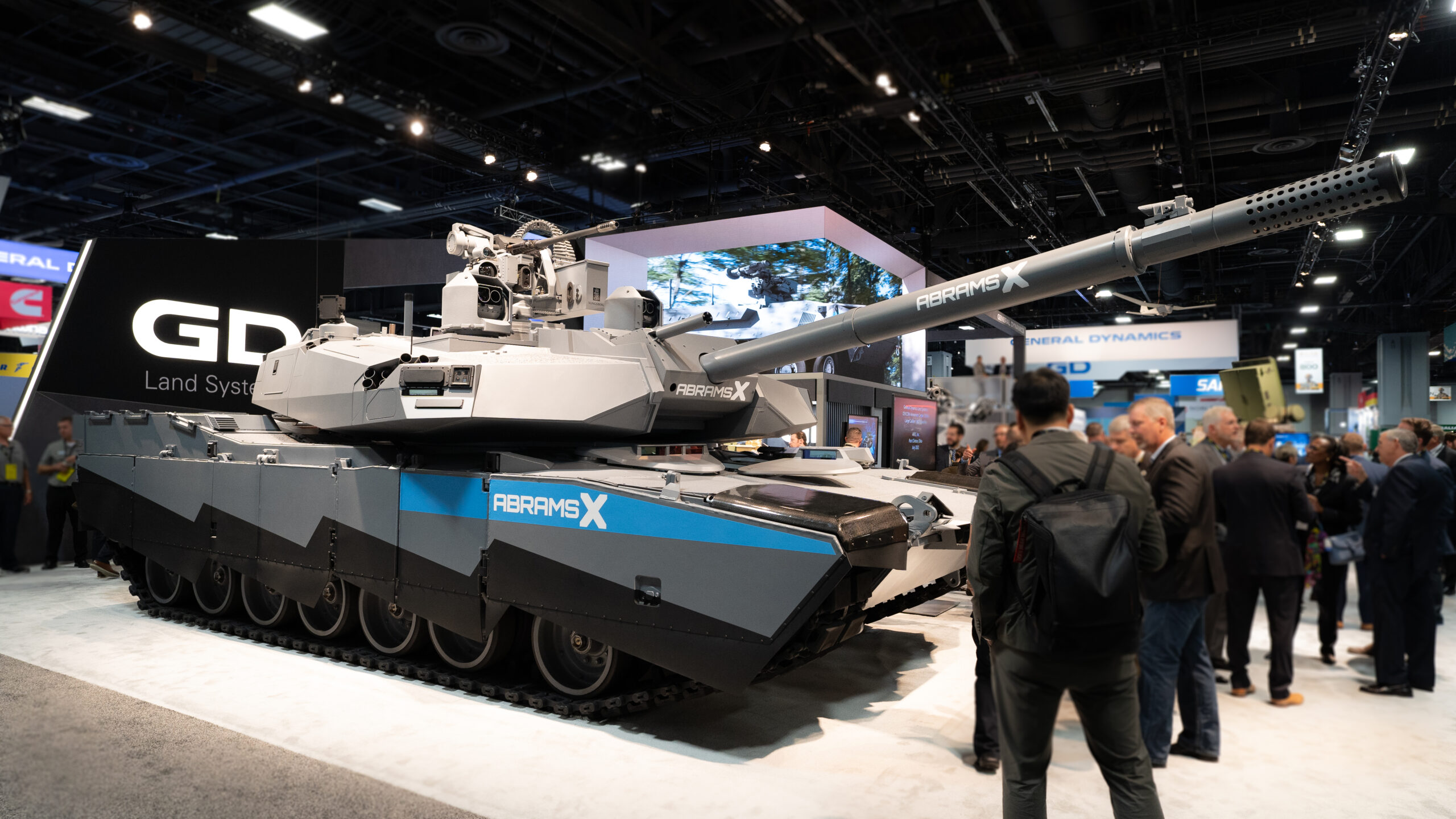
The AUSA show floor offered a fresh look at a futuristic version of an old Army standby: the Abrams tank. This one, the Abrams X, is made by General Dynamics Land Systems, manufacturers of the current Abrams M1A1 and M1A2 battle tanks used by the US Army. (Breaking Defense/Brendon Smith).
Attendees may walk by model versions of the famous Iron Dome system, in use for years in Israel, and its sister SkyCeptor system, both made by Rafael. The SkyCeptor, in particular, is meant to "defeat short- to medium-range ballistic and cruise missiles and other advanced air defense threats," the company says. (Breaking Defense/Brendon Smith).
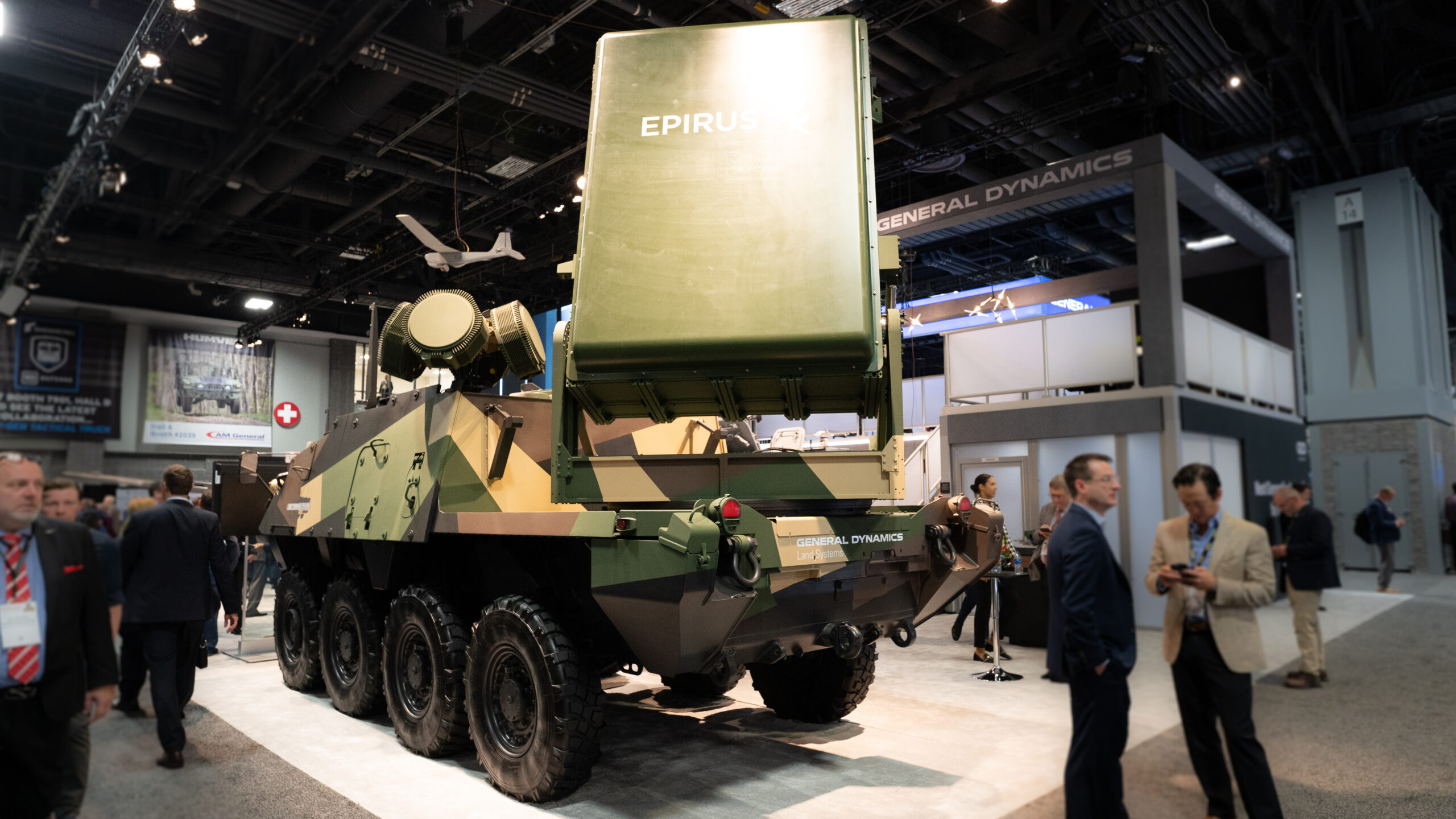
As the need for counter-UAS systems explodes, Epirus is at AUSA repping its counter-electronics system Stryker Leonidas, made with General Dynamics. The system's "counter-swarm" weapon "fills a pressing short range air defense (SHORAD) capability gap," the company says. (Breaking Defense/Brendon Smith).
A new unveiling for AUSA, Rheinmetall announced this week the Mission Master CXT platform, the newest addition to the company's "family" of autonomous ground vehicles. The company says the CXT "combines the power of a diesel engine with a silent electric motor." (Breaking Defense/Brendon Smith).
The GMC Hummer EV Platform, the first vehicle on GM's New Ultium EV Platform, goes on display at AUSA 2022. All-electric offerings are the center of much of the Army's attention these days as it aims to electrify its non-tactical, and eventually tactical, fleet. (Breaking Defense/Brendon Smith)
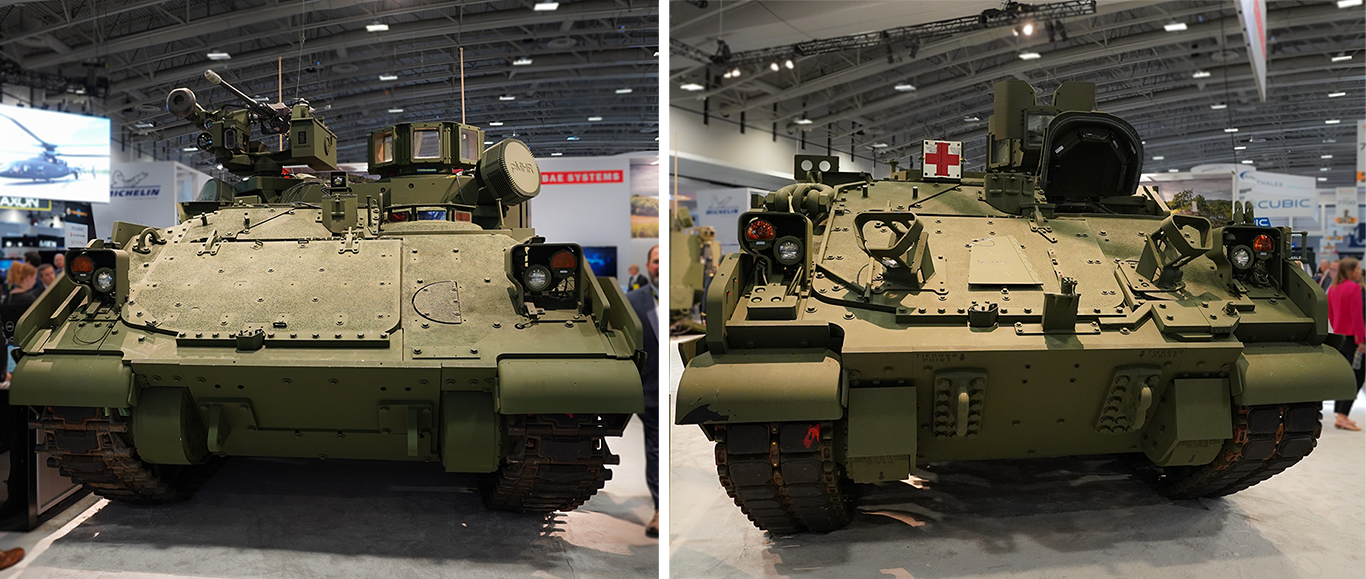
Two new Armored Multi-Purpose Vehicles (AMPV) sit at the booth by Bae Systems. The vehicles are meant to replace the Army's venerable, but old M113s. (Breaking Defense/Brendon Smith)
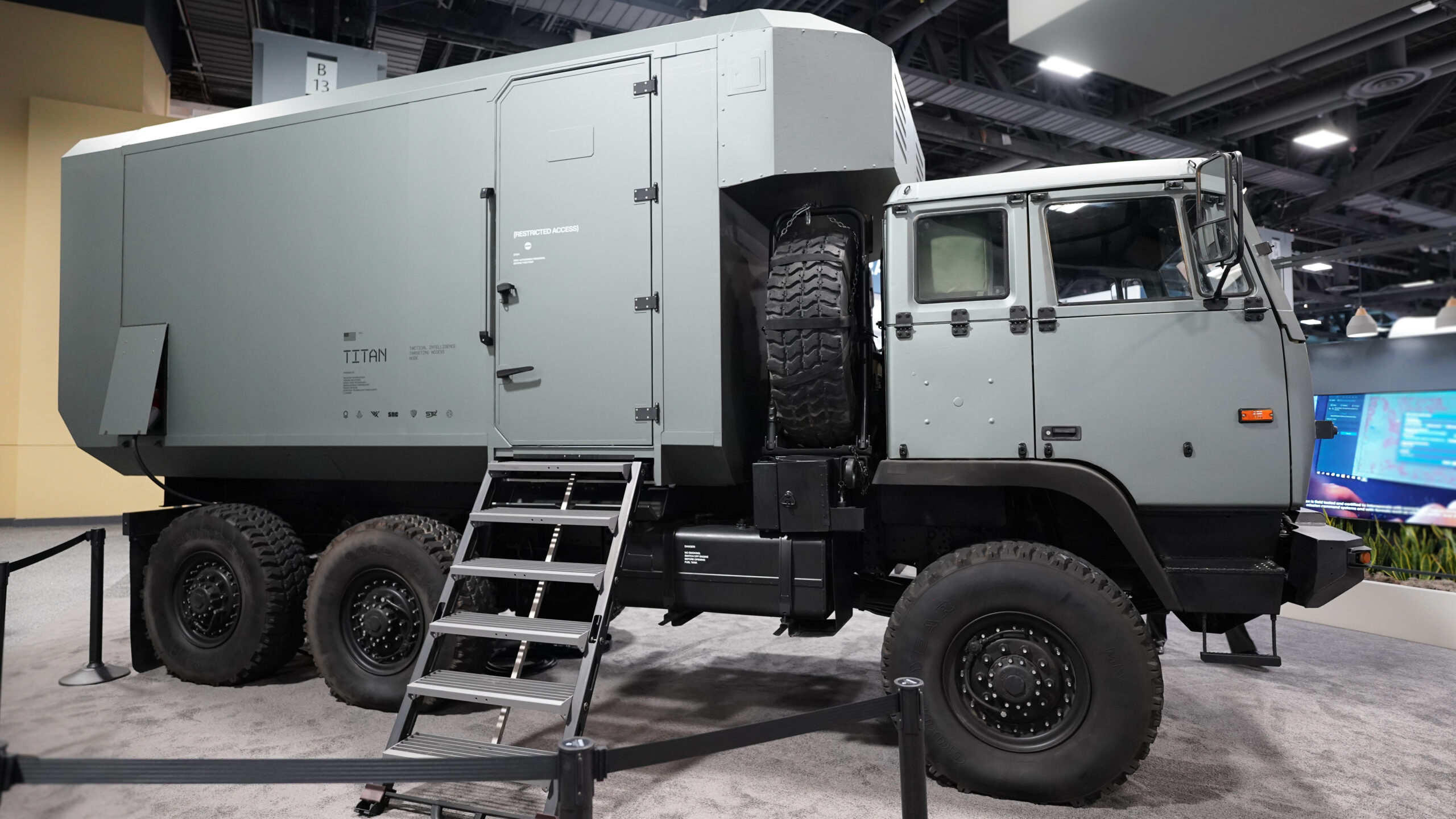
Palantir shows off its prototype for the Tactical Intelligence Targeting Access Node (TITAN) vehicle. The company says the TITAN "will be the critical backbone that provides correlation, fusion, and integration of sensor data alongside insights from AI/ML overlaid at the tactical edge." In other words, it's meant to find the signal in the noise. (Breaking Defense/Brendon Smith)
A model of a "modernized" Boeing Apache AH-64E shown Association of US Army Conference in 2022. While the Army is about to choose two new airframes, there's currently no Apache replacement on the horizon. (Breaking Defense/Brendon Smith)
Lockheed Martin teamed up with Sikorsky to produce the Raider X, the team's competitor in the Army's Future Attack Reconnaissance Aircraft (FARA) program, one of two high-profile Army Future Vertical Lift contests currently underway. (Breaking Defense/Brendon Smith)
The Bell 360 Invictus is the other FARA competitor, looking to beat out the Lockheed-Sikorsky team. The Army's expected to make its decision in fiscal 2024. (Breaking Defense/Brendon Smith)
The defense start-up Anduril has expanded its footprint in the defense market in recent years. This product, the Mobile Sentry, "brings autonomous fixed site counter UAS and counter intrusion capabilities into a mobile form factor," the company says. (Breaking Defense/Brendon Smith)
The military's no-so-furry friendly robot dogs are back at AUSA this year. This model, called the Vision 60 Q-UGV from Ghost Robotics, is an "all-weather ground robot for use in a broad range of unstructured urban and natural environments for defense, homeland and enterprise applications," the company says. (Breaking Defense/Brendon Smith).