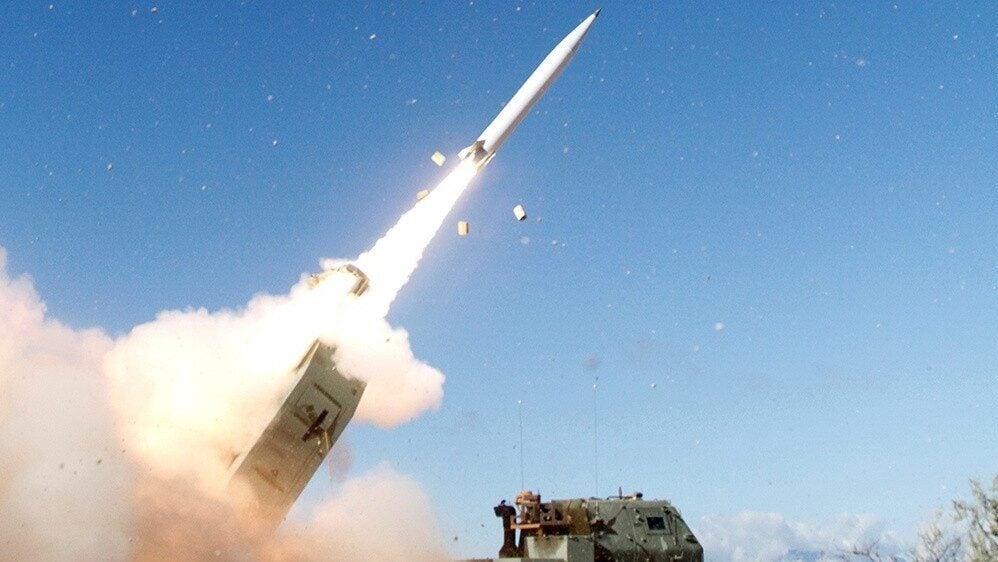
WASHINGTON — As the Pentagon rushes to refill its weapon stockpiles, it announced a trio of framework agreements today aimed at accelerating the production of Precision Strike Missile (PrSM), seekers for Terminal High Altitude Area Defense (THAAD) interceptors and an array of missile components.
Under one deal, Lockheed Martin has agreed to invest an unspecified amount in “advanced tooling, facility modernization, and critical testing equipment” to “slash” the production lead times on PrSMs, a new weapon that is being first used in operations against Iran.
“By focusing on these critical industrial base elements, the department is ensuring this deep-strike capability can be delivered to the warfighter faster and more efficiently than ever before,” the Department of Defense wrote in an announcement. “This framework agreement also establishes the potential to negotiate a multi-year contract for up to seven years, should Congress authorize a multi-year contract in the future.”
While the department did not disclose just how much money the company has agreed to invest in shoring up PrSM production or how many PrSMs the company could eventually produce each year, the Army was planning to have Lockheed produce 45 missiles this year, according to fiscal 2026 budget documents.
The PrSM Increment 1, designed to strike targets at least 500 kilometers (over 300 miles) away, can be launched from both a M142 High Mobility Artillery Rocket System (HIMARS) and M270A2 Multiple Launch Rocket System (MLRS).
Today’s PrSM announcement is the second framework agreement for Lockheed, following a similar in January where the company agreed to quadruple production of THAAD interceptors over the next seven years, moving from its current rate of 96 missiles a year to an annual rate of 400 interceptors.
To get to those numbers, the department also today announced a new framework agreement with BAE Systems to ramp up the production of seekers for THAAD interceptors.

The defense intelligence community’s AI and cyber view forward
From AI adoption and agentic systems to Zero Trust and cyber resilience, Breaking Defense’s latest eBook brings together key reporting from DoDIIS 2026 on the technologies and strategies shaping the future of defense intelligence.
“Securing our supply chain is just as critical as our partnership with the prime contractors,” Michael Duffey, the Under Secretary of Defense for Acquisition and Sustainment, said in an announcement today. “This agreement with BAE Systems sends a clear, stable, long-term demand signal. We are providing the certainty our partners need to invest, expand, and hire. This is how we place the industrial base on a wartime footing.”
The department did not release investment details about that agreement either, though company President and CEO Tom Arseneault said the multi-year deal provides the “long-term demand signal” to expand capacity at facilities in Nashua, N.H., and Endicott, N.Y.
“Aligned with the DoW’s [Department of War’s] strategic investment in the defense industrial base and American jobs, BAE Systems will continue to expand its capabilities through sustained investment in technology, manufacturing, and its workforce, leveraging its robust supply chain management, positioning the company for long-term, high-volume production,” BAE Systems wrote.
In a third multi-year, framework deal announced today, Honeywell Aerospace has agreed to invest $500 million of its own money into the production of “critical components” for munitions like navigation systems, actuators, and electronic warfare solutions.
“Our strategy is to provide the long-term demand signals that unlock private investment, and this half-billion-dollar commitment from Honeywell Aerospace demonstrates we are succeeding,” Duffey said.
Today’s trio of announcements is part of a larger Pentagon plan to refill the weapon stockpiles, highlighted in a meeting earlier this month at the White House attended by the chief executives of RTX, Lockheed Martin, Boeing, Northrop Grumman, BAE Systems, L3Harris Missile Solutions and Honeywell Aerospace.
“We just concluded a very good meeting with the largest U.S. Defense Manufacturing Companies where we discussed Production and Production Schedules,” President Donald Trump said in a post this afternoon on Truth Social.
“They have agreed to quadruple Production of the ‘Exquisite Class’ Weaponry in that we want to reach, as rapidly as possible, the highest levels of quantity. Expansion began three months prior to the meeting, and Plants and Production of many of these Weapons are already under way,” he said.