Rocket engines, helmet displays and ground robots: Last looks from AFA Day 3
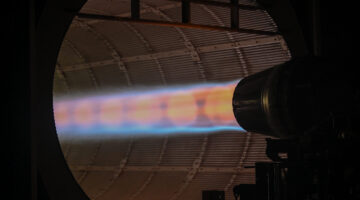
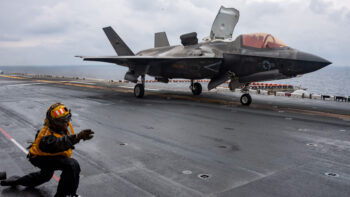
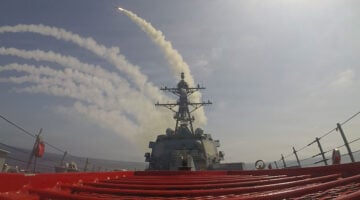
Here are some parting sights from across the show floor at this year's conference.
“It means that the design is solid. It means that we're ready to move forward from an industrial base as well,” Jill Albertelli, the president of Pratt & Whitney's military engines business, told Breaking Defense.
Hermeus CEO Zach Shore told Breaking Defense the company can now vertically integrate production of its Quarterhorse drone and serve as a second source of engines for Pratt’s F100-PW-229 powerplant.
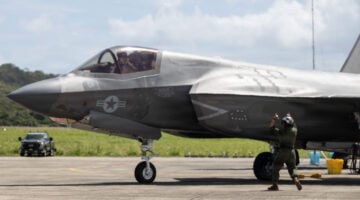
Compared to recent contracts, the average flyaway cost of an F-35A and F-35B rose by over 11 percent, while the price of an F-35C climbed over 8 percent, according to figures supplied by the F-35 Joint Program Office.
The Defense Department anticipates it will spend an additional $51 billion to acquire the stealth fighter, though revised estimates have pulled the program’s total cost beneath $2 trillion, according to a recent Pentagon report.
One contract worth up to $603 million was issued to RTX subsidiary Raytheon, while a second valued at roughly $163 million was issued to B-52 prime contractor Boeing.
Over the past year, Pentagon leaders have leveraged multiyear contracts for critical munitions as an incentive to get defense primes to make larger investments in their production facilities and supply chain.
“I know there's lots of discussions on budget amounts and mechanics, but what I can tell you, as we engage with Congress, is there's a bipartisan support for increased munitions," RTX CEO Chris Calio said during a July earnings call.
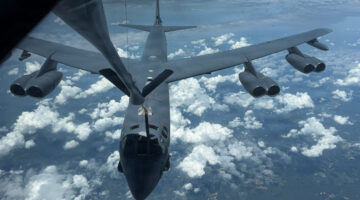
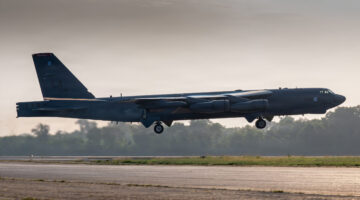
A new audit from the Government Accountability Office found concerns with the Air Force’s modernization of the B-52 Stratofortress, which is planned to fly through the middle of the century.
“Working with the United States government, we are working [...] to determine what is feasible and what is best for Ukraine,” said Raytheon’s Tom Laliberty.
The 90-day suspension tees up a final decision on whether to compete a deal for new ejection seats on the F-16, despite a previous move by the Air Force to reopen the Next Generation Ejection Seat program.
“It wasn’t just an AMRAAM that came off,” Air Force Chief of Staff Gen. Kenneth Wilsbach told Breaking Defense. “It was tracking the target.”
“We need all hands on deck, we need as many of these as we can possibly get, and Divergent is good complimentary supply for [Raytheon],” said CEO Lukas Czinger.
The Next Generation Adaptive Propulsion program is now projected to complete prototyping work in 2031, a cumulative delay of three years compared to earlier projections.