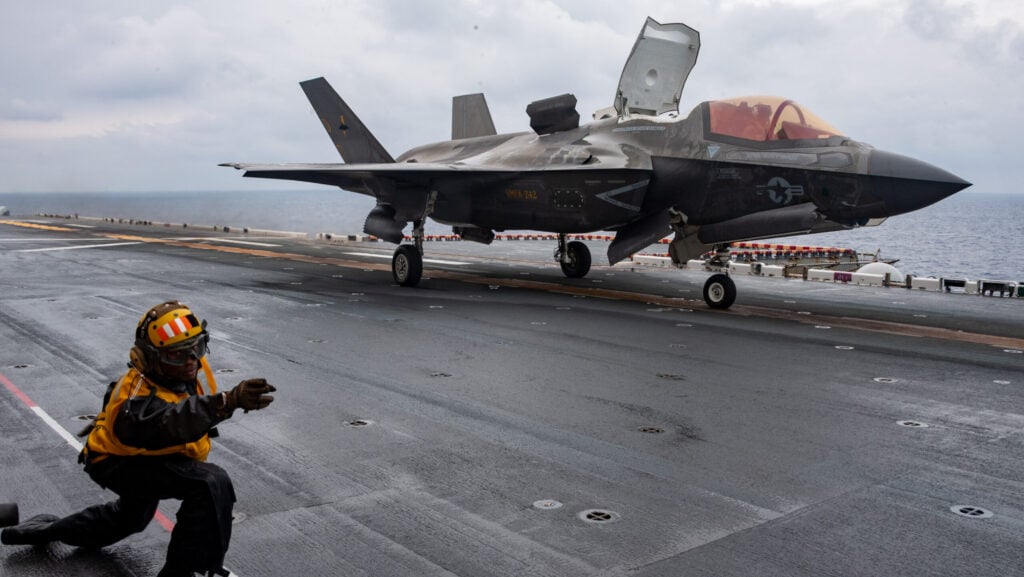
WASHINGTON — The cost of all three variants of the F-35 Joint Strike Fighter are increasing by as much as roughly 11 percent, according to the Pentagon.
A spokesperson for the F-35 Joint Program Office (JPO) confirmed to Breaking Defense that the average flyaway cost — a metric that measures when a jet has all the equipment it needs for delivery — of the conventional takeoff and landing F-35A rose to $92 million in the aircraft’s 18th and 19th production lots, which will deliver over the next two years. That’s up from the $82.5 million price tag of the jet’s most recent group of production contracts spanning 2023 to 2026, a growth of 11.5 percent.
Similarly, the price of a jump jet F-35B rose to $121.4 million across lots 18 and 19, while the carrier-capable F-35C climbed to $110.8 million. For the F-35B, that’s an increase of 11.4 percent compared to a previous price tag of $109 million; the F-35C had the smallest increase of 8.5 percent set against a prior cost of $102.1 million.
Air & Space Forces Magazine was first to report the new figures.
In response to a Pentagon document known as a modernized selected acquisition report (MSAR), which revealed rising buying costs for the stealth fighter, F-35 manufacturer Lockheed Martin previously said the report “shows the combat-proven F-35 program moving into full-rate production, resuming high-volume development deliveries and growing globally.” The company added that the report “also shows that the hard work has shifted from proving the basic aircraft to executing major modernization, improving fleet readiness and controlling long-term sustainment and integration costs.” Lockheed referred back to that statement today when asked to comment on the increased flyaway costs.
The F-35 program has been battered by inflation, rising prices of raw materials and supply chain issues, which drove up costs for lot 18, the Pentagon previously told Breaking Defense. Rising rates even sparked a cost dispute with Switzerland, culminating in Bern trimming its buy of the stealth fighter.
The flyaway cost includes government-furnished equipment outside the scope of Lockheed’s contract, such as the jet’s F135 engine built by RTX subsidiary Pratt & Whitney. The aircraft’s upgraded radar is supplied by Northrop Grumman, though delays have forced the Pentagon to accept new aircraft without the nose-mounted sensor, Breaking Defense previously reported. It’s not clear exactly how much those features may have influenced the overall price increase.


How integrated modeling and simulation accelerates Europe’s defensive edge
Lockheed Martin’s ACES platform delivers a shared virtual battlespace that strengthens readiness, interoperability, and faster decision-making through advanced, integrated modeling and simulation capabilities designed for evolving global threats.
Projected F-35 buying costs are going up by over $50 billion across the program’s lifespan due to factors like upgrades, shifting buy profiles and a surge in spare parts to boost lackluster readiness rates. Those costs, detailed in the MSAR document, also showed the F-35’s total lifecycle costs — the sum total the government expects to spend to buy and sustain the fighter — dipping beneath $2 trillion after surpassing that number in 2024.
One set of upgrades underway for the fighter is meant to enhance its engine, while a separate is intended to deliver a new power and thermal management system to address cooling challenges. Another modernization program known as Block 4 — which is over budget and years behind schedule — will add a suite of capabilities for the fighter, officials say. Block 4’s computing backbone, known as Technology Refresh 3, has still not been certified for combat, relegating jets delivered over the past two years to training.
A total of 20 customers globally, including the US, are on contract for the F-35. International customers can have differing requirements, which may come with varying costs. Foreign buyers also largely acquire the A variant, though some are procuring the F-35B; only the US flies the F-35C.
The Pentagon is planning to acquire 148 aircraft each in lots 18 and 19, for a total of 296 aircraft. Lockheed said in September 2025, when the contract was finalized, that the increase in price per jet was below the rate of inflation, while the JPO has said that the cost of the fighter’s airframe is “consistent” compared to prior years when adjusting for inflation.