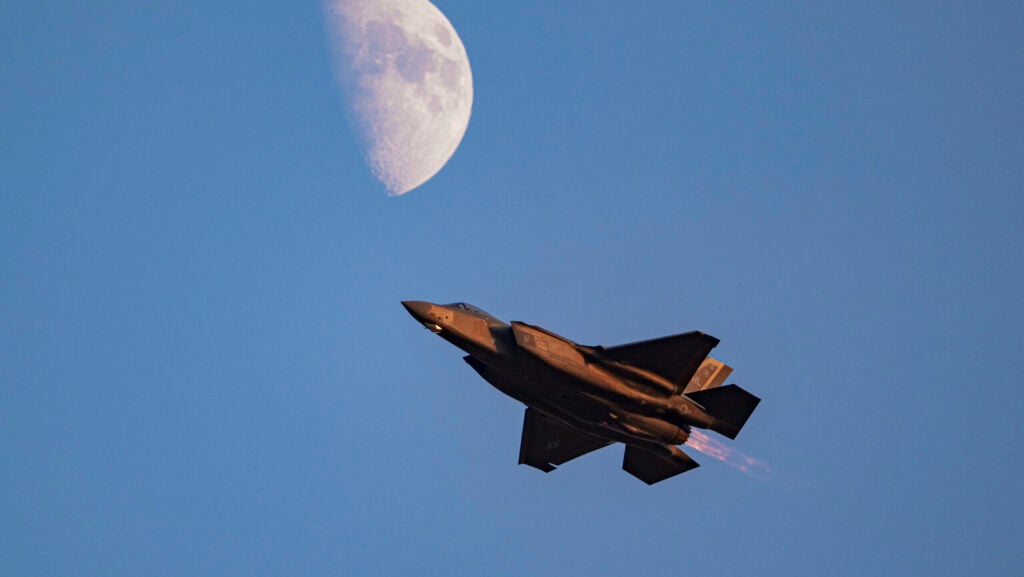
SÃO JOSÉ DOS CAMPOS, Brazil — The Pentagon is seeking an additional $13.7 billion to boost sustainment of the Lockheed Martin F-35 Joint Strike Fighter, whose readiness rates continue to decline despite years of concerted effort, according to a new watchdog report.
In a wide-ranging review of F-35 sustainment published today, the Government Accountability Office revealed the tri-variant F-35’s full mission capable rate — where a jet can meet all of its assigned missions — dipped from 38 percent in fiscal 2021 to 25 percent in FY25. The stealth fighter’s mission capability rate, measured by whether an aircraft can perform one of its designated tasks, similarly fell from 67 percent to 44 percent over the same period. (Some of that decline, GAO noted, is driven by a lengthy delay for an upgrade called Technology Refresh 3, whose woes previously froze deliveries.)
To arrest the trend, the F-35 Joint Program Office last year launched what’s known as a “Global Support Solution Reset,” according to GAO. The additional billions of dollars in planned spending envisioned by the effort would be spread across FY26 through FY31, though GAO found “multiple risks” lay ahead for the reset effort to meet its readiness targets.
For example, the military services who operate the jet will need to cough up the money for the plan. While the Air Force told GAO it could “likely afford the costs associated with the GSS Reset” for its F-35As, officials from the Marine Corps and Navy, which fly F-35Bs and F-35Cs, told the watchdog that “competing priorities” could “limit the extent” of their respective resources. And despite previous additional appropriations from Congress, JPO officials told GAO sustainment funding gaps remained.
Moreover, GAO found that except for the Marine Corps F-35C, the projected annual cost of operating the aircraft out in the mid-2030s — known as the program’s “steady state,” when fleets will be even larger and upgraded — increased over earlier estimates, in part driven by a higher number of anticipated flight hours. GAO said each services’ respective funding “may be expected to meet requirements,” but that “long-term affordability will remain a challenge” and “potentially” endanger sustainment efforts.
And further, even if more funding comes through, GAO found that the fighter’s industrial base may struggle to meet demand. Production of the aircraft’s canopy, for example, has previously been identified as a leading reason for lagging mission capable rates. And regarding the aircraft’s F135 engine, officials from manufacturer Pratt & Whitney and representatives from the JPO told GAO that “even with additional funding, there may not be enough industry capacity to meet demand” for parts.
RELATED: US poised to accept new F-35s without radars, sources say

The defense intelligence community’s AI and cyber view forward
From AI adoption and agentic systems to Zero Trust and cyber resilience, Breaking Defense’s latest eBook brings together key reporting from DoDIIS 2026 on the technologies and strategies shaping the future of defense intelligence.
A Lockheed spokesperson said in a statement that the company “continues to partner with the Joint Program Office and our industry partners to ensure we are delivering efficient and effective sustainment for the warfighter,” and that the world’s largest defense contractor “recently invested more than $2 billion in advanced funding to accelerate spare parts to increase readiness rates across the F-35 fleet.”
A spokesman for Pratt & Whitney’s parent firm RTX said in a statement that the company “is building on a strong operational readiness track record while investing to expand capacity and continue delivering the performance, reliability and capability operators depend on.
“Over the past five years, Pratt & Whitney has invested more than $1 billion to expand and modernize F135 production and sustainment capacity,” the spokesman added. “This initiative has significantly increased F135 engine and sustainment output, increasing current F135 production rates by 20% over previous contract rates.”
Overall, the reset plan aims to resolve a range of challenges facing the F-35 fleet, from increasing the supply of spare parts to better managing corrosion of the aircraft. GAO found the strategy addresses several of the watchdog’s key previous recommendations for improving the F-35 program, except for the Pentagon’s lack of technical data to independently maintain the jet. The JPO is also separately planning to establish a working capital fund to oversee the supply of spare parts, which would take effect “no earlier than October 2028,” according to GAO.
Additionally, GAO said that millions of dollars in incentive fees previously paid to Lockheed for improving the jet’s sustainment have “consistently not incentivized the achievement of JPO and US military service readiness requirements” — a finding similar to a previous Inspector General review [PDF]. The JPO was even lacking “accurate records” of incentive fees paid out between 2021 and 2023, the report states.
“Until it ensures the future use of incentive fees better achieves the desired performance, JPO increases its risk of continuing to reward performance that does not help the program meet its goals,” GAO said, suggesting alternative measures like penalties for poor performance.
GAO issued a total of three new recommendations, including that officials establish risk mitigations plans for the GSS Reset, improve incentive fee structures and implement a system that can better track incentive fee metrics and payment information. All three recommendations remained open.
After publication of this report, a spokesperson for the JPO said that office “concurs with the findings in the GAO report” and that “[w]e fully support all three recommendations to enhance fleet readiness, improve contract incentive structures, and implement rigorous financial quality controls.
“Through our Global Support Solution Reset initiative, the JPO remains focused on achieving our 2030 readiness goals and ensuring strict fiscal accountability for every sustainment dollar spent,” they said.
UPDATED 6/15/26 at 4:04 PM ET with comment from the F-35 Joint Program Office.