
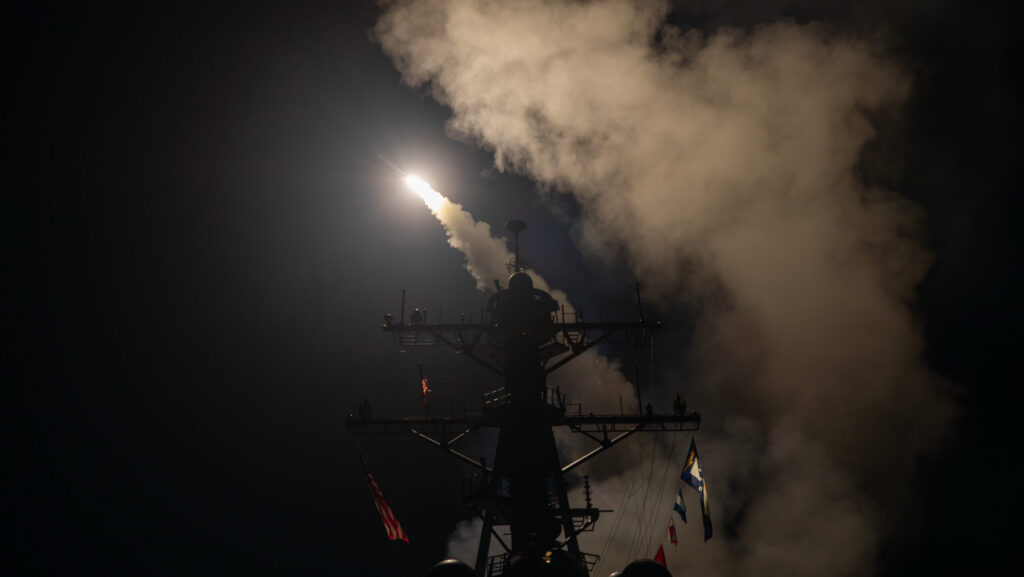
WASHINGTON — The Navy has awarded RTX subsidiary Raytheon a $22.9 billion contract to ramp up production of the Tomahawk cruise missile to 1,000 rounds a year.
The contract follows a February framework agreement with the Pentagon that laid the groundwork for the finalized deal. RTX said today the production increase will occur over a “multiyear period,” but did not detail a specific timeline for the ramp up.
“We are making significant investments in our workforce, technology, supply chain and facilities to dramatically boost production capacity and meet surging demand,” Raytheon President Phil Jasper said in a statement.
Over the past year, Pentagon leaders have leveraged multiyear contracts for critical munitions as an incentive to get defense primes to make larger investments in their production facilities and supply chain.
“The Department called upon industry to expand munitions production, and RTX has answered that call,” Michael Duffey, the Pentagon’s top acquisition official, said in a statement. “This Tomahawk award increases our ability to equip the Joint Force, ensuring our Warfighters never face a fair fight.”
RTX has “invested heavily” to boost production of the Tomahawk and other critical munitions, and has delivered three times more Tomahawks in the first half of 2026 compared to the same period last year, it said in a news release.
Beyond the Tomahawk, Raytheon has also inked framework agreements to increase production of the AMRAAM air-to-air missile, Standard Missile-6 and Standard Missile-3 IIA, while accelerating production of the Standard Missile-3 IB.


In the age of drones, a bigger fence around your facility doesn’t protect you anymore
Traditional thinking about how to protect facilities must adapt to new threats such as drones or downstream attacks.
During a July 23 earnings call, RTX CEO Chris Calio said that the company has had “very, very productive and constructive conversations” with the Pentagon about turning those framework agreements into definitive contracts.