
WASHINGTON ― The Space Force, in “partnership” with the Pentagon’s Golden Dome office, has tapped Viasat to build a Missions Operation Center (MOC) to integrate multiple satellite constellations and manage data traffic through the nascent Space Data Network (SDN) Backbone, the service announced.
The company has been awarded an indefinite delivery/indefinite quantity contract with a ceiling of $450 million to “design, field, and scale” the center, Space Systems Command said in a Thursday press release. “In this role, Viasat, Inc. will serve as the network and mission system integration partner as SSC expands its open-architecture ecosystem across multiple space-segment providers.”
The MOC will serve as the central network orchestration hub for the SDN Backbone, a constellation of low Earth orbit satellites being built by SpaceX to provide high-speed, low-latency communications. The backbone constellation is designed as the glue connecting the Space Data Network’s broader architecture of disparate military, and eventually commercial, space-based sensor and communications satellites with decision-makers and weapons platforms. The network’s near-term focus will be on supporting the Trump administration’s Golden Dome missile defense initiative.
Network orchestration enables autonomous shifting of data among the various satellite constellations in various orbits and down to the multiple ground stations supporting them, allowing data to “hop” from one constellation to another in the event of a slowdown in transmission due to bandwidth congestion or adversary jamming.
In essence, the MOC will function as a modern-day, software-run equivalent to an old-time telephone exchange where multiple human operators patched together phone calls via cables and provided troubleshooting services when calls failed.
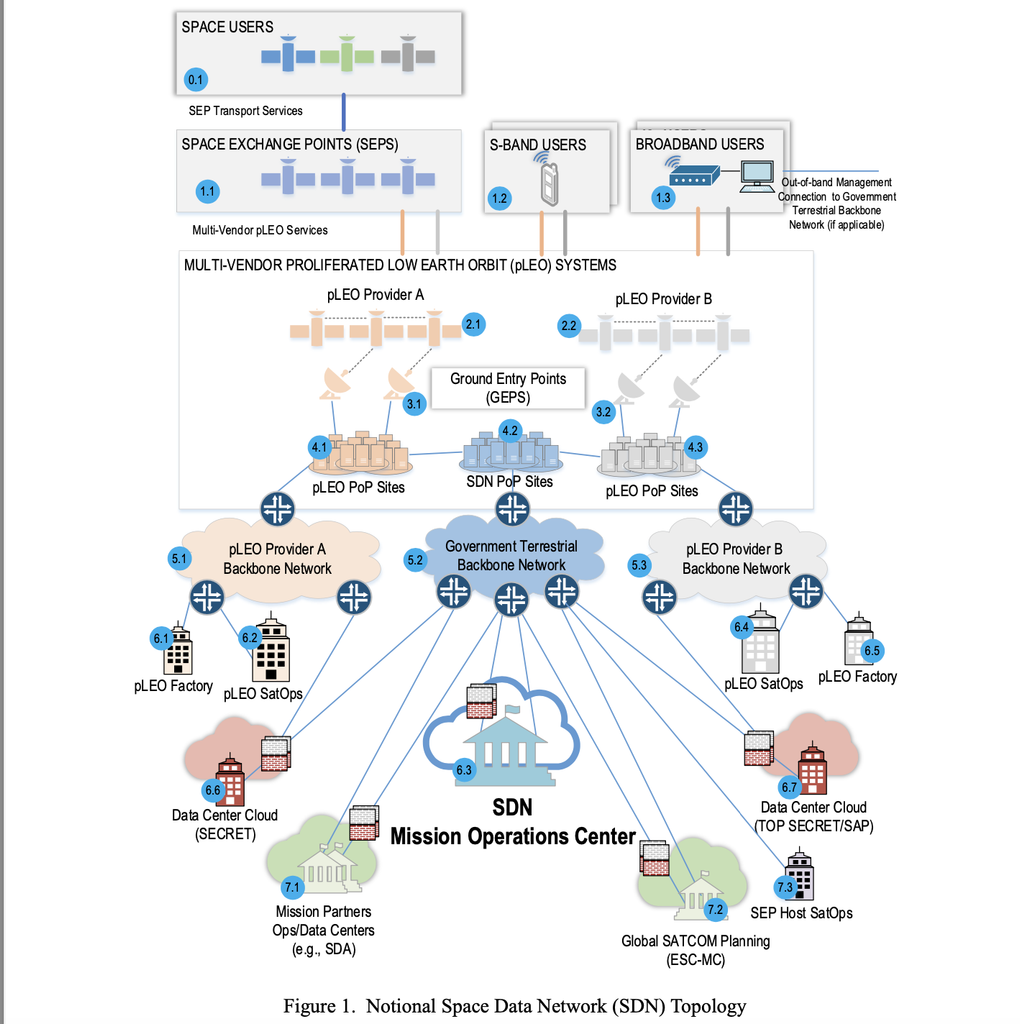
“The MOC will bring together mission integration, network operations, and data transport management across a growing multi-vendor architecture,” the SSC release said.


A leap in drone range and payloads come from a battery with different chemistry
Lithium-metal batteries are one way to break the weight and endurance limits of today’s unmanned systems.
According to the release, the MOC will provid the SDN Backbone with:
- Multi-Vendor Orchestration: Integrates disparate satellite systems into a unified communications network.
- Multi-Domain Joint Connectivity: Supports high-speed, low-latency, and cyber-resilient data paths for users across air, land, sea, and space.
- Real-Time Priority Routing: Enables dynamic data management and routing based on mission priorities through network operations infrastructure.
“The MOC establishes the mission operations layer needed to integrate the diverse space data transport and space exchange systems being developed across related efforts,” said Lt. Col. Alexa Eggert, materiel leader for the SDN Backbone program at SSC’s Space Based Sensing and Targeting Portfolio Acquisition Executive office, in a statement. “By bringing the systems together in one place, it positions us to deliver a more integrated mission capability across multiple constellations and systems.”
Breaking Defense Video