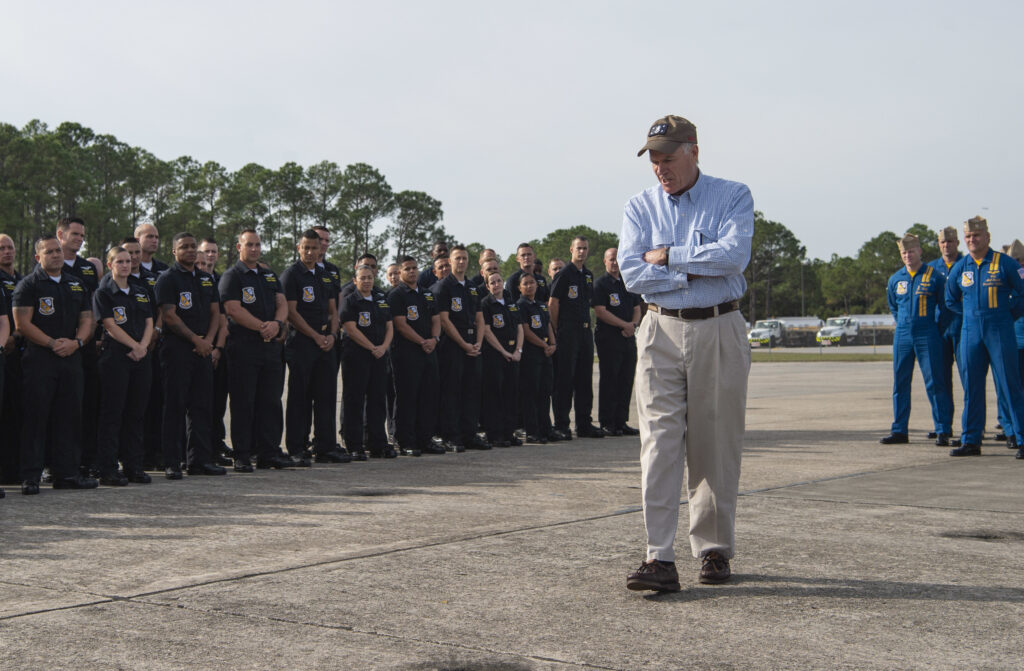
HALIFAX: In his last interview as Secretary of the Navy, conducted as the White House and Pentagon were huddling to plan his termination, Richard Spencer stood in a small conference room here, jovially chatting with a small group of reporters.
It was Saturday evening, less than 24 hours before Defense Secretary Mark Esper announced his firing.
Spencer, as he had done earlier in the day in a press conference at the Halifax Security Forum, insisted he never offered to quit over the case of Navy SEAL Eddie Gallagher, who was acquitted of murder charges after a controversial trial and then championed by President Trump. Gallagher was convicted of posing with a dead body, which is a violation of the rules of war. The president insisted Gallagher retain his SEAL Trident when he retires.
In a hasty called press conference at the Pentagon this morning, Esper flatly rejected Spencer’s denial, telling reporters that “Spencer had said to me he was…likely probably going to resign if he was forced to retain the Trident. I had every reason to believe he would resign.”
Esper also confirmed President Trump ordered that Gallagher would retain his status. “On Sunday when I talked to the president to update him on the situation he said ‘what about the pin,’ he wanted Eddie Gallagher’s pin restored.” That order went against the advice that Esper and Chairman of the Joint Chiefs, Gen. Mark Milley, gave the president on Friday.
In the Pentagon’s telling, Spencer was fired for talking to the White House in secret to fix the result of an ongoing Navy process to allow Gallagher to retain the Trident, even after Esper, Milley, and Spencer had agreed among themselves to allow the Navy process to play out.


Undersea superiority: ASELSAN’s integrated approach to naval defense
As global navies adapt to evolving underwater threats, ASELSAN’s integrated sonar, countermeasure, and sonobuoy solutions offer a scalable, future-ready approach.
“I lost trust and confidence when I found out this secret proposal was happening” Esper said.
Spencer’s last words
The Navy finds itself at a critical juncture as it scrambles to craft a new modernization plan to stay ahead of massive Chinese investments in its own armed forces. Those plans aren’t likely to be in jeopardy, but the churn at the top will last at least through the confirmation of Spencer’s successor. President Trump has said he plans to nominate the current Ambassador to Norway, Kenneth Braithwaite, a retired rear admiral who spent most of his career as a public affairs official in the Navy Reserve.
It’s unclear what priorities Braithwaite, who is not well known in Washington, will bring with him. He’s been in Oslo since February, where one Norwegian official tells me he has shown keen interest in Norwegian military modernization.
But with the constant firings and hirings in the Trump administration, Braithwaite is “just the latest mystery figure to bubble up in the national security firmament,” Bryan McGrath, head of The Ferrybridge Group consultancy and a former destroyer captain, observed.
The Navy’s most significant planning effort is the eagerly anticipated Force Structure Assessment, due by the end of the year, which promises deep structural changes in the Navy’s force design and integrate the Marines more deeply in operations and planning. The review is being jointly led by Marine Corps Commandant Gen. David Gilday and Navy Chief Adm. Mike Gilday.
Spencer told me Saturday the service’s annual 30-year shipbuilding plan “might actually be a useless document.” The new assessment is the latest version of that plan, though Spencer said the speed of technological change makes it impossible to predict what technologies might be ready in three decades.
“The force structure assessment worked really well when the technology velocity curve was flat,” he said, but changes are happing too quickly now for a 30-year plan make sense. Curious about the success rate of past plans, he tasked his staff with taking a deep dive into previous assessments to quantify if the Navy had ever gotten its predictions right. He expected the results next week. It’s unclear where that bit of analysis will end up now.
“I make the argument you shouldn’t want me to do a 30-year plan,” he said. “One year we’ll be ahead. The next year China will be ahead. When it comes to weapons, same thing. We’re going to be fighting with similar weapons.” In that regard, he said, making shorter-term shipbuilding plans makes much more sense.
His comments reflect a grim acceptance within the Pentagon that Chinese military modernization has rocketed ahead of all rivals save — for now — the United States, and that Chinese precision weapons present a real, immediate challenge to traditional American dominance on the high seas.
“I think Berger and Gilday are working marvelously together and there’s an energy behind his integrated approach,” McGrath said. “It has a momentum that will not stop,” with Spencer’s departure. “This is a huge change in the status quo. If it is taken to its logical development there will be considerable difference to the fleet” in the coming decades, which vastly more drones flying off ships and operating at sea.
He added he doesn’t expect Spencer’s ouster to have much impact on the plan, though it remains to be seen what Braithwaite, or whoever might take over next, will prioritize.
For now, the Navy and Marine Corps will continue to work on their new plan and wait for a new Senate-confirmed civilian leader. With 20 legislative days left in the calendar year, there remains a budget deal to pass, a North American trade deal to chew over, and the ongoing impeachment inquiry, making it unclear when a hearing for a nominee might take place.
On Saturday night, the last I saw of Spencer was as he happily worked the room at a cocktail reception in Halifax, glass of champagne in hand, enjoying the last few moments before catching his flight back to Washington.