WASHINGTON — In response to an American buildup in the Caribbean, Venezuelan President Nicolas Maduro has pledged there is “no way” the US could invade the South American nation, as the nation was well prepared to defend its sovereignty.
And while Maduro may be handing out weapons to civilians to aid any fight on land, the potential for conflict — and the presence of US Navy ships in the region — also raises the question of Venezuelan capabilities at sea.
While official statistics are hard to come by, videos and statements uploaded by the Venezuelan government and military, as well as analysis by experts, provide an idea of what works. Or rather, floats.
The analysts told Breaking Defense that what’s formally known as the Bolivarian Navy of Venezuela likely has limited capabilities in the open water, as questions remain regarding the fleet’s marquee vessels like submarines and frigates.
The service likely has “brown and green water capabilities, so [the fleet] can conduct operations at a limited range,” Andrea Resende, a maritime security scholar and professor of international relations at Belo Horizonte University in Brazil.
Most recently, the coastal defense Exercise Luisa Caceres de Arismendi took place last weekend, and a video uploaded by the service shows transport vessels Los Llanos and Goajira transporting amphibious landing vehicles.
In September, the Navy conducted Exercise Sovereign Caribbean 200 (Caribe Soberano 200) close to La Orchila Island, during which Los Llanos also participated, as well as the amphibious landing ship Capana. Also in September, Exercise Cumanagoto 200 took place. The service announced in a social media video that the exercises featured the Capana, the transport ship Los Hermanos, the coastal patrol vessel Serreta, and what appeared to be three Iranian Peykaap II speedboats. Each exercise was carried out in coastal waters, not in the high seas.


America must adopt a Sixth Domain of warfare doctrine
The Sixth Domain is not defined by geography. It’s a new kind of conflict in which autonomy and networked systems allow thousand-dollar consumer electronics to destroy multi-million-dollar conventional weapons systems.
Those exercises, like others in recent years, however, did not show bigger ticket vessels Venezuela is known to have sailed in the past, such as submarines or frigates.
Resende said the subs are probably “not operative, as far as scholars and analysts know.” On paper, the service has two submarines that were built in the 1970s, Sabalo and Caribe. A video uploaded to the Navy’s social media account in April appears to show a sub identified as the Sabalo in a hangar at the Dianca shipyard.
Another unknown is that status of the fleet’s main surface ships, the Mariscal Sucre-class frigates, which were acquired from Italy in the early 1980s.
Defense news agencies Defensa.com and Infodefensa reported in late 2022 that frigate Almirante Brión was in a Dianca dry dock undergoing maintenance. In January 2023, the shipyard released a photo of a ship bearing Almirante Brión’s hull number, F-22. Neither the shipyard nor the Navy have announced if the warship formally returned to service.
Caracas has not issued statements regarding the status of the heaviest warships and no reliable image of any frigate at sea appears in social media channels reviewed by Breaking Defense.
The two main Venezuelan shipyards, Dianca and Ucocar, announced the successful repair and return to service of some smaller ships in the last few weeks, including the combat patrol vessel Victoria, the transport vessel Los Frailes and the patrol ship Yavire.
Andrei Serbin Pont, president of the CRIES think tank, noted that even if a ship is seaworthy, it is not necessarily well equipped. The Guaqueri-class oceanic patrol vessels (also classified as corvettes) “were never properly armed and today depend on improvised solutions like the integration of C-802 missiles, or an Iranian variant” and the installation of a “ZU-23 anti-aircraft gun, which is unfit for naval operations,” Serbin Pont said. (In 2024, Venezuelan Defense Minister Vladimir Padrino López inaugurated the Navy’s center for CM-90 missiles of Iranian origin.)
Some Venezuelan vessels are known to have been lost or compromised in non-combat operations. The patrol vessel Warao hit reefs during exercises with Brazil in 2012, and there are no confirmed reports that it ever returned to service. More recently, the patrol vessel Naiguatá sank in 2020 after colliding with the luxury cruise ship Resolute during a bizarre incident in the Caribbean.
This does not mean that the Navy lacks some coastal deterrence capabilities, like the Peykaap III speedboats with missile launching capabilities acquired from Iran. Moreover, in 2022, the Venezuelan navy released online two sets of photos appearing to show the Iranian Fajr-1 multiple rocket launch system installed aboard Damen Interceptor 1102 speedboats (and a Tiuna tactical vehicle).
Still, protecting the Venezuelan sea of any maritime invaders will be the responsibility of aircraft, not ships. “The new UAVs produced with Iran’s assistance may assist in defensive measures against foreign threats,” Resend theorized, but ultimately, they “are not enough to create maritime deterrence.”
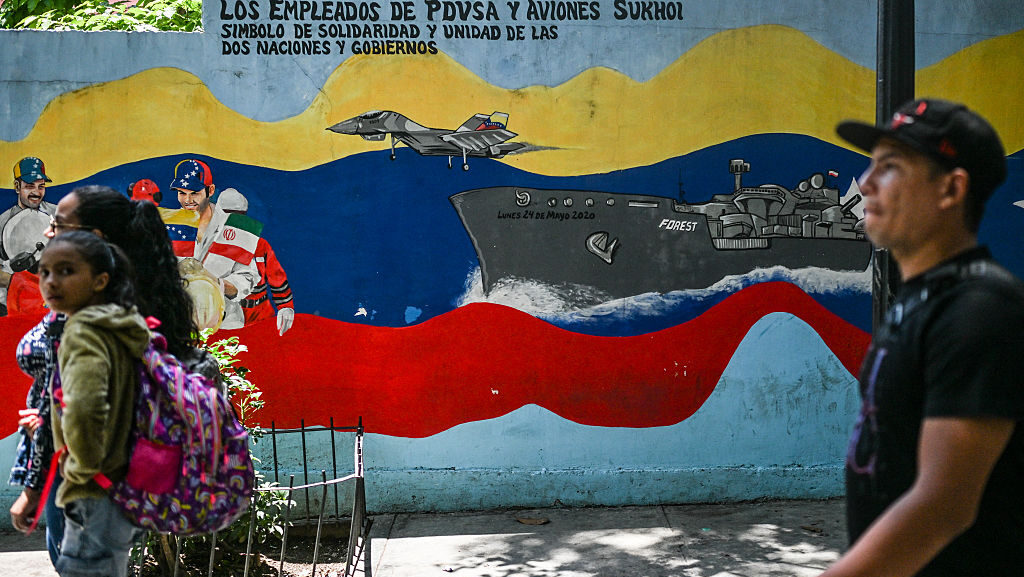
A similar opinion was shared by Serbin Pont, who said he believes “most anti-surface capabilities” among the Venezuelan armed forces are found in the Air Force, not the Navy. The “real deterrence power” of the South American nation are their Sukhoi warplanes, equipped with Kh-31 missiles, he added.
“I consider the Venezuelan Navy at the verge of obsolescence,” Resende concluded.