

WASHINGTON — When Fincantieri Marinette Marine won the initial contract to build Constellation-class frigates in 2020, it was a game-changing moment for the shipyard based an hour north of Green Bay, Wisc.
The program was worth more than $20 billion for 20 ships, and Fincantieri was poised to get a lion’s share of the work. Prior years of investment to the tune of $800 million in both the shipyard itself and making a winning proposal appeared to be paying off.
But then last week, after years of cost overruns and delays, a shock: Navy Secretary John Phelan took to social media to announce the service would accept just two frigates built in Wisconsin, cancel the remaining four vessels on contract and make a “strategic shift” away from the program.
“From day one I made it clear: I won’t spend a dollar if it doesn’t strengthen readiness or our ability to win,” Phelan said. “To keep that promise, we’re reshaping how we build and field the fleet—working with industry to deliver warfighting advantage, beginning with a strategic shift away from the Constellation-class frigate program.”
In the wake of the announcement, analysts told Breaking Defense they don’t expect that the abrupt cancellation of such a big program is likely to put the Wisconsin shipbuilder out of business anytime soon. But, they said, the Navy must move quickly to aggressively reinvest into small, maneuverable and unmanned ships both to ensure Fincantieri’s Wisconsin shipyard stays viable moving forward and replace the capability it is losing by severely truncating the frigate program.
“This is going to be devastating for [Fincantieri’s] workforce. They invested heavily buying the yard in 2009 and invested a lot to win the frigate class competition,” said Jerry McGinn, who researches the defense industrial base at the Center for Strategic and International Studies (CSIS). McGinn said finishing the first two frigates would buy the shipyard time to prepare for the future, but “I think this is going to [have] a significant impact,” he added.
Following Phelan’s announcement, Fincantieri sought to strike a positive tone. In a lengthy statement, the shipyard’s eponymous Italian parent company, which is one of the world’s largest shipbuilders, said it had reached an agreement with the Navy to deliver a “new class of vessels” as well as receive piecemeal work for other ship classes.


Why enterprise IT modernization matters now – and how to “delight by design”
Do more with less: streamline workflows, reduce duplication, invest upfront to save long-term.
In response to questions for this story, Eric Dent, a Fincantieri spokesman, declined to provide further details about the company’s agreement with the Pentagon, but said the company “expect[s] the Navy will present options for additional work in our Wisconsin system of shipyards soon. […] We believe that the agreed-upon framework we have with the Navy will position us well for important future work for the U.S. government and the Navy.”

Dent also said the company, which currently employs 2,175 people at Marinette Marine, must “balance the size and composition of our workforce with the projected workload for the Navy.” He added that Fincantieri had to “let go of some contracted labor (more than one hundred) over the recent months, and now we are carefully matching the expertise of our workforce with work already in the shipyard and with what we expect from the Navy soon.”
A spokesperson for the Navy for did not respond to a request for comment by press time.
Meanwhile, on Capitol Hill, at least one Wisconsin lawmaker was far less optimistic about the future.
“This is a blow to our state’s economy and our national security,” Wisconsin Sen. Tammy Baldwin (D) said in a social media post. “Thousands of skilled workers support this critical program, and this administration is pulling the rug out from under them. [The Navy Secretary] must lay out a plan to protect Wisconsin’s shipbuilding industry immediately.”
‘Great Harm’ To Supply Chains
Prior to winning the frigate competition, Fincantieri Marinette Marine was fulfilling two prominent programs for the Navy: the Freedom-class Littoral Combat Ship and the Multi-Mission Surface Combatant. But neither of those programs are positioned to sustain the company’s workforce long term.
Within a day of Phelan’s announcement, the Navy separately stated the final Freedom-class LCS was accepted for delivery, meaning the work that ship class provided to the Wisconsin shipyard is finished — barring the unexpected.
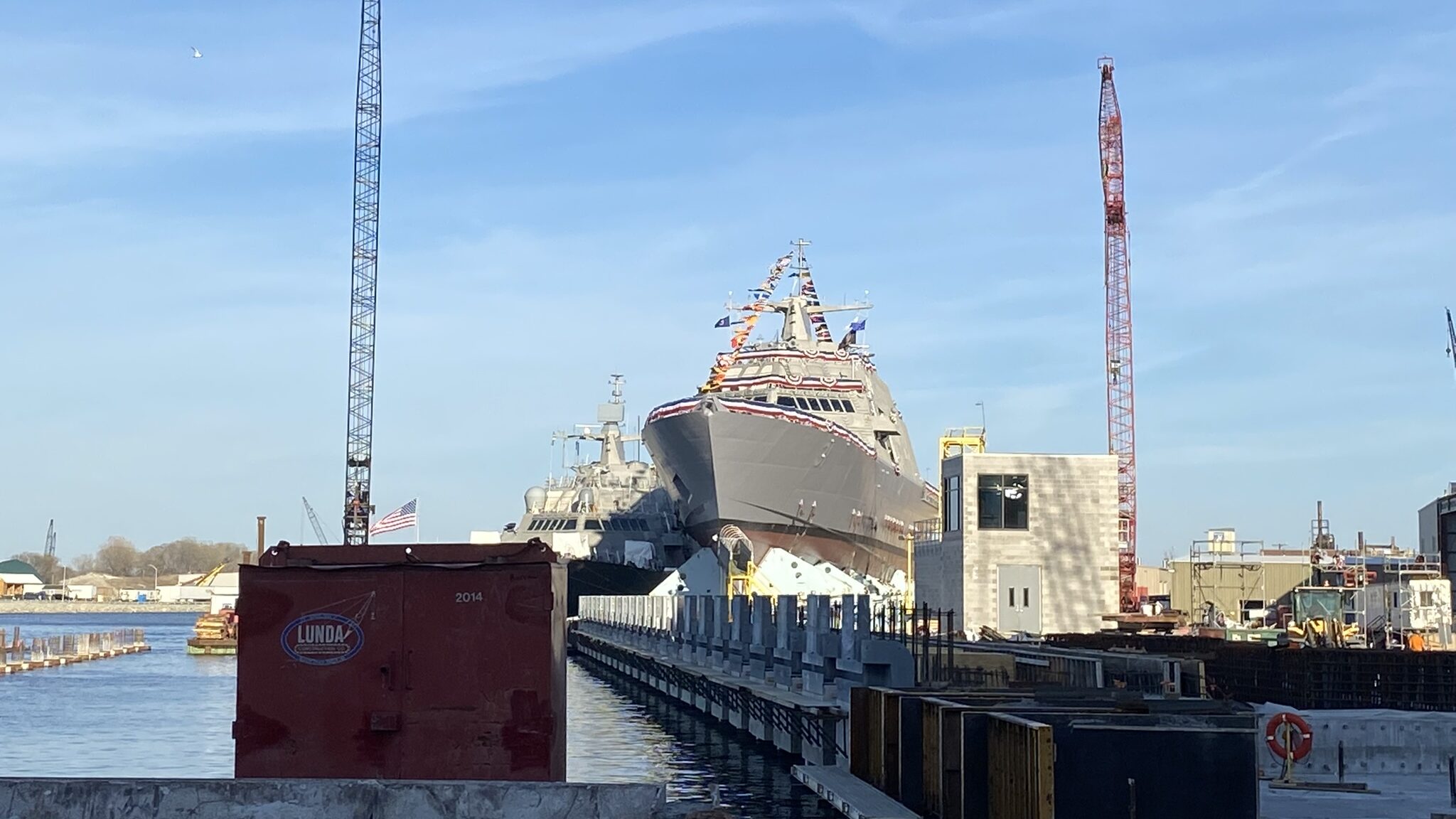
Meanwhile, Saudia Arabia is purchasing the Multi-Mission Surface Combatant for its own naval forces. But that program includes only four ships in the class, the first of which was being prepared to enter the water as of October.
Without Constellation, the slimmed down workload at Fincantieri stands to disrupt businesses and workers in and outside of Wisconsin, analysts said.
“A second implication of this is not just at Fincantieri, but of their supply base, which is an often under discussed aspect of the industrial base,” Cynthia Cook, a senior fellow at CSIS, told Breaking Defense. “The maritime sector supply base is also a national strategic asset, and the fact that they’ve lost some ships will hurt the full supply chain.”
Paul Roden, a retired Coast Guard officer and senior official at the Amphibious Warship Industrial Base Coalition, said that while the frigate’s cancellation “may be necessary given the circumstances,” it stands to “cause great harm” to the supplier base.
“Major suppliers often spend many millions of dollars on the sales effort as well as working to qualify their equipment to the requirements. When a program is cut short suppliers don’t have the opportunity to recoup those expenses over the length of the program,” he wrote in a post on social media.
Both the previous and current administrations in the White House have noted the overall decline in American shipyards in recent decades and have been vocal about the need to revitalize naval and commercial shipbuilding. McGinn and Cook said that it will be critical for the Navy to keep Fincantieri Marinette Marine busy, whether that is with piecemeal work or a new class of vessels, if the Pentagon is serious about maintaining the maritime industrial base.
“There is an upper limit on infrastructure in the maritime industrial base. It’s really hard to find sufficient land to build a new shipyard,” said Cook. “The fact that there is an existing shipyard at Marinette really means that there’s a national strategic interest in keeping it alive.”
The Navy Stills Needs Frigates, Or Something Like Them
After Phelan’s announcement, the American Shipbuilding Suppliers Association called the cancellation a “significant adjustment” in a statement about the frigate program, but emphasized it doesn’t change that the Navy’s requirement for “capable, modern surface combatants remains urgent, and meeting that need will depend on a stable, well-supported domestic supplier base.”
It was a sentiment shared by analysts, who said that without 18 of the expected 20 frigates, the Navy has to fill a significant capability gap.
As envisioned, small surface combatants like the frigate were designed for escort missions, whether that be to protect commercial vessels, logistics ships or allies and partners, especially against adversaries such as Russia and China which have capable submarine forces. Before the Constellation, the LCS was envisioned as carrying out part of that role, but concerns about its survivability in a high-end fight and other serious development issues have derailed its original intent.
“The LCS was kind of a weird quirk in time, and it turned into this platinum-plated vessel that was not the intended [outcome], and the world changed,” said Brent Sadler, a fellow at the Heritage Foundation. “But we need frigates still. There’s no vessel out there for escort duty, for convoys and for moving high-value logistics to make sure it doesn’t get sunk by a Chinese submarine or even a Russian submarine.”
Since Fincantieri won the original frigate competition in 2020, both Navy officials and lawmakers have repeatedly floated the idea of having a second shipyard produce the Constellation class. And while the Pentagon has taken preliminary steps towards that end, the Navy has never pulled the trigger on seeking formal industry proposals.
Sadler said despite Fincantieri’s troubles, the Navy should still consider offering the frigate design to another shipyard. Failing to do so would be a waste of the time and money spent on the program to date, he added.
He also echoed McGinn and Cook’s statements about the necessity for the Navy to ensure Fincantieri stays afloat to help produce the kinds of unmanned and corvette-sized ships that could bring necessary firepower to a fight in the Indo-Pacific.
“We don’t have enough shipyard capacity,” said Sadler. “There’s been a lot invested into the yard at Marinette, and it has potential. It’s not necessarily adequate [for] the frigate production, but it can do a lot of other things. It needs to be kept in the game.”