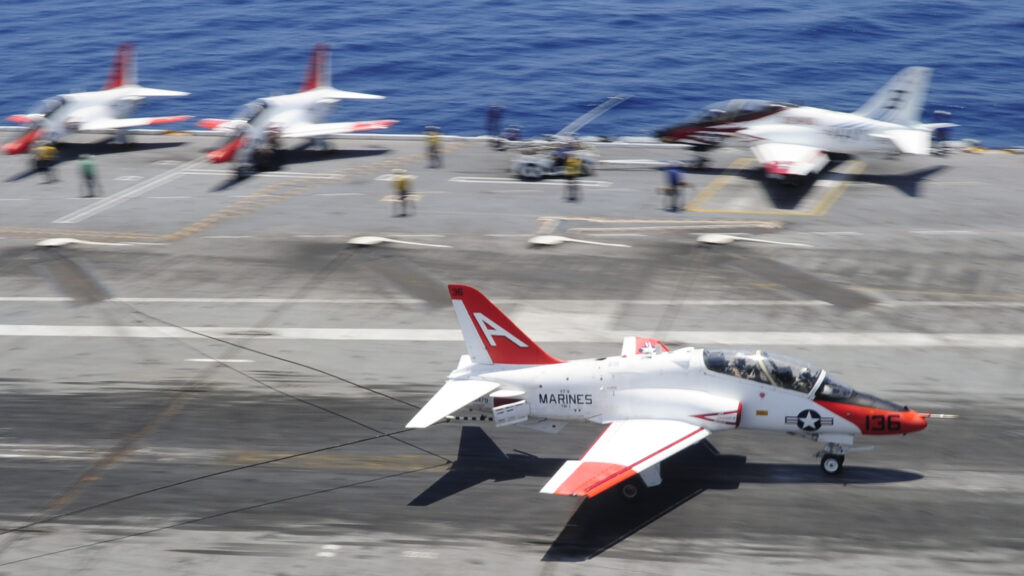
WASHINGTON — The Navy has unveiled its final requests for proposals (RFP) for its Undergraduate Jet Training System (UJTS) as the Navy seeks a new, next-generation aircraft for “intermediate and advanced training” of Navy and Marine pilots.
The UJTS will succeed the Navy’s T-45 Goshawk fleet, which first joined the service in the early 1990s, that the Navy and Marine Corps employ for pilot carrier qualification.
The T-45 is designed to land on aircraft carriers, but that is not the case for the UJTS. The Navy’s plans show it will not use the new trainer aircraft to conduct training on carriers, or a field carrier landing practice (FCLP) touch down, in which planes land on an airfield runway aimed at simulating a carrier landing.
The Navy previously indicated it would scrap the FCLP-to-touchdown requirement when it issued a request for information (RFI) in March 2025 that said “the UJTS air vehicle will only be required to conduct Field Carrier Landing Practice (FCLP) to wave off.”
As a result, industry must share “unique aircraft simulation capabilities“ to prepare aviators for carrier landings, according to the RFP published on Thursday.
Offers for engineering and manufacturing development (EMD) with a total cost exceeding approximately $1.8 billion will be “considered unreasonable” and will be rejected, the RFP said. Additionally, offers for the initial EMD must remain under $52.8 million for FY2027, and $181 million for FY2028.
The Navy plans to award the contract in March 2027, and plans to purchase a total of 216 aircraft, according to Aviation Week, who was first to report on the final RFP. Aviation Week also reported the Navy will purchase four EMD aircraft before commencing low-rate initial production (LRIP) for the first seven aircraft in 2032. That number will increase to 25 annually starting in 2035.

Answering the demand signal to move faster, field sooner, iterate continuously
As threats rapidly evolve, digital engineering, manufacturing capacity and robust supply chains are critical to meeting challenges.
Among those likely to be vying for the UJTS program are Boeing, Lockheed Martin, and SNC in conjunction with Northrop Grumman and General Atomics Aeronautical Systems Inc.
As the Navy pursues the UJTS, Naval Air Systems Command (NAVAIR) announced in July that the first two T-45 aircraft had entered the Service Life Extension Program (SLEP) production line, with repairs to the fleet expected to go on through 2036, presumably keeping the aircraft flying at least through that time.