
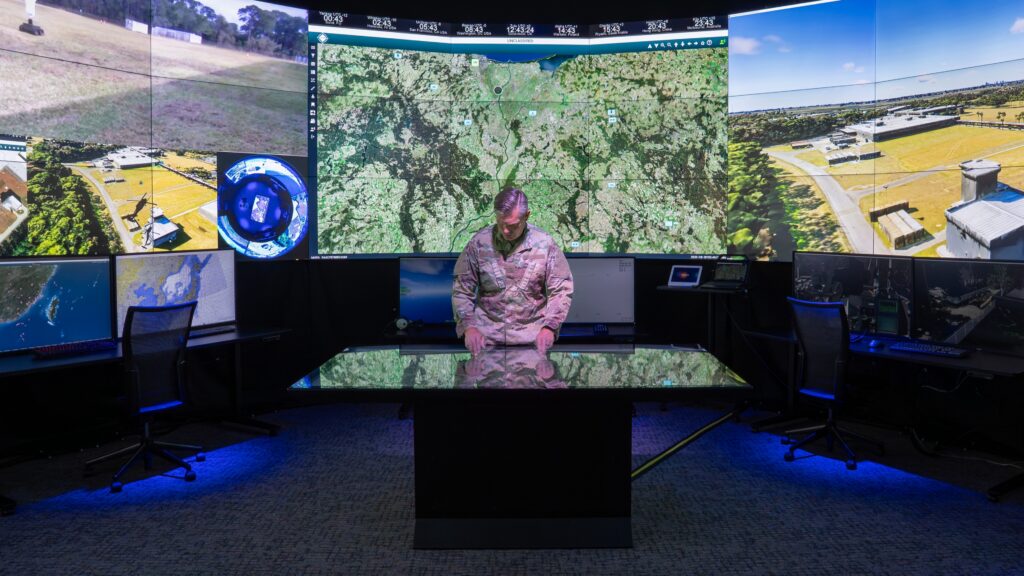
Europe stands at a pivotal moment in security. The alliance’s ability to respond to emerging threats depends on seamless coordination among its 32 member states and partners. While NATO has advanced joint doctrine and communications, the simulation and experimentation layer remains fragmented. Nations still rely on legacy tools, disparate data, and siloed test environments.
In the current landscape of evolving threats, hybrid warfare, and rapid technological change, simulation enables multinational forces to rehearse joint operations, test force structures, and sharpen decision-making in realistic, data-driven settings. It strengthens interoperability by aligning tactics, communications, and command structures before deployment, turning insight into action faster and ensuring forces are prepared to anticipate and outpace emerging challenges.
A Unified, Multinational Simulation Environment
Lockheed Martin’s Advanced Center for Experimentation and Simulation (ACES) offers a single, integrated modeling and simulation (M&S) platform that unifies assets, data, and scenarios so NATO allies can plan, rehearse, and assess multinational operations with unprecedented fidelity, speed, and interoperability.
The ACES open architecture system allows any platform across air, land, sea, cyber, or space to “plug and play” within the virtual arena. The platform supports dynamic federation, which means nations can contribute live or synthetic models in real time, creating a shared virtual battlespace, and can do so through integration with their existing simulation capabilities or with newly acquired tools.
Joint exercise planning and preparation are streamlined with scenario authoring tools that let multinational staff cocreate campaign level exercises in a common workspace. ACES’ rapid rerun capability means minor adjustments to force composition or rules of engagement can be evaluated within minutes, dramatically shortening the planning to execution cycle.
Enhancing Readiness & Situational Awareness
The platform excels at “what if” analyses, allowing emerging technologies such as hypersonic weapons, autonomous swarms, and directed energy systems to be inserted virtually alongside legacy platforms. This provides NATO decisionmakers with quantifiable force level impacts and enables lifecycle cost modeling that links performance data to logistics and sustainment considerations.
Commanders benefit from a real-time digital twin of the battlespace, overlaying live sensor data with simulated adversary actions. Interactive decision trees allow rapid assessment of alternative courses of action without committing physical assets. And, automated after-action reviews, deliver performance dashboards that create verifiable readiness metrics across the alliance.
Enabling the Collective Edge
ACES takes live, virtual and constructive training and delivers it in a single, integrated platform that enables commanders to understand force organization, plan for contested logistics and much more. Imagine you are a commander planning a multinational exercise that will field air, land and sea assets. Your troops are training on a ground range, your pilots are flying the scenario in a simulator, and you need to understand how each element will interact against a defined threat. With ACES, you can connect every asset, run, pause and rerun the same scenario, and evaluate the joint performance, seeing how everything works together and bringing troops home safely after every mission.
By delivering a shared sandbox, ACES shortens the feedback loop between concept, prototype, and fielding, ensuring NATO stays ahead of peer adversaries. The common M&S language reinforces alliance doctrines, reduces misinterpretation, and builds trust among partners. Our approach to ACES protects sovereign data while enabling coalition-wide insight, delivering the edge for collective defense.
ACES can accelerate joint training, improve capability assessment, and deliver the next level of operational awareness for commanders and forces throughout the alliance by knitting together the assets, data and expertise of every member nation into a shared virtual battlefield that tests concepts and prepares forces. Lockheed Martin stands ready to partner with NATO and its member states to operationalize ACES, ensuring that the alliance’s collective edge remains sharp, resilient, and adaptable for the challenges of tomorrow.
About the Author Raashi Quattlebaum – Vice President, Land & Maritime Solutions, Lockheed Martin. With more than two decades of experience across aerospace and defense, Raashi currently leads key projects across test, training, and simulation, driving innovation and growth in these critical areas.