
For decades, the global defense industrial base optimized itself around efficiency, specialization, and centralized production. Critical manufacturing capacity consolidated into a relatively small number of facilities, while supply chains stretched across continents and production timelines expanded alongside increasingly complex logistics networks.
That model is now under pressure from multiple directions.
Geopolitical instability, supply-chain disruptions, labor shortages, sustainment complexity, and the accelerating pace of technological change are pushing defense organizations and industrial manufacturers to rethink how mission-critical components are produced and delivered.
At the same time, the demands placed on modern defense manufacturing have evolved significantly. Military platforms and industrial systems increasingly require faster iteration cycles, greater operational flexibility, localized production capacity, and sustainment models capable of functioning in contested or disconnected environments.
The challenge is no longer simply manufacturing more. It is manufacturing faster, closer to the point of need, and with enough consistency and repeatability to support operational deployment at scale.
Many defense and aerospace organizations see advanced additive manufacturing as part of the solution. Yet despite years of industry attention, much of the sector has remained concentrated in prototyping and low-volume engineering support, with industrial-scale adoption slowed by challenges related to repeatability, material stability, process control, and qualification.
Today, advances in materials, software, process control, and manufacturing systems are helping move additive manufacturing into a more mature phase, where production applications are becoming increasingly viable.
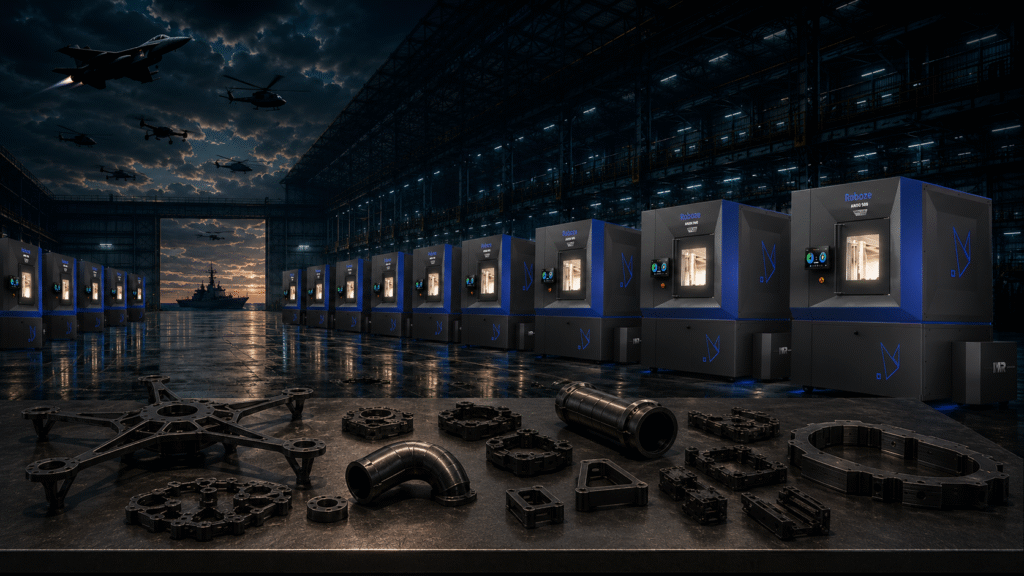
One company working on this transition is Roboze, which has focused on developing an integrated additive manufacturing ecosystem for mission-critical industrial applications. Rather than concentrating solely on hardware, the company has built a broader platform that combines production systems, high-performance materials, process-control software, and distributed manufacturing capabilities.
Underlying this approach is the idea that manufacturing itself is becoming strategic infrastructure, particularly in sectors where operational resilience, supply-chain security, and localized production capacity are increasingly critical. In this view, future industrial systems may rely less on centralized factories and more on distributed, software-defined production networks capable of operating across multiple geographies.
A key challenge for additive manufacturing in aerospace and defense has always been repeatability at scale: the ability to produce qualified parts consistently across multiple facilities and operational environments. Addressing that challenge requires close integration between hardware, materials, software, and process validation.
Roboze’s manufacturing platforms focus primarily on high-performance polymers and advanced composites used in sectors where lightweighting, corrosion resistance, thermal performance, and reduced supply-chain dependency are becoming increasingly important.
Materials such as ULTEM 9085 are already used in certified aerospace applications, particularly where flame, smoke, and toxicity compliance and weight reduction are critical. At the same time, advanced carbon-fiber reinforced materials such as Carbon PEEK are opening opportunities for corrosion-resistant and lightweight Class II components traditionally produced through machining, casting, or labor-intensive composite workflows.
The strategic significance extends beyond the materials themselves. The ability to digitally standardize production could allow qualified parts to be manufactured more consistently across distributed facilities, potentially reducing reliance on long and vulnerable supply chains.
Over the past several years, Roboze has expanded its international footprint while supporting aerospace, defense, and energy applications across North America, Europe, the Middle East, and Asia.
These facilities operate as digitally connected production environments, where workflows, materials, hardware, and process controls are coordinated through a unified software-driven manufacturing architecture.
For OEMs, distributed production models could make it easier to localize manufacturing closer to operational regions without duplicating large-scale industrial infrastructure in every geography. For defense organizations, the same approach could support more flexible sustainment models through secure digital inventories and localized production of spare parts near operational theaters.
This direction aligns with broader efforts across NATO and allied defense ecosystems to strengthen industrial resilience, operational readiness, and sovereign manufacturing capability.
Earlier this year, Roboze announced its involvement in DIANA (Digitales Partes Ad Necessitatem Armatorum), a project co-funded by the Italian Ministry of Defence under the National Military Research Plan. The initiative focuses on secure digital infrastructures for identifying, reconstructing, validating, and producing spare parts near naval operational environments through distributed manufacturing technologies.
The project reflects increasing institutional interest in expeditionary and decentralized manufacturing capabilities designed to reduce dependence on traditional logistics systems.
Roboze has also expanded its presence within the U.S. defense ecosystem through a recent investment from Rule 1 Ventures, the venture firm led by retired Admiral James “Sandy” Winnefeld Jr., former Vice Chairman of the Joint Chiefs of Staff.
Founded by Alessio Lorusso, Roboze has spent more than a decade focused on one of additive manufacturing’s most persistent challenges: moving the technology beyond prototyping and into repeatable industrial production.
That effort increasingly reflects a broader shift taking place across the defense and industrial manufacturing sectors. As supply chains become more fragile and operational requirements more dynamic, distributed and software-defined manufacturing infrastructures are gaining attention as a potential component of future industrial resilience.
The next generation of manufacturing may be defined less by centralized scale alone and more by the ability to deploy secure, repeatable, and adaptable production capacity wherever it is needed.
The future of defense manufacturing will likely be distributed, autonomous, and increasingly software-defined.