STOCKHOLM — The number of deployed nuclear warheads worldwide has increased over the past year, the Swedish think tank SIPRI found in its annual report released today.
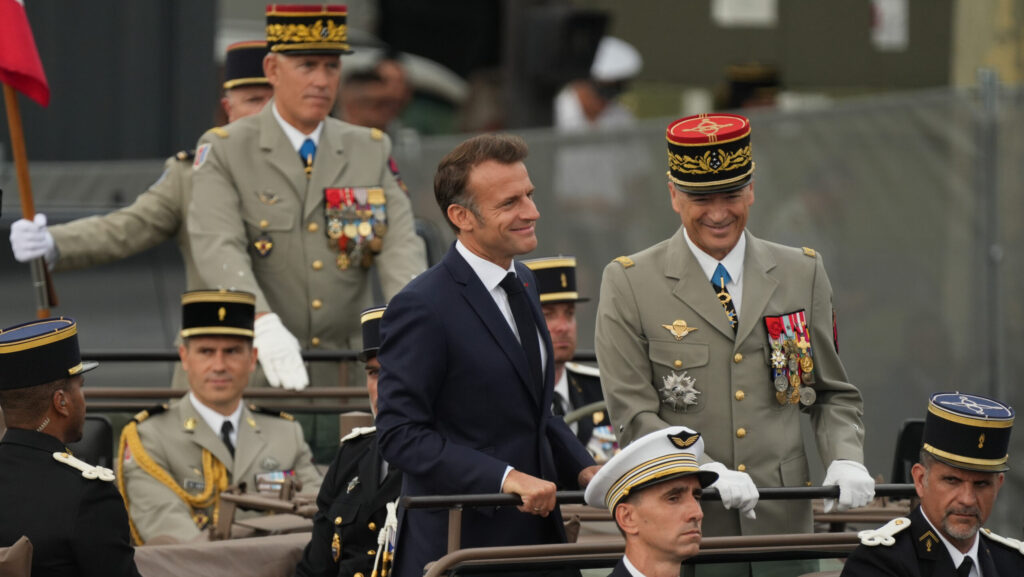
The expansion comes as Europe wrestles with its own nuclear future amidst a French plan that is drawing interest from nine countries, most recently Norway.
Of the world’s roughly 12,000 warheads in the nine nuclear-armed states, as many as 2,200 were kept on high operational alert as of January this year, an increase of up to 100 from the previous year, per SIPRI.
“The evidence is growing that the nuclear weapon states are sidelining, and even walking away from, their disarmament commitments and are instead flexing their nuclear muscles,” Hans Kristensen, associate senior fellow at SIPRI and director of the Nuclear Information Project at the Federation of American Scientists said in its press release, adding: “By reaching for nuclear solutions, states are creating new risks and fuelling arms-race dynamics.”
83 percent of all useable warheads belong to Russia and the United States, with smaller numbers from France and the UK. China now has around 620 nuclear warheads and is expanding its arsenal faster than any other country. It could field as many intercontinental ballistic missiles (ICBMs) as Russia or the US by the end of the decade, SIPRI found.
As part of the “arms race” dynamic that SIPRI noted are the development of new nuclear delivery systems, such as Russia’s Sarmat ICBM and Burevestnik nuclear-powered cruise missile, both of which had testing failures in the last year.
Russia has also started building a forward operating base for its dual-capable Oreshnik IRBM in Belarus; that missile has been used with conventional warheads against Ukraine, most recently last month.

Localizing tactical communications for sovereign, NATO-ready C3I
Beyond foreign sales, Rafael’s model enables tech transfer, local engineering, and is a template for NATO partners.
The SIPRI report comes in the wake of Oslo’s announcement last week that it has opened discussions with Paris about France’s extended nuclear deterrence initiative, makes it the latest European capital to look to an alternative to its longtime strategic deterrent strategy — and likely not the last.
“Together with some of our closest partners and Allies, Norway will be discussing in more detail how France’s nuclear weapons can further enhance European security and deterrence,” Prime Minister Jonas Gahr Støre said.
He noted that French nuclear strike capabilities have long been tied solely to France’s own national defense. Støre added that the arrangement does not alter Norway’s nuclear policy of “no nuclear weapons on Norwegian soil in peacetime.”
RELATED: Russian nukes threaten ‘almost all’ US cities, Norway’s FM says, highlighting NATO’s value
According to Støre, nine European nations have discussed Macron’s initiative: the United Kingdom, Germany, Poland, the Netherlands, Sweden, Denmark, Belgium, Greece, and Norway. Paris has also included the US and NATO in these discussions to avoid jeopardizing its relations, and Oslo has stressed that the nation’s nuclear deterrence will continue to be provided by NATO.
Shortly after Oslo’s announcement, Finland — sharing a 1,340 km (832 miles) border with Russia — confirmed similar talks with Paris regarding extended nuclear deterrence.
The Finnish Prime Minister Petteri Orpo said that Macron has welcomed Helsinki to join the pact. The two leaders agreed that Finland will receive more detailed information soon, and then decide if Helsinki will join the pact, according to local media.
The current nuclear signaling from Oslo and Helsinki builds on a recent message from Stockholm in March. At the time, Prime Minister Ulf Kristersson officially said he had started discussions with Europe’s two nuclear-armed states, France and the UK, on extended nuclear deterrence. It was a notable statement from the former militarily non-aligned state. He was also the first among the Scandinavian leaders to officially state a genuine interest in discussing the Paris proposal.
A former NATO Director of Arms Control, William Alberque, assessed that additional European countries are likely to join the talks with Macron as Paris’s nuclear deterrence has become clearer.
“So, for me, France having bilateral security guarantees with European allies is very credible, and I think they can do it with all allies that want such an agreement with full credibility…It’s a belt-and-braces approach that ensures no ally will wonder if France will stand by them if Russia attacks,” he told Breaking Defense.
Still, Alberque said, “It fascinates me that Denmark and Norway have done this, considering their historic self-imposed restrictions on their membership.”
RELATED: Sweden sending Gripens to NATO’s Steadfast Noon nuclear drill, in historic first
Paris’ Six-Year-Old Proposal
It was in February 2020 when President Emmanuel Macron first proposed a dialogue with his European partners on the role of France’s nuclear weapons in Europe. This came just a week after Brexit, when Britain left the EU, leaving France as the Union’s sole nuclear-weapon state.
At the time, interest in these talks among Macron’s allies was generally low. Now, with President Donald Trump in the White House and Russia’s full-scale war on Ukraine in its fifth year, the situation is different. European countries are lining up to talk with Macron.
In March 2026, President Macron announced plans to increase France’s number of nuclear warheads. The country has kept its stockpile below 300 warheads for nearly 20 years, roughly half its Cold War peak. However, Macron gave no specific target number in his speech.
The SIPRI report states that France has increased its nuclear warhead inventory by 80 in a single year, from 290 in January 2025 to 370 in January 2026.
Kristensen, however, downplayed the significance of the rise, noting that France is retiring old warheads while producing a new modification.
“Therefore, until the old [warheads] are dismantled, there appear to be more warheads around than the 290 we count for the stockpile,” he told Breaking Defense. “It’s a temporary situation similar to the US and Russia, where the total inventory is affected by retired but yet to be dismantled warheads.”
The French deterrent’s overall structure remains unchanged. Macron reaffirmed the long-standing nuclear doctrine in his speech in March. It is centered on national sovereignty and the protection of “vital interests.” Macron stressed the deterrent remains purely strategic.
France’s independent approach to nuclear deterrence is reflected in its decision not to join NATO’s Nuclear Planning Group (NPG), of which the US and the UK are members. This decision dates back to President Charles de Gaulle in the 1960s.
However, Paris also has a clear commitment to NATO’s nuclear deterrence, Alberque said, noting “France always has had the Article 5 commitment — the problem was, they would never describe it in depth.”
The French nuclear force (Force de frappe) relies on both sea- and air-based systems. An upgraded M51.3 submarine-launched ballistic missile (SLBM), carrying a new warhead, is already operational on France’s current SSBNs. A new version is planned for the third generation of SSBN (Invincible-class) submarines scheduled for delivery in 2036.
The air leg features the upgraded ASMPA-R cruise missile on Rafale fighters, and Macron announced the start of a major new hypersonic missile program.
Paris had also announced plans to establish a new nuclear airbase in eastern France for two new nuclear-capable Rafale aircraft squadrons equipped with France’s next-generation hypersonic nuclear air-launched cruise missile, according to SIPRI.
Despite all these plans, Kristensen expressed doubts about the credibility of French nuclear deterrence.
“Just take French nuclear doctrine: it doesn’t have tactical nuclear weapons; it insists there is no tactical use of nukes,” he said. “Then how can French air-launched nukes be argued to be a credible deterrent against Russian non-strategic nukes?”
Over the past year, London and Paris have expanded their cooperation on nuclear deterrence but have also highlighted several issues. Kristensen stresses that the UK doesn’t have a tactical nuclear force and the nuclear sharing they have announced with F-35 fighter jets and B61 gravity nuclear bombs “is entirely US dependent — the same country that is creating doubts about the US commitment. How does that work?”
Kristensen concluded that British nuclear weapons are already integrated with NATO, “so a security guarantee from London would be more credible than one from Paris.”
“Overall, it sounds like there’s a lot of worst-case patchwork thinking going on that’s throwing nuclear spaghetti against the wall to see what sticks.”
Breaking Defense Video