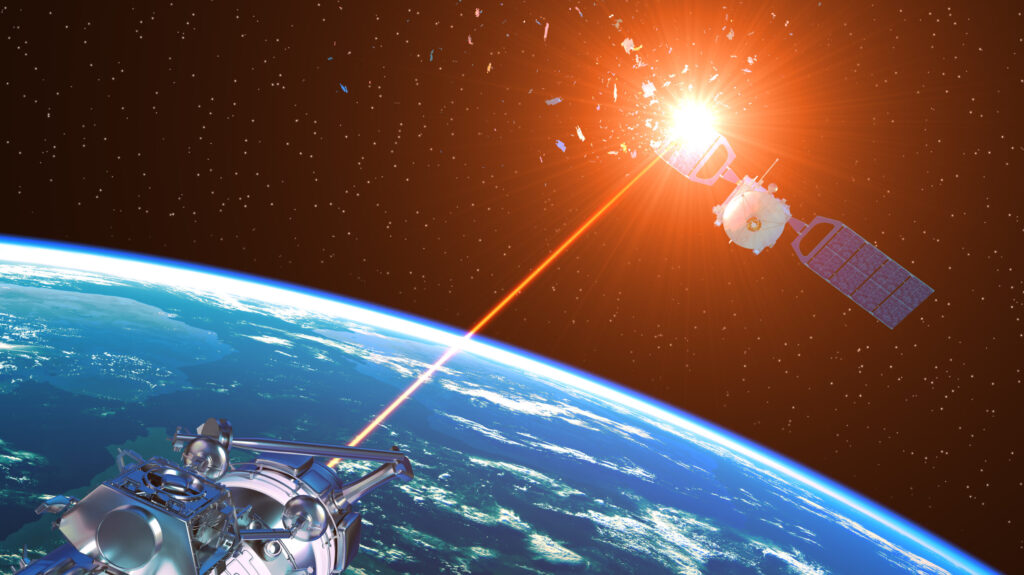
HUNTSVILLE, AL. — As the Pentagon and other militaries around the world rush to deploy large satellite constellations designed to be less susceptible to kinetic attack, US military officials responsible for space operations see laser weapons — on the ground, in the air, at sea and even in space ― as both a future threat and an opportunity.
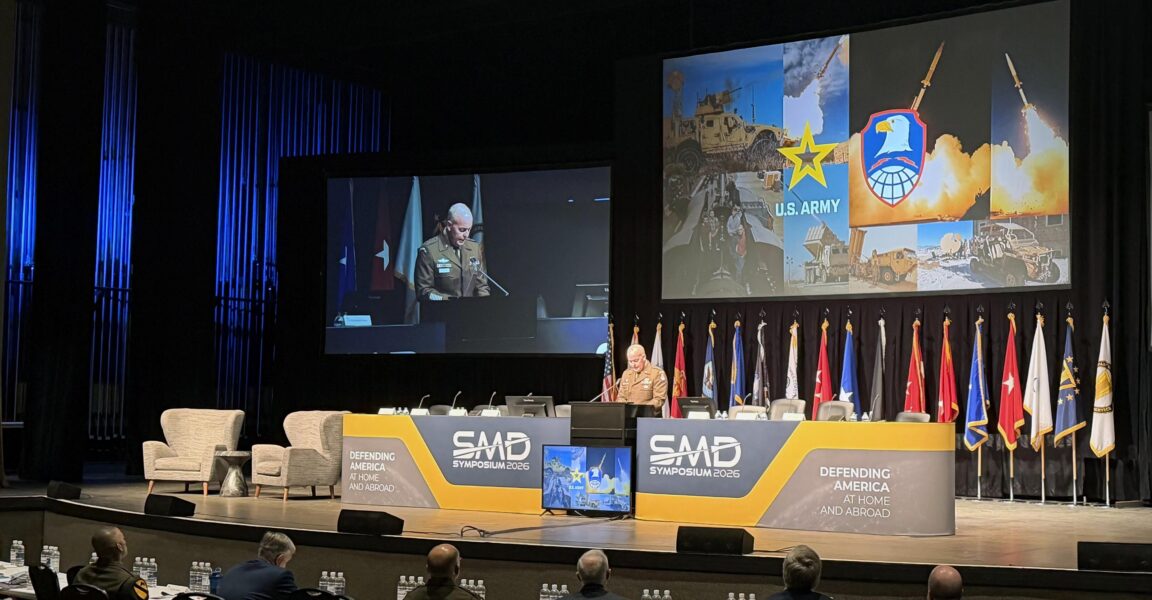
“Surely you’re not going to try and attack with a direct asset ASAT [anti-satellite weapon] 10,000 satellites,” Lt. Gen. Rick Zellmann, deputy commander of US Space Command (SPACECOM), said today.
Instead, he told the annual Army Space and Missile Defense Symposium here, both adversaries and the US military’s “targeting folks” are looking to find “the various nodes where you can get a one-to-many solution” to take down “proliferated constellations.”
Those solutions include cyber and directed-energy weapons, as well as focusing attacks on the limited number of ground systems used by satellite networks, Zellmann said. Directed energy is particularly attractive, he said, because it “doesn’t cost you much for a shot.”
Brig. Gen. Drew Morgan, deputy head of Army Space and Missile Defense Command (SMDC), agreed, telling the symposium that directed-energy weapons provide new “opportunities” for counterspace operations.
“I would emphasize a couple of the items that [SMDC commander Gen. John Rafferty] also had highlighted as opportunities: as Gen. Zelman mentioned, certainly non-kinetic effects and directed-energy [systems] mounted on all types of platforms, from the surface all the way to space and everywhere in between,” he said. “That includes, I think, largely underappreciated, underinvested high-altitude or stratospheric, as we’re referencing it now, platforms and payloads.”
According to a July 2024 brief by the Congressional Research Service, high-energy lasers (HELs) designed to “dazzle” sensors based on the ground, in the air, at sea and in space “might offer lower logistical requirements, lower costs per shot, and—assuming access to a sufficient power supply—deeper magazines compared with traditional munitions.”
But its not just the US who has been exploring the capability. The Space Force over the past couple of years has increasingly been voicing concern about Chinese and Russian development of laser ASAT systems.
“Once upon a time it was the stuff of science fiction: lasers in space so powerful they could blind satellites sending GPS and other signals to earth. Today, directed energy weapons are very real and can be used to damage and degrade equipment and signals. They might take the form of a ground-based directed energy weapon, radiating lasers from to blind or dazzle satellite sensors on orbit, or they could operate from space as a directed energy weapon in orbit,” according to a 2024 Space Systems Command fact sheet.
With regard to cyber weapons, Zellmann noted that already the Navy’s component to SPACECOM integrates cyber and space operations in a way that “is very powerful.”
Rear Adm. Karrey “DeWayne” Sanders, deputy head of Navy Space Command, told the symposium the command has “a unique command structure that integrates and deconflicts both space and cyber effects [that] ensures our three priorities: one being ensured command control; two, about space awareness; and three, non-kinetic effects to support the joint force.”
Sanders added that the Navy sees this integrated approach as “as layering space’s cyber-non-kinetic effects in order for successively to disrupt and degrade the adversary’s kill webs.”
Zellmann said that targeting communications hubs and satellite ground stations is yet another way to cheaply and efficiently disrupt or disable proliferated constellations ― noting that this is “something I think we’re seeing play out in real time in the Middle East.
“[I]f you take a look at a number of our satellite systems today, on orbit you can have 10,000 of them, but they’re all going to come down to a small number of landing sites. And those are all susceptible to those one-way attack systems,” he said.
Thus, Zellmann said, there now needs to some thought put into “how do you diversify or proliferate new ground systems.”
Corrected 08/12/2026 at 1:40 pm ET: The original version of this story provided an incorrect rank for Lt. Gen. Rick Zellmann. It has been updated to reflect the correct rank.
PHOTOS: SMD 2026

 Gallery