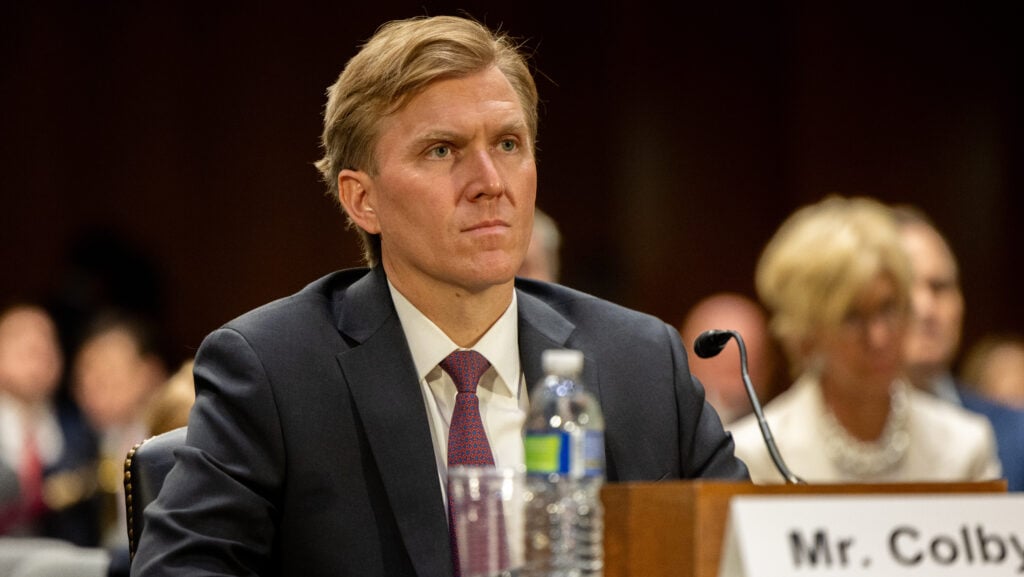
MELBOURNE — The Pentagon’s top policy official said today that the US is happy with ongoing progress on the AUKUS trilateral partnership, with Australia especially moving forward with “energy and focus” on the program.
Speaking at a virtual media briefing during his visit to Southeast Asia, Elbridge Colby also stressed that the US would like to see “middle powers,” such as Japan, continue efforts to indigenize their local defense industries and sharply warned against efforts by some countries to band together to exclude the US.
Colby’s visit to the region began in the Philippines on Aug. 10 and will also take him to Indonesia, Thailand, and Cambodia.
At the outset of his tour, Colby said throughout the trip he “intend[s] to deliver a clear message that is at once both realistic and perhaps bracing but also reassuring: That America’s interests are more engaged than ever in the Indo-Pacific, and that we at the Department of War are concentrated on ensuring those interests are stoutly defended. This means a strong and growing U.S. investment in the region. But it is also coupled with a newfound but common sense expectation of much greater effort and contribution by our allies and partners. “
Today Colby also addressed the recent name change that saw the US Indo-Pacific Command (INDOPACOM) revert to its previous Pacific Command (PACOM) designator, stressing that it was not seeking to undermine the importance of the Indian Ocean and the South Asian countries.
AUKUS: ‘No Better Ally’ Than Australia
Colby, once skeptical of the Australia-UK-US partnership, said today he was “pleased with [its] progress.” The partnership will see Australia operating nuclear submarines delivered by the US as well as the development of a next-generation nuclear-powered sub for the US and the UK.
Colby previously led a review of the program, which unnerved allies at the time, but said today there’s a “very tight discussion and a very clear understanding between the Pentagon and the broader administration and the Australian government.”
“We all know this is a historic endeavor on the part of both countries, but particularly for Australia, and that requires a real sort of level of effort that we see the evidence for,” Colby said in response to an Australian reporter’s question about ongoing progress on US submarine production and AUKUS in general.
On US submarine production, Colby said that the Pentagon remains “very focused on submarine production [and] submarine maintenance,” although he provided no further details on progress on that front.
He also touched on progress on the rotational deployment of nuclear-powered submarines from the US and UK to Australia, which he said was “tremendously important” for both countries and regional security as a whole.
“I think one of the things that we’ve been impressed with our close ally — no better ally, Australia — is that Australia really sees things through the lens of collective defense and a strategy of deterrence by denial designed to sustain a balance of power in this key region,” adding that he saw an “alignment in thinking” between Australia and the US.
A Warning To ‘Middle Powers’: Step Up, But Don’t Exclude US
While in Asia, Colby also pushed back on efforts by some “middle powers” such as Canada who are moving towards banding together with other similar countries to hedge against what they see as a faltering US presence in the region.
He cautioned that these countries “risk wasting a lot of time, effort, resources, et cetera, if they embark on a futile and kind of foolhardy quest.” Instead he cited Japan, Poland and Finland as countries who are considered middle powers yet seek to increase spending and their engagement with the US when it comes to defense.
And he stressed that the US is fine if countries moved away from buying US arms and opting for domestic products — as long as the purchases improved their deterrent or defensive capabilities.
“We actually want middle powers as an empirical category to build up their strength. And we’re also encouraging them to indigenize a lot of their defense industry” Colby said, adding that he understood if these countries felt that buying American weapons was not the best option in some circumstances.
“But let’s make sure it’s designed to strengthen deterrence and defense capabilities as rapidly, as efficiently as possible,” he said. “Don’t use — and there are some countries that are doing this — don’t use your defense industrial dollar as a kind of political or industrial economic strategy for your domestic context.”
Why PACOM, Why Now?
Colby also spoke on the importance of India and the Indian Ocean during the media call, and stressed that the recent renaming of INDOPACOM back to its previous name PACOM was not aimed at “denigrating” India or diminishing the importance of South Asia and the waters around it.
“We really see India as a vital relationship where there’s a natural partnership,” he said, pointing out that several administration officials including Colby himself had visited India in recent months.
“The change back to PACOM has multiple reasons, but I think what I would stress here is that the strategic focus of the United States military is really — and consistent with the National Security Strategy, the National Defense Strategy — is on the first island chain,” he said.
The first island chain refers to the islands and island nations stretching from Russia’s Kamchatka Peninsula down to Peninsular Malaysia that includes the Kuril Islands, Japan, the Ryukyu Islands, Taiwan, the Philippines, and Borneo.
“And so the Pacific element to that is really the focus, the Western Pacific area, obviously stretching into Southeast Asia here. Again, that’s the strategic logic,” he said.