
Europe’s time to shine in space? 2026 preview
Germany is sprinting to pump up its military space systems, perhaps changing the balance of power in setting European-wide priorities.
Germany is sprinting to pump up its military space systems, perhaps changing the balance of power in setting European-wide priorities.

'Unsettled' is a polite word for 2025 in the space domain.

As threats evolve, the winning model ties digital engineering to manufacturing capacity and a reindustrialized supply chain.
ESA's ruling Council of Ministers approved a whopping $25.7B in funds over the next three years — a 32 percent increase over the previous three-year budget.
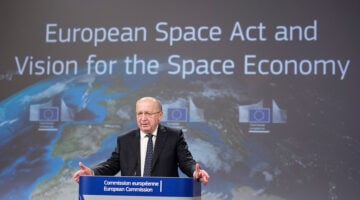
The State Department's damning critique argues that, if enacted, the draft law would imperil cooperation on "space weather, remote sensing, space exploration, spaceflight safety, space debris mitigation and remediation, [and] communications."

Since its founding 50 years ago, the European Space Agency has shunned involvement in military space activities.
"Project Bromo is a sovereignty play," Caleb Henry, research director at Quilty Space, told Breaking Defense.

Partnerships with outside industry are a cornerstone of the kingdom’s ambitious growth strategy.

Germany is not the first European country to join, but as a political and economic center of the continent, Berlin's move could convince several others to follow suit.

"Russia’s illegal invasion of Ukraine has highlighted the importance of a persistent space surveillance capability," said the United Kingdom, as European nations (and Canada) band together.

The concept of solar power satellites, first posited in 1968, seems to be back in fashion — not just in the US with initiatives at DoD and NASA, but around the globe, including in Beijing.