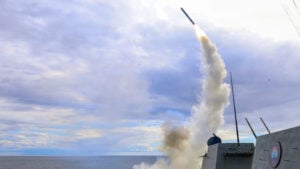
After Epic Fury, a munitions supplemental becomes imperative
The conflict with Iran has incurred a staggering expenditure of ordnance that jeopardizes long-term deterrence and defense goals.
The conflict with Iran has incurred a staggering expenditure of ordnance that jeopardizes long-term deterrence and defense goals.

When the Pentagon stops buying, it doesn’t reflect “demand signal,” but “execution volatility” for smaller suppliers, Rachel Gorken, president of GMS Industrial Supply, writes in this op-ed.


On today’s battlefield, mobility isn’t optional - it’s mission-critical.

A doctrine of air denial leads to stalemates and drawn out conflicts, while air superiority can lead to decisive victory, Lt. Col. Grant "SWAT" Georgulis writes.
The Pentagon’s plan to spend all $152 billion from reconciliation by end of year diverges from its budget request.

America's armed forces already suffers damages and handicaps due to climate change, and recent action is only going to make it worse, writes Will Rogers of Johns Hopkins University.

Focusing on the Coast Guard's development can help the US match countries like China who have already moved on the trend.


Agentic AI helps defense manufacturers speed up production, cut complexity and improve decision-making across global supply chains.

An executive from Textron argues that while new entrants can help the Pentagon, the department needs to remember that experience matters.

Proxies, such as the Houthis, should be heavily considered by the US while measures are taken against Iran.

A unified force in Japan's House of Representatives opens the door for widespread military reform under Prime Minister Sanae Takaichi, writes analyst Ronny Sasmita.

Current policy strongly prohibits the Army from ordering small quantities of spare parts with short notice. That currently acts as an Achilles heel for their Abrams tank fleets.


As global navies adapt to evolving underwater threats, ASELSAN’s integrated sonar, countermeasure, and sonobuoy solutions offer a scalable, future-ready approach.

Columnist Robbin Laird visited a major Marine exercise in December, and left with a few key impressions for the future of the Corps.

The Chinese PLA has gone through wide-scale restructuring in recent years, leading to questions as to why and what the effects may be.

A $600 billion increase to the budget in reconciliation will be needed to get to $1.5T in spending, say a pair of AEI analysts.

For the last 16 years, the US has not had any nuclear nonproliferation policies. Henry Sokolski in this op-ed argues why that needs to change.