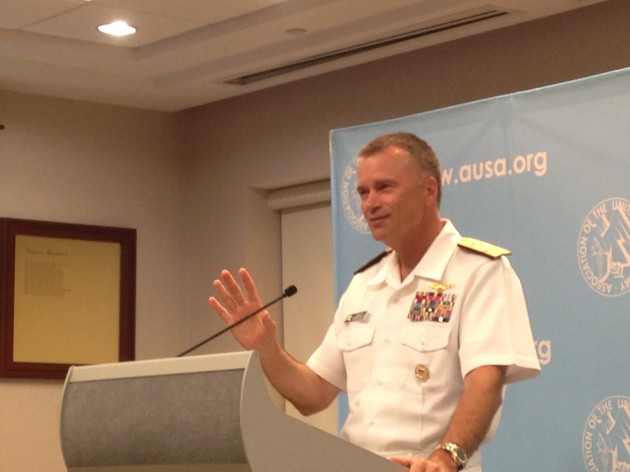
Adm. James "Sandy" Winnefeld, Vice-Chairman of the Joint Chiefs, speaking to the Association of the US Army Thursday night.

Adm. James “Sandy” Winnefeld, Vice-Chairman of the Joint Chiefs, speaking to the Association of the US Army Thursday night.

ARLINGTON: A candid Vice-Chairman of the Joint Staff delivered some tough messages to the Army yesterday and got in a few swipes at Congress and “the political leadership” in general.

Adm. James “Sandy” Winnefeld’s  raised the most hackles among the serving and retired officers gathered at the headquarters of the powerful Association of the US Army Thursday night when Winnefeld said the nation would probably not need an Army sized to do any large-scale, long-duration ground operations. The admiral did not only downplay the possibility of prolonged counterinsurgencies like Afghanistan, Iraq, or Vietnam, although he certainly emphasized the decline of COIN: He raised doubt about long wars of any kind.

“We’ve seen very recently that the American people are very wary of getting into an extended war of any type,” Winnefeld said, in a veiled reference to Syria. “We should take to heart three principles that [Maj. Gen.] Fox Conner imparted to Eisenhower and Marshall when they were both young officers: never fight unless you have to, never fight alone, and never fight for long.”

“I’m talking about a national commitment on a large scale to a long-term combat operation,” Winnefeld said when a skeptical soldier pressed him on the point during the question-and-answer session. “We just don’t see that happening in the near future. But we do need to hedge that bet by keeping enough capacity in case that’s wrong.”

“Marty and I both would say that the nation needs to keep the capacity to defeat another nation on the ground… if nothing more than as a deterrent, but we don’t see that as being a long fight. We can’t afford it,” he went. (“Marty” is Winnefeld’s boss, Chairman of the Joint Chiefs of Staff Gen. Martin Dempsey, an Army man himself).

So what is the Army’s future role in Winnefeld’s vision? “If we get in another fight – and some day we will get in another fight on the ground – I think it would be a different fight: one that’s shorter, faster-paced, and much harder,” Winnefeld said in his opening remarks. “The battlefield will be a more hostile environment than it’s ever been. The fog of war, despite all of our technology, will not clear for us, and the adversary will use the tools we have employed so successfully recently, such as quality ISR and networks and precision guided weapons, against us. We will need ground forces that can handle this.”


“Speed of deployment, whether by being there already or through prepositioning or through lift, will become more important than it’s ever become,” Winnefeld went on. Getting to the war zone quickly, by the way, has been an agonizing issue for the Army since the failure of Task Force Hawk during the Kosovo campaign of 1999. Indeed, even further back, many in the Army remember the desperately vulnerable position of the much-vaunted but lightly-armed 82nd Airborne after it flew to Saudi Arabia in 1990, only to have to wait months for heavy backup to come by sea: For a stinging critique, read the Defense Science Board’s 2006 Summer Study: Search for the words “speed bump.”

Yet Winnefeld said he wanted the Army take on even more rapid-response missions. “I’d like to see the Army place more emphasis on the growth industry… of protecting American citizens abroad,” he said. “Don’t yield that entirely to the Marine Corps.” (The Marines are famed for their role in short-notice Non-Combatant Evacuation Operations, or NEOs, as well as their standard duty of protecting US embassies and consultates).

As for counterinsurgency, Adm. Winnefeld said “we are more likely to see a Desert Storm type of operation, ejecting a nation that has invaded an ally or a friend of the United States, than we are to see another decade-long counterinsurgency campaign.”

“I simply don’t know where the security interests of our nation are threatened enough to cause us to lead a future major, extended COIN campaign,” he continued, “though we very well might provide support to a nation fighting its own COIN campaign, as we continue to do today in Colombia.” (Note that supporting Afghan security forces, whether today or post-2014, was not his example of choice). “The president himself made it clear in his Defense Strategic Guidance that we will retain some capability for COIN, but only on a limited scale.”

But wait a minute, I asked the admiral when he opened the floor to questions. Smaller forces, rapid deployment, short wars, decisive victories, and no getting bogged down on the ground – doesn’t this sound a lot like the “Revolution in Military Affairs” (aka the RMA) that Defense Secretary Donald Rumsfeld so successfully besmirched in Iraq?

“First,” Winnefeld replied, “I’d say that one of the points that we tried to make when we put together the Defense Strategic Guidance was that we were going to try to avoid institutional hubris. [As] Secretary Gates was fond of saying, we hardly ever get this right; and that’s why we’re leaving hedges there. But I still would make the point that we don’t see a situation in the real world where we will have a long counterinsurgency campaign.”

“We believe that the types of conflicts that we would be in would be shorter than 10 or 12 years,” he said, “but, potentially, we experienced four-year wars in the past,” noting that the Civil War lasted 1861-1865 and World War II (for Americans) 1941-1945.

“Our political leadership has it in mind that they will do what they can to avoid a long war,” he added, admitting that we might get drawn into one regardless.

That message did not go down well. “They’re assuming away an awful lot of risk,” one Army officer told me warily when we spoke after the event.

Less irritating to last night’s Army audience was that Winnefeld sounded deeply frustrated with civilian politicians. Asked if sequestration was here to stay, for example, he replied: “It’s the law of the land; we’ve seen no willingness on the part of the political leadership to compromise with one another to make it go away.”

Nor did Winnefeld limit himself to generalities, repeatedly citing Congress as an obstacle to specific military needs. While he began by saying the military “needed help” from the Hill, he made it very clear that help would consist largely of getting out of the Pentagon’s way.

“We’re going to need help from Congress in giving us freedom to maneuver within our own budgets [i.e. by giving the Pentagon reprogramming authority] and by removing the host of restrictions on our ability to be more efficient, “ Winnefeld said, “such as limitations on our downsizing glide slopes in all the services, and prohibitions on base closures, and a mandated pay and benefits growth glide slope that’s out of touch and simply not sustainable.”

It’s well worth noting that the vice-chairman wasn’t criticizing Congress off-the-cuff. Many of his criticisms were in his prepared remarks, made available beforehand, although in his actual remarks he elaborated, often harshly.

“Were you aware that Congress prohibited us from decommissioning ships this year or removing old aircraft from our inventory, or that they’ve placed limits on [Army Chief of Staff Gen.] Ray Odierno’s ability to downsize?” Winnefeld said. “Were you aware that, contrary to the popular narrative, the closure part of the 2005 BRAC [Base Realignment And Closure] only cost us $6 billion and is now saving us almost $4 per year, and we need new closures desperately?”

What’s more, as the Defense Department tries to balance limited funding between the size of the force, modernized equipment, and training, “we’re very worried that we’re going to lose on the readiness piece because it doesn’t have much of a constituency,” Winnefeld said. “If you are a congressman that has an F-15 squadron in your district, you don’t really care if that squadron is flying or not as long as it’s there, OK? And so that is a powerful impeller of keeping force structure at the expense of readiness.”

It was a night for harsh messages delivered in increasingly harsh times.

Comments

  • M&S

    If the Armed Forces would present, publically, a best case and worst case scenario of linked force posture reductions, they would get farther, with the public’s awareness, than they would by bits and pieces approaches to defunding programs and shifting assets which /Congressional leakers/ then report as major losses of capability.

    Be very blunt about it, don’t act like you’re looking for approval and be generalist enough that you can apply Base Force postures that the public can understand as a reduction in X many tank units and Y many personnel rather than brigades/divisions/bases.

    The VCJCS is also very misleading and inappropriate in his can do and can’t do emphasis on high tech campaigns.

    If the Army cannot get to theater with a fully organic force composite (all ops units, combatant and support in a single lift), it isn’t an army, it’s not even a speed bump, it’s a bunch of crossing guards in training.

    How can the Army know what it’s going to be able to lift when there are no hard numbers, East and West coast for how far and how many (days, enemy units, hold or sieze objective sizes, ready APOD/SPOD or highway insert as forced entry) it’s commitments in-theater are going to be?

    A fight in Africa is one thing. A fight in Iran or Syria is another.

    We just delivered the last C-17 but if you want to go high tech you have to be able to put in an OBCT or -at least airbase seizure elements thereof- sufficient to breach the force into the theater. Do we have enough jets? If not, how do we get behind the USAF with a ‘we need this many more airlifters to bring in this many short tons’ as a baseline load, sans the unit plans needed to move _appropriate_ (less than 25 ton) units?

    The Marines know how much this is because they’ve got it all on a lading list to be jammed onto a boat along with the sea and airlift to deposit it across the surf zone once they get to the threat.

    The Army _still_ has no such guidance as assigned lift guarantees.

    The Army needs a warplan based on modular plug’n’play as ton:miles delivery that it knows it can build from to rapidly enter a given theater, completely mounted and hopefully under armor (at least for the LOS combat forces) while doing those things which a given regional Ally cannot, assuming we have any waiting for us.

    This means being a useful mission element without being tied to any particular main force battle plan. I have to tell’ya, that if the ROKs ever get into it with the Norks, we had best stay out of the way. Because the ROKs of today are not the ROKs of 1950.

    But the Norks have nukes.

    At the other end of the scale, there is no need for redundancy in the NEO mission. High Intensity force elements lack the manpower to cover or the transport to an extraction point for nearby sea-basing to grab folks and get them out. See: Eagle Claw for what kind of disaster entails when shooters try to play rescue rangers.

    We have 60,000 SpecWar and 180,000 Marines if we need to do a mission like the oil sites in the deep Libyan Desert or a Liberian evac. Trying to compete with them in one of their key mission arenas is stupid and wasteful.

    The Army needs to stay _Main Force_ capable because that is actually a smaller force structure and one which can be made sufficiently tech-high that it can be useful in sustaining industrial base as training ranges where Maneuver Warfare needs to be practiced _daily_ to be good at. This is the fighter combat on the ground people. You go away from it for a couple days and you spend seven more getting it back because your coordinative sense of things is shot.

    As an element of this, I might suggest that we augment simulators with virtual systems. We don’t have to go all the way back to broomsticks and ‘tank’ painted trucks. But a Wiesel or equivalent, high mobility, low armor fraction, system can mimic an MBT for pennies on the dollar of fuel burn while still delivering the modernday equivalent to MILES based _weapons system_ hits.

    As a function of this, I think the Army also needs, badly, to increase it’s robotics elements, particularly in organic targeting and screening capabilities. DARPA has been working on auto-drive for the better part of a decade until their Crusher is actually a better land navigator than most human drivers, simply because it compares high fidelity digital maps to both GPS and LIDAR based terrain location models to provide navigation without cliff or forest ‘bumping’ as backup.

    Combine this with laser link position sensing between units and you have the makings of a perfect unit formation maneuver system on-par with the best of Army drivers in wheel and refuse coverage.

    Such a system, applied to a light tank which can be carried 10+ per plane load gives you an instant LOS-forward cavalry screen. Which deals with microforces with mortars and autocannon and carries sufficient HVM as son-of-LOSAT/CKEM to at least spoil the movement of an MBT heavy threat force. This is your tripline force which may be part manned (MOUT) but which depends on mobility, NERA, APS and obscurrents to hit and fade when faced with threat overmatch.

    Back these up with an 8-12km secondary capability that can use either 120mm automortar or high pressure main tubes to loft MRM-KE/CE weapons as well as cargo shells with ether brilliant cluster, unitary homing or baseline GPS delivered smart munitions without waiting half an hour for air.

    And finally, for highest value ‘secure or destroy’ threat environments where you cannot force the overrun, reinvent Netfires as Jumper or similar. So that you can take the fight out to at least 25-30km. I would suggest that such a system actually be part of a VLS multifires carrier (module cells which can be subdivided for smaller rounds) as capable of firing throwaway Silent Eye or Finder type ‘1hr’ MAVs and possibly SL-AMRAAM or MALI type interceptors for organic, OTH, low level AD.

    The Army cannot portage ATACMS or MLRS. They cannot even inventory a proper replacement for the Paladin 155 SPH. Nor should they try as the 20,000 T-72s that justified those mass-fires approaches to saturate tactics are long gone.

    But the Army should not abandon ranged fire as an area of influence around the unit. And it must be prepared to SELL that concept by saying:

    “Look, we can take twenty days to move an M1A2SEP-TUSK tank battalion by rail to a boat and by boat to a theater where it mates up with PPME ammunition and donated gas.

    Or….

    We can move a team with double the fires and quadruple the ranged fires, in a single lift, of half the vehicles, the same distance, in three days, by air.”

    The AMAP-ADS is a German Active Protection Suite-

    http://www.youtube.com/watch?v=vTmas41tVhY

    Which was recently (2011) tested at the Redstone Arsenal where it met or exceeded all parameters as a 10m ATR killer and an 2,000m/sec KE defeat mechanism.

    It is light enough to be mounted on trucks like the MRAP or Humvee. NERA is effectively spaced multiplate armor in a resin matrix which bulges and dissipates impact force of both KE and Chemical attack rounds via large, angled or slabsided, boxmounts.

    These two systems alone offer the ability to defeat hits outright. Destabilize inbounds enough that armor is impacted but not compromised (tilting or predetonating rounds, into the dirt) and if need be, sacrificially absorb several hits.

    Which is where the differentiation between a 72 ton MBT with all-round applique and slat armor atop it’s frontal arc protection is exceeded by the no-hit 25 ton (Buford/Thunderbolt as an example) expeditionary tank -if- that light vehicle only treats it’s terminal defense as a last ditch protection and instead employs UAVs to spot for targets which if fires autonomous homing (ex: XM395 or XM1111) rounds at _before the target unit breaches horizon_ for LOS shoot back.

    It is a well known fact that HEAT indexed tube with an APFSDS loaded will ‘leave the range’ at max elevation.

    Add to this that most MBT are not optimized to deliberately look for such a capability (30-40` main tube elevations) which would take a mile per second round even further. Most MBT don’t have autoloaders though this is changing, which means that the ability to sling 120mm rounds into highly depressed -breaches- is limited for a manually loaded system. The XM35 and the XM291 do have autoloaders and would likely be amenable to high elevation breach rammers more so than the existing M256.

    This is an area where updating our own forces to remove a man, shrink the turret and lighten the tank, brings an ability not present in _any other_ MBT force on the planet.

    The key differentiation here is that while any threat state can copy a U.S. single-point technology innovation as force model, none can field full-spectrum equivalent capabilities to that which we possess, innately if not fielded, to our component technical base.

    As an example: while we can defeat an APS equipped threat by shifting to cargo rounds with clusters of SADARM or Skeet EFPs, the threat which has APS mounted cannot make such weapons to defeat our own APS systems because of the high-shock G microelectonics packaging involved.

    Nor can they -find us- using tube launched micro UAVs to look past the horizon (Certainly not without us using the Raytheon CRAM laser to shoot them down…). Nor can they securely network targeting between UAV launcher request and forward fires elements looking to find those targets with upwards of 100km potentially between them.

    It is time to take this step.

    Unit by unit if need be.

    Because such a step allows the Army to shrink as it modernizes, recapitalizing known expertise on a much less expensive force and training model while standing ready to engage high capability threats in places like Asia and if need be, the PacRim.

    It also implies that a high mobility maneuver oriented force is NOT being kitted out for anything ‘dangerous’ (high manning ratio = high billet costs and high political risks to soldier losses) like COIN/OOTW.

    Switching over the USAr rapid deployment model towards a system of light armor insert lets us handle the Iraq mission without permission. Rather than rush to Baghdad from the border, we can do exactly what was done at Bashur in the Option North campaign and go straight for the throat, surrounding the COG and patrolling with more than a couple cargo Humvees over a division sized AOR.

    That we stay interleaved with the followon legacy heavy force construct means that we retain traditional capabilities in case the new model doesn’t work out. We can even modernize the heavies with some of the same (VLS UAV, XM111 CLGM and APS) enablers.

    But it also means that we have some exchange model of 2:1 tradeable force modernization around which to build a budget and particularly with which to go before Congress as “We have the tactical unit design, we just need the ton-lift to get it there. How fast depends on the Air Force’s ability to dedicate lift to us. And the USAF depends on you.”

    If it’s all airlifted, the Congress will listen. Because an air insertable maneuver component is one which doesn’t sit there, useless and helpless, like the 173rd did, strungout over a 10,000m drop spread in the mud. And just as importantly, is also air retrievable. Which means a ground war that’s as easy to unplug as to play.

    METHOD:

    Wet lease a few tanks. Pumas, CV-90s, Wiesel, Scimitar/Scorpion. The XM8s if you can find them. Say four of each so that you can mimic a platoon level unit. By a Jumper or Spike battery and strip out an M113A4 troopbay to stuff an adhoc VLS cell into.

    Buy some robotics steering and throttle setups for a couple all terrain buggies and shoot a couple warheadless Spikes through a flag atop them to simulate fore-and-aft stopping a convoy or hitting a command tank.

    Then send them out deep into the North 40 and see if they can be found. Then see if they can find the threatfor you have moving through an adjacent area.

    Go to whoever has the R&D residuals on the Silent Eye (mortar launched UAV) or Finder (Mini-UAV under Predator) and using a light helicopter like an OH-58 or RQ-8, mimic the sensor footprint and loiter window _from within the maneuver element_ where you are starting from (reaction time and flyout lag).

    If you can afford it, buy a rudimentary ‘Tac Brawler on Tracks’ weapons simulation network that lets you pretend you have functional CLGM and NETFIRES and HVM capabilites as well hyperelevation, autoloading, 120mm mounts and masted sensors, APS and high quality expendable obscurrents for individual units that don’t have any of these.

    And take them all out into the field for a month or three.

    I’m not saying you have to create another 9th LID HTTB. I am saying that you might consider asking the OpFor at the NTC to run up some tactics for them as an ‘elite threatfor’ technical model to use against the best of the conventional heavy armor units passing through a couple training rotations.

    And see what both sides have to say about the light armor firing from over the horizon.

    Finally, get the USAF to do some fast marshalling and remote roadway (reversers not pinned) C-17 shortlands under varying ‘surprise them’ or ‘waiting for us’ scenarios and see how fast and coordinated you can get away from an unsupported vs. infantry secured highway insert without a secure border as logistical pipe at your back.

    Fight a full week using OpFor’s best tactics and without any supplies that can’t be airdropped (fuel bladders and basic ammo/parts) to see how many vehicles you lose to enemy action versus operational (reliability/maintainability) causes.

    Then man up, get a consensus, and go before Congress with enough of a data package to be _convincing_ that “What you see is the video as it was shot in the field”.

    Not Powerpoint Promises.

    I think you would be surprised at the amount of support you might receive, particularly from those Legislators who are looking at major defense job losses in a much reduced budget environment.

    CONCLUSION:

    The only thing better than having an existing unit in a Congressional district which can be declared obsolescent in a heartbeat, is having a fresh unit, just bedding down with new gear as an untried mission capability deemed important enough to get in-production kit.

    Factory Happy. Unit Happy. Congress Happy.

    Forces smaller, more lethal, more deployable, less compatible with ‘Long War Strategies’.

  • Shozbot

    Have a problem with the VJCS. The BRAC was approved by Congress after the military put recommendations together with the Commission. Seems the military did a poor job if they are only saving $4. So why do another BRAC if the cost is more than the savings? Also, the VJCS sounds more like the White House Press Secretary than the second highest ranking member of the Joint Chiefs. The whole pivot to the Pacific looks to the public like a cut and run from the insolvable problems of the Middle East. Ignore it and it will go away is not a good foreign or strategic policy as evidenced by recent Egypt, Libya and Syria problems.

    • Johnrambo1

      How do you “cut and run” from an insolvable problem?

  • george

    Lets invent a name for this – Blitz Krieg. That sounds good.

  • Johnrambo1

    DEFUND PETMAN AND ATLAS.

  • Gov

    France and Austria would not allow Task Force Hawk to deploy through their airspace and was more a failure of diplomacy than military capability. During Desert Storm it took the air campaign over a month to destroy over 500 combat vehicles; the ground campaign destroyed almost 3 times that in a 100 hours. You cannot establish security on the ground with air or naval forces for diplomacy and whole of government effort to project/protect our national interests. This is Task Force Smith-like shortsightedness

    • Landsnark

      Task Force Smith was the first thing that popped into my mind. This is just further evidence that our military senior leaders are strategic failures. Our enemies will fight us when and where they think they can win. Would they rather take on a well supplies navy and air force or an underfunded army that isn’t capable of conducting long term ground conflict. I do find it funny how the admiral stated that we would only need a short term force (hmm, is that what the marine corps does?). Thank heavens that we only fight wars that our political leadership wants to fight because it would be awful if we had to fight on our enemies terms and they didn’t get the memo that we can only fight for a few hours because our mom wants us home for dinner.

    • M&S

      Task Force Smith happened because an infantry unit with limited armor and artillery in direct fire mode was set as a block force to a superior (technically and numericaly) armor force along a predictable choke lane with limited opportunities for cover or secondary flank engagement.
      We lost the battle but won the right to go to war which was all that TF Smith could and likely was intended to achieve to begin with.
      Desert Storm happened in an early PGM era with no through-weather bombing capability and limited availability of targeting pods as sophisticated BAI capable aircraft as well as limited on-ground SpecWar to call and clear area targets.
      Aside from the fact that we will be highly unlikely to face another Saddam Hussein (as a dictator backed by both east and west using the power of oil to sustain an -enormous- war debt in tank inventory) the true threat at the moment is that the GBU-53 is a lousy standin for the JCM/JAGM while threat states have basically acknowledged that they cannot defend against airpower by shooting down the archer but they -can- kill the arrow with APS.
      Sooner or later those APS will become Laser Driven and the lasers will scale to the point where anything that isn’t armored and -is- exposed to half the country below it, will be vulnerable.
      OIF/OEF was a war because we refused to make it a police action. Make the people utterly dependent on you for decent food in trade for a national ID system that says where they live upon pain of losing their homes if they lie.
      Use biometrics cameras in huge densities so that it’s impossible to attack a camera without being seen by another camera, even using gunfire (Boomerang). Upon pain of death for monkeying with a camera.
      Force every state that sends a shahid to the country on their passport to hold a 1 million dollar insurance policy for every person hurt or killed. Upon pain of losing trade privileges.
      And keep the U.S. military governancy in place for 5-6 years so that daily pickups, short trials and televised firing squads can make it clear that if you mess with Uncle, he will end your miserable existence, squalid as it is.
      Because then it’s no longer a game. No longer about coup psychology with primitive minds. Then it’s about law enforcement.
      We should not use historical case points for future condition force structure justification unless we _REALLY KNOW_ what the operative parameters for the engagements as conflicts were and whether they still apply today.

  • Araya

    Pleas not again, sorry but this s the same bullshit what the US-Army has seek with is FCS Program how has become a historical disaster. The truth is what the War in Iraq has manly lasted so many time because of the idiotic FCS doctrine thousands died and then thousands crippled because of a lack of Armor Protection, Firepower and mostly because of the lack of troops one the Ground. Desert Storm the Operation how become the US Version of a “Blitzkrieg” has took nearly 1 Million (about 960.000) Soldiers one the Ground to be successfully with just 454 deaths one the side of the coalition force against a much stronger Iraq Army them the Army what the coalition has face 2003. With other Words for fast, effective and low losses Victories you need a big Army with massive firepower and not a FCS like Army. What Winnefeld say is the same bullshit what Rumsfeld and is FCS Nerds have done and lead to the disaster in Iraq. Ironically the Iraq War become at last a success as Rumsfeld and is FCS doctrine (small force, highly mobile, low Fire Power a lot of unusual Computer technique) was gone and the “surge” started. The truth is what the USA has never planned to fight 12 Years in Afghanistan or 8 Years in Iraq they have planned for fast Wars. But like gates has said the USA has an impressive record in predicting the next War they were always wrong! The reality is what all this Comments what people like Winnefeld deliver are just political comments in order to defend the indefensible political agenda of the Obama Administration how cut the military since they took the office deeper and deeper. With other Words they didn’t have the money to fight real Wars (how are more and more likely) so they decide what this big Wars will never occur and this way of thinking is simply bullshit what didn’t work in the real World !

    The reality is what the USA need a lot more Money to fix the damage what the peace dividend under the Clinton Administration and the FCS Disasters under the Bush Jr. has already done and the reality is also the evident fact what the actual Administration has no willing to fund the DOD sufficiently to meet with the threats of the real World so they create a fictional environment what correspond to their
    idiology.The actual Administration is so weak what they are completely incompetent
    even to deal with the gnome Assad in Syria! The next War will come and it will
    be not the War for what the USA will be prepared to fight.

    • bobsomm@aol.com

      Araya
      You are dead on!!
      I was retired but called in as a SME for FCS.
      I was constantly appalled with the ironic approaches we were forced to use. The Army failed for over 30 years to make a modern force and then tasked SAIC and BOEING to manage FCS. But in meetings it was clear that the Army’s PO reprexntatives were forcing, or so it seemed, forcing the contractors to use the ARMY methods and it was a disaster. I saw people from the Army who failed for 30 years to provide economical hard hitting technologies, override common sense and appied the failed concepts to steer the FCS contractors into activities destined to fail. When I saw them make HWMMVs into Stretched vehicles because the equipment could not be carried in a traditional HWMMV I complained against deaf ears. That argument was that the Army Brass would appriciate seeing the equipment run in what sort of looked like a HWMMV.. ARGGG
      We sculpted our program requirements to forbid any products to weigh over 19 tons because that is the max capacity of C-130s. So, we tried to stay within SWAP to accommodate an aircraft that had been flying over 50 years. That’s a problem … we really do need to have something that can use short fields and haul more than a C-130.

      I am now rambling. Sorry bout that. But the failure was destined to happen but they continued with the Army leading the charge to failure. Peace bob

  • armyduck

    hat
    is a lot of serious smack talk from a guy whose Service has spent the
    last decade chasing pirates in 3rd world skiffs, and twice been the
    post-tsunami bed and breakfast and HAZMAT team for the rest of the
    world… not to mention I think their last few major naval actions
    include ramming undersea mountains, being decisively defeated by a
    Filipino Reef and using the USS Greenville to sink a Japanese fishery
    training vessel filled with high school students.

    • Warrior07

      Actually, The “Japanese Training vessel was in an exclusion zone set up for the USS Greeneville (SSN-772) to conduct emergency assents. It was a sad event however the Japanese skipper was really at fault. However, ….

  • armyduck

    The Civil War and WWII were “short” wars? Okay – maybe US major military actions ended in 4-5 years, then how long was the occupation, stability,reconstruction, COIN, and continued presence of major ground forces after the end of major military combat? The bottom line is that almost always – when ever the US commits to a land war – it is committing to a long term ground operation- the initial phases may be decisive even, but then there is the Phase IV aspect and what to do with the big win?

  • D-mann

    Like most Americans, I hope we are not in more 10-12 years wars in the near future. Although I’m not sure there is really a huge public wariness against the military participation in Iraq and Afghanistan. More like apathy. Nonetheless, the Admiral fails to address the real issue…how do American wars end? That’s the part that the U.S. civ-mil leadership have not figured out. Yes, we can go in and quickly and decisively kick out another land force that has invaded a neighbor but then what? How do we consolidate victory, transition back to civilian control, and ensure that the political issues that were the cause of the dispute are reconciled? Whether it’s regime change or coming to the aid of an ally, you still have to plan for and be able to execute the transition. And depending on the type and length of the “ground war,” this transition can be difficult and time consuming. Our American military is great at the tactical fight on the ground, but we must have clear political/strategic objectives from our civilian leaders that can be linked to our operational/tactical actions.

  • Don Bacon

    Excellent. World class. (I read it carefully.)

    Winnefeld sounded deeply frustrated with civilian politicians.

    That’s because military officers are supposedly so much more capable of making important decisions than the peoples’ representatives, and democracy shouldn’t get in their way, Winnefeld thinks. But he’s wrong.

    There’s absolutely no need for a large US ground force, None. Yet the plan is to go from 541,000 to 490,000 soldiers by 2017. Big deal. That’s an example of why we should be deeply frustrated with military officers making important decisions about national security.

  • an army guy

    what do you really expect from a navy guy?

  • popsiq

    The civil war and World War two were maximum efforts. The recent set, and before that the Vietnam adventure, were fought as sideshows to the far more important home front activities – societal change and, latterly, shopping.

    That one can gallop off for a conquest and wind up doing a dirty long slog has happened to America more than the short sharp thrust to victory type of wars, particularly when the end-state is not defined. Enduring and Iraqi Freedoms, like the conquest of the Philippines in 1898, were cakewalks. … until somebody upset the locals then …. resistance, bleeding ulcers and a cumulative loss.

  • Serge Krieger

    Meaning is. Always fight Third world powers and goat herders. Never fight major powers like China or Russia. One cannot have quick and decisive win against those.
    He is being frank. US cannot win war against major power.