Army photo

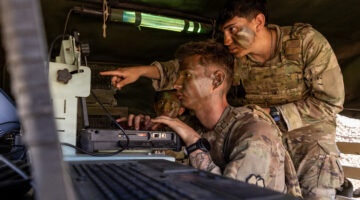
Japan Ground Self-Defense Forces soldier.

WASHINGTON: How can we deter — or, in the last resort, defeat — a more assertive China? Air and naval forces may not be enough. While the US Army is ambivalent, the Japanese army may have some lessons for their ground force counterparts in America.

“They’re not standing around waiting for us to do something,” Andrew Krepinevich, head of the Center for Strategic and Budgetary Assessments, told me after his latest trip to Asia. “Japan wanted to do its part in defending the northern sector of the ‘First Island Chain'” — a long arc running from the Japanese home islands down through Taiwan and the Philippines into Indonesia. “They are building a series of facilities along the Ryukyu island chain to discourage Chinese acts of aggression and coercion,” he said. “It was very impressive.”

In particular, the effort by the Japan Ground Self-Defense Force aligns with a concept Krepinevich laid out in  in a February Foreign Affairs article on “archipelagic defense.”

Andrew Krepinevich

Andrew Krepinevich

“Rather than risk sending warships within range of PLA defenses,” Krepinevich wrote, “the United States and its allies could rely on ground forces, based along the first island chain and armed with mobile launchers and anti-ship cruise missiles,” as well as anti-aircraft missiles and missile defenses. In Krepinevich’s concept, Navy ships and long-range Air Force bombers would form a mobile reserve behind the land defenses, reinforcing threatened points and stopping Chinese breakthroughs. The fleet itself, however, would stay on the far side of island chain from China.

In the Western Pacific, Krepinevich told me, “one of the big advantages we have is — unlike many of our other recent military operations, where we’re projecting power — in this case we’re merely trying to defend our allies. It’s the Chinese who have to come out.”

In short, we don’t have to take the war to the enemy or destroy them: We just have to keep them from successfully taking the war to and destroying us. By contrast, advancing US ships and aircraft into easy missile range of the Chinese homeland would be a very expensive way to lose.

That message isn’t easy for the US military to hear. We’ve not had to play defense since the Cold War. Once the Soviet war machine collapsed, the US focused on power projection: aircraft carriers, strike fighters, rapidly deployable ground forces and the like. Going into other people’s airspace, waters, and territory to destroy targets is what we do. The Army in particular, under intense pressure to reinvent itself for the post-Afghanistan era, would rather tout its agile expeditionary forces than its ability to dig in and hold islands.

Digging in and holding islands, however, is hardly counter-cultural for the Japanese armed forces, as veterans of Iwo Jima would attest. Nor is a defensive strategy anathema for Japanese policymakers, whose post-1945 political culture is deeply pacifistic.

In his Foreign Affairs article, Krepinevich had already noted with approval Japanese wargames that put shore-based anti-ship cruise missile units in the Ryukyus. When he visited this summer, he found they had gone farther. “I was invited to visit the commander of the Western Army and his staff,” Krepinevich told me. “He was excited because he believes they are implementing what the article was talking about in terms of ground forces.”

The Japanese are deploying air and missile defense batteries to the islands to protect against Chinese strikes. They are deploying shore-based anti-ship missiles to keep Chinese ships at bay. They are training to lay minefields offshore. And they are working with the US Marine Corps to develop an amphibious brigade that could seize or reinforce embattled islands.

Krepinevich cautioned against relying on amphibious units as a mobile reserve, however. In an “anti-access/area denial” (A2/AD) environment dominated by precision missiles, he said, “it’s going to be difficult to maneuver troops. They’ll be going across no man’s land.”

Instead, he argued, in many cases the best reinforcements may be long-range missiles. The geometry of the Western Pacific is such that if one fortified island is being overwhelmed, other islands along the defense line can fire their long-range weapons in its defense. It’s a massively upscaled version of the machinegun nests whose interlocking fields of fire made First World War trenchlines nigh-unbreakable.

An "archipelagic defense" in the West Pacific (CSBA graphic)

An “archipelagic defense” in the West Pacific (CSBA graphic)

How far can missiles reach? “We’re of course limited by the INF [Intermediate Nuclear Forces] treaty, but we could still go up to over 300 miles — 500 kilometers is the limit,” said Krepinevich. “300 miles gives you a lot of ability to maneuver fires instead of forces, to concentrate fires instead of physically concentrating units and troops, and that can be a way to help protect a threatened point.”

Even with long-range missiles, however, Japan can’t cover the whole threat zone by itself. “The Japanese I spoke to were thinking of a division of labor,” Krepinevich said, “where they took primarily responsibility in the northern sector of the First Island Chain and we took primary responsibility in the southern sector.” While advanced and prosperous US allies like Japan, Korea, and (unofficially) Taiwan can anchor the north end of the line, poorer countries like the Philippines can’t hold the southern end without extensive help from US forces.

The US Army doesn’t have all the weapons systems it needs to execute these tactics, however, particularly anti-ship missiles capable of being launched from shore. But it could buy them from Japan or other allies — if the Army decides it wants them.

Right now, the service is unsure. “The Army’s under a lot of pressure right now as the service that’s being asked to sacrifice the most in the drawdown,” Krepinevich said, and it has obligations not only in the Western Pacific but in the Middle East and in Europe.” While both the House and Senate Armed Services committees want the Army to look into shore-based anti-ship weapons, he went on, “it hasn’t really been directed by senior Pentagon civilian policy-makers to figure out how ground forces can help defend the First Island Chain.”

“Finally, you’re talking about upsetting several dominant subcultures in the Army,” Krepinevich said. “Archipelagic defense is not built around brigade combat teams.” The Japanese are downsizing their conventional ground combat units to free up resources for their new coastal defenses. Given limited budgets, the Army would face the same choice. With the service still struggling to implement the last round of cuts and bracing for another, finding money for anything new is hard.

Comments

  • ycplum

    From an Army guys perspective, use the islands as entrenched infantry to blunt the enemy’s attack and keep the ship (aka armored cavalry) in reserve as the maneuver group.

  • Zhuubaajie

    Japan is not a China problem. Abe is doing very well stirring up illwill in many neighbors.

    Key terms: Proxy war; Kim III; lob-one-get-two free (blow-forward only weapons, of course); concentration of Japanese industry between Kinki and TMA (Tokyo Metropolitan).

    Japan totally lacks strategic depth. The “war” will be over within hours, with all Japanese ports and 90% of Japanese industry wiped out by then, there is nothing to fight over.

    Kim wouldn’t dare? You’d be surprised. Plus what does he have to lose? He would end up with twice the number of nukes, and also a protected retirement with a huge stash of spendable cash.

    • jeffrey exposito

      If I were a betting man between China though a much larger force and Japan a smaller but more technologically advanced force Id bet the farm that Japan would be able to inflict a very nasty and bloody nose on China and repel an attack sufficiently long enough to allow reinforcements from the US to unstill the final coup de gras. The Japanese have a rich naval heritage and their navy is among the most advanced in the world and they know how to fight a modern style point defense war. China has no experience whatsover in fighting a modern high tech war or any deep naval heritage like the US Navy or the Jaoanese navy. Your characterization that China would walk over Japan is pure fantasy and wishful thinking. The US would never allow China to defeat a major ally like Japan. The US is bound by treary to defend Japan. And theres no question the US alone has the capacity to send the Chinese navy to the bottom of the ocean.

      • Zhuubaajie

        Did you even read?

        As the Chairman said, you fight your way, we’ll fight our way. Japan is not for China to fight. It is too much of a strategic midget to be worth dirtying the hands. Thanks to the dictate of the American occupying force, post war Japanese industry is concentrated in the narrow corridor (100 km wide) between Kinki and TMA (Tokyo Metropolitan). Kim III’s existing nukes would be sufficient to take all of that out, including all the ports.

        That would fundamentally change the strategic picture in Asia. Take for instance Australia – who are they then going to sell their dirt to? America?

        • jeffrey exposito

          The SM3 Block 2A missile on American and Japanese Aegis ships is perfectly capable of knocking out North Koreas ballistic missile. You have no clue what you are talking about. The use of or the attempted use of nuclear weapons by NK would be utter suicide and result in destruction of NK. NK will not.launch ballistic missiles at Japan. Even if it did none would reach the mainland.

          • Secundius

            @ jeffrey exposito.

            Block IIA or IIIA?

          • Zhuubaajie

            That might be true with NK made missiles. WHO the hell is talking about Dae Pudong firecrackers??

            Blow-forward only munitions are the top of the line, including Mach 10 maneuverable ultrasonic gliders. In the hand of the proxy there is multiplier effect. There is no know defense against that yet.

      • Ztev Konrad

        Plus the territory favours Japan as the island chain from Taiwan through Ryukyus to the home islands. There are a few islets and reefs where the ROC, China and Japan are in dispute. Known in english as Pinnacle Is. It will be one of those places they will never agree but wont go to war over

      • Jeepslave

        OBAMA

        • Secundius

          Jeepslave.

          What about him? So far he’s done pretty good despite Congress’s meddling…

          • Jeepslave

            Yes he’s done a pretty good job of undermining our allies like Egypt and Israel. His lack of resolve inCrimea,Iraq,Afghanistan, Libya, Syria and on a whole all of the Middle East.
            His leadership or lack thereof.
            His leading from behind strategy has done nothing but in bolden our enemies and made the world a much more dangerous place to live. It will be future generations that clean up the damage one man has made. I only hope we can find someone Great to be the leader of the free world and not just someone whose best is only pretty good.

          • On Dre

            You forgot how Barack HUSSIAN Obama forged the Apollo moon landings. Dang you Obama!

          • Jeepslave

            I also forgot the cancellation of the Space Shuttle and the Russian rockets re supplying the Space Station because we have no ability to do so.
            He’s my hero

          • John Allard

            The red line speech was a bloody disaster. It was like threatning a misbehaving child with punishment, and when the child continues, you do nothing. If your plan is to do nothing, then don’t tell everyone something opposite.

            That was very, Very damaging to the credibility of the United States. Basically, we make empty threats now.

      • fuzzball

        China has internal problems it has to worry about. If it gets into a war with Japan, Tibet might make trouble, the Muslims almost certainly would, and Taiwan and Hong Kong could see this as a means to show more independence.

    • Chernenko

      You are forgetting JMSDF has BMD equipped vessels, and the JGDF have pac 3 patriots. Not to the U.S. a Navy’s BMD equipped ships in 7th Fleet. Furthermore any attack on Japan is an attack on the US. Kim would suffer the same fate as Saddam pulled out of a rabbit hole, then hung by his own people.

  • Zhuubaajie

    The newest unmanned attacked craft offered by China on the international market has a range of 4,000 km. Add on to that the range of the cruise missiles (e.g., the Long Sword with a range of 2,500 km), where is the strike force going to base itself? Hawaii?

    • VelvetMark

      China has a bad record with reverse engineering stolen technology. Look at their bullet trains that crash and kill their own people. Nothing to see here.

  • Mina

    With the U.S. cuts in the military countries like Japan have no choice really but too beef up its own forces. Doing that when you’re deep in debt, your economy is sluggish at best, and your population is shrinking might be a unattainable goal. Not going to happen without the population willing to sacrifice. Cutting your infantry to pay for coastal defences? Didn’t the French count on a defence line they built before WW1? Didn’t work out all that well for the French if I remember.

    • Ztev Konrad

      A French defence before WW1 ? They had a mystical belief in the french infantry and were going to recapture Alsace-Lorraine. A german attack through belgium wasnt considered possible as that would draw in the british!

    • Secundius

      @ Mina.

      I think your, thinking of Verdun. The Fortress town built in the 1850’s or 1860’s and Fortified in 1870-1871. During the Franco-Prussian War of the same year. And later used to Stonewall, Imperial German General Ludendorff’s 1.35-million Imperial German Army Steamroller Push through France in 1914…

  • Mina

    No they built a series of fortresses in northern France. Starts with m. I’m going to goggle

  • Mina

    Maginot Line

    • John Allard

      The Maginot line was fine, given why Framce built it too, it makes sense. No the real folly of the French was in failure of imagination in many ways.

      They failed to appreciate the internal combustion engine properly, France had more tanks and of superior design than Germany, so did the British, in June of 1940. What the Allies did wrong was the never created anything similar to Germany all tank panzer divisions.
      France also never woke up to the Ardennes region as being as invasion corridor. They wrongfully considered it impassable by large Armies.

      They French Army was ready to fight World War 1 2.0, not this new rapidly loving highly mobile war. They were just too slow. Had the French been faster in stopping Guderian, that war would’ve gone very, very differently.

      • Mina

        The Maginpt Line was built before ww1. The Germans went around it and thru it during ww1. The line was mostly abandoned by Ww2. The French counted on a treaty and keeping Germany weak economically by making them pay for war damage. Hitler rose to power because of how bad the economy got. He ignored the treaty and started rebuilding the military

  • Mina

    The thing is in the end if your enemy thinks your weak they will eventually attack. Greed wins every time

  • Vincent J.

    Does China have neutron bombs? One neutron bomb on one cruise missile exploded over one of those little atoll bases that people are putting out there these days means one atoll base destroyed. I hope 7th Fleet has this sort of attack planned and ready to go as soon as we have a president with clarity of vision.

    • Zhuubaajie

      Whatever bombs America has, China does too.

      The WU-14 Mach 10 gliders can be fitted with whatever warheads necessary.

      Clarity of vision is that MAD assures no direct military conflict between the two nuclear states. Wars will be fought by proxy, such as Kim III’s lob-one-get-two-free program. When Japan’s production capacities are wiped in the early few days of such a proxy war, the strategic picture in Asia totally changes, as China would be the only major importer left.

      • John Allard

        As you yourself stated, whatever bombs they got, we got. So why then would no one strike China’s infrastructure? Japan is just going to lay down and take it??

        • Zhuubaajie

          Like the Japanese being born short in stature, there’s not much you can do about it. Japan is so small geographically, a Kim III proxy attack would take all of a couple of hours to finish Japan off. There’s no need to lie down when you are dead.

        • afkbrb

          You’d have to launch 15 tactical nukes to hurt China a bit. It takes 2 to completely devastate all of japan. China has a biillion people scattered across a landmass greater than America. It’s equivalent to saying hawaii has a chance against the U.S. mainland.

          • VelvetMark

            If China even launched one nuke they would be finished either by military means or economic. China would not do that.

    • John Allard

      Yeah they do, its called nuclear weapons. If China does that, they’d be entering into a nuclear confrontation with the United States.

      • Vincent J.

        A neutron bomb is a particular kind of nuclear weapon. The warhead is wrapped in cobalt, which emits massive numbers of neutrons when the core fissions. The neutrons kill all people and animals, but leave the target largely undamaged. The radiation clears in about five hours, then the guys who fired the neutron bomb can send in the troops to bury the bodies and occupy the city / atoll.

        • David Flandry

          And you think the U.S. is going sit by while China attacks an ally with nuclear weapons because?

          • Vincent J.

            Hunh? I never said that. Why should I defend it?

  • Mina

    Coastal defences are useless unless you have a seriously strong military behind it. And let’s be fair, you need leadership that is capable and up to the task. Lee was good but Grant was better. You find this reality throughout history. America had clout with a strong military and a political leadership that followed words with action. You don’t make threats and than fail to follow thru. No one takes you seriously if your all mouth.

  • Tim

    I would tell Japan not to bite off more than it can chew.

    • John Allard

      Japan did ok last time against the Chinese, and they have one of the best navies on the planet. Not as toothless as you imply.

      • guest

        Fools like you (plenty around) can’t wait to bare your big teeth !
        Wait till the Chinese loose off a fusillade of rockets at Fukushima AND then we will see exactly how ok you fools would be in the aftermath.big

      • David Flandry

        I agree. Japan would be no pushover. Their navy is bigger and more modern than the Royal Navy, with very advanced and quiet subs, destroyers, mine warfare ships. They are well aware of China’s capabilities and their own.

      • afkbrb

        You know that China in the past is not the same sick country it was. Now, everyone knows that China could obliterate the tiny island with sheer force. China is going to take back its pre-war territories like the diayu islands etc regardless of whatever international laws or treaties there are. Those belonged to their motherland from ancient times and they are taking it back regardless of propriety and what other countries think. They own the worlds debt and the U.S. will not defend Japan like you think they will. Their military is a fraction of what China has built in the last 15 years. China spends 3 times what japan does on military expenditures and research and development. They have hacked the israeli iron dome technology and have hacked the U.S. for its R&D as well. China is obviously not going to use this information for imperialism or attack, but for a strong strong defense. They control the internet traffic in their own country and can essential overwhelm any countries cyber security with their great wall or great cannon internet tools. Note, China is the only nation that has not invaded other countries in her existence. She has only been the recipient of war and will never allow itself to be in that position ever again. They’re building vertical industries to slowly decrease reliance on other countries and are now limiting Japans access to rare earth metals and will starve out their tech economy as they increase their own. That small island with little to no natural resources, can never compete with a goliath economy, military, and resource landmass.

        Why talk about war? It would be utter destruction. All the world leaders know this and thats why they won’t “bare teeth” at the new big dog. It would be economic death.

  • Marcus Aurelius

    WW2 Japaneses murdered 18 million people.

    US Command responsibility is as old as war. So is guilt for murder done or murder ordered. The US is mostly to blame for the Japanese failure to deal with its past. They prevented that the Emperor was charged for his role in the war. The US stupidity also prevented an Japanese attempt to establish its own court after the war to deal with those responsible for the war.

  • John Allard

    The author failed to take note of the fact that the U.S. Army IS investing in the arena. That’s why they recently reactivated the old Coastal Artillery units.

    The Pacific is to America what the Atlantic was to Europe, or to what the Mediterranean was to the classical world. If China thinks they can push us half way out of it without a hick up, then for all their sudelty they have no wisdom.

    • Guest

      Don’t flaunt your so-called great great pro-jap ‘wisdom’ here, please. Japan was once a very highly terrible predator and today, it has lost none of this instinct / past behavior.
      In WW2, Japan’s war in China was essentially a battle between the weapons of the Jap military and the blood of the Chinese populace. See the ‘Kweilin Incident.’
      The son of the former commander of the Pacific fleet (Adm James Otto Richardson) was burned alive with gasoline by Japan simply in retaliation for a US air raid. Thanks for your wisdom.

      • Common sense

        Not sure what to make of your comment, its nothing really in relevance to the original comment? Have no clue what your trying to say?

  • Paralus

    THAAD/Patriot/NASAMs 2 batteries, ATACMs with submunitions, OTS truck-mobile anti-shipping missiles available from Taiwan or Japan, all wrapped in a BCT sized unit that can deploy via C17 and C130.

    The other side of the coin is that the islands become difficult to defend once they are isolated. or think of all the French outposts in Vietnam that were surrounded and pounded by Vietminh artillery.

  • David Flandry

    One of the Great Myths is about the Maginot Line. It worked fine. As many have stated the Germans went around it. That’s because when France got to the Belgian border, wishful thinking set in. They assumed (hoped and prayed) that the Belgians and the Ardennes would slow down the Germans to give France time to set up a defense and counter-attack.

  • Mina

    If it worked fine it would have stopped the Germans. It didn’t Other factors came to play causing WWl becoming a vicious trench warfare on the western front. I guess the point I’m trying to make is,; for a defensive strategy to work you need a strong offivive strategy. Your enemy has to be afraid of the consequences of attacking you.

  • George Orwell

    The problem is the current Prime Minister of Australia Tony Abbott.

    He is basically lying down in front of China. He has granted or been bribed to give them carte blanche Australian food suppy chains, land, mines in the middle of prime agricultural land SHENHUA

    This means that Chinas first victory will be Australia.

    The first thing the US needs to do is REGIME CHANGE IN AUSTRALIA.