NATO photo

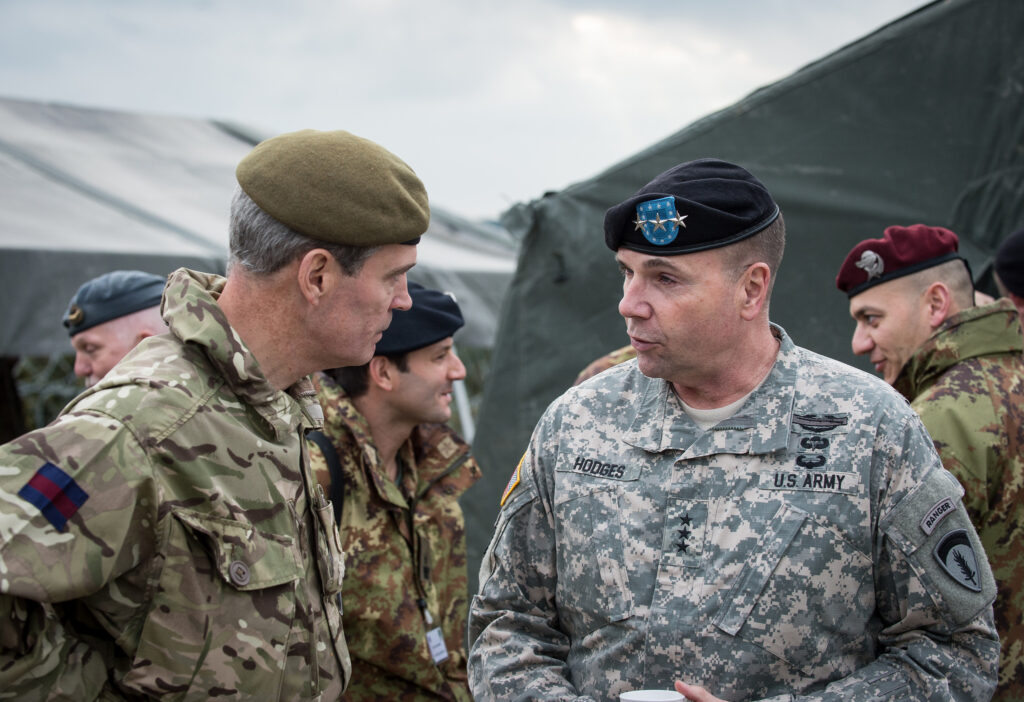
Lt. Gen. Ben Hodges talks to a British general during a NATO exercise.

RESTON, VA: US command and control networks take too long to link to allies and respond to Russia’s rapid-fire aggression. In Ukraine, “we’ve had at least two, maybe three of these cycles [already, where] they’ll back off, and there’ll be a long kind of quiet period, and then they’ll spike back up,” Lt. Gen. Ben Hodges the Army’s top commander in Europe tells me. The Russians could re-escalate quickly in Ukraine — or anywhere along an arc from the Arctic to the Baltic to the Black Sea.

That requires the US to respond with a degree of rapidity, flexibility, and intimate cooperation with allies that exceeds anything required in the Cold War, or even in Afghanistan or Iraq, Hodges says. Young US Army soldiers and officers are rising magnificently to that challenge in 51 Atlantic Resolve exercises with allies this year, he said. Their information technology? Not so much.

“This is about speed, to give our political leaders options,” Hodges told me in a recent interview. If the Russians move, “things are going to happen fast,” he said. “We’re not going to have six months to get ready…and then deploy into Latvia. It’s going to be come as you are, plug and play.”

There are three missing pieces, Hodges said:

  1. Secure FM radios so US troops can talk securely and to allies without being jammed;
  2. Shared data that allows troops to see a common operating picture (COP), so that US and allied commanders see the same situation on their screens.
  3. Secure digital networks to call in artillery fire by linking human observers and radars to the guns themselves.

“Right now we do not have, universally, any of those three,” Hodges said. Some of the key decisions are well above a three-star general’s paygrade, he added: “There’s policy decisions to be made [and decisions] in the acquisition process.” For example, Harris makes a “great radio” that both the US and many allies use, he said, but export rules require the company put a different kind of encryption on radios sold abroad, making them incompatible with American ones.

“We’re not talking about the White House or the Chairman of the Joint Chiefs. We’re talking about company commanders being able to talk,” he said. “Why can we not have the same radio?”

US forces face a laborious process to set up their own systems — let alone what it takes to get different nations’ networks working together. It took years to set up alliance networks customized for Afghanistan and for Iraq. Units had months to prepare for their deployments and arrived at well-established bases. That infrastructure and that prep time won’t exist in an Eastern European crisis, which means the networks need to be interoperable from the start.

“A lot of people use the i-word, but we haven’t made some hard choices that will get us truly interoperable,” Hodges said. “We can’t get over certain hurdles yet until we fix those interoperability things.”

For now, said Hodges, the alliance works around technological shortfalls with human labor. An American field commander will send one of his people, with a set of his communications gear, as a liaison to the allies’ headquarters, and vice versa.

This is clumsy. First of all, it’s hard to spare the extra personnel, especially when you’re talking about small US forces operating far from their parent unit. Second, every message has to go from the US commander to the liaison to a translator and then, finally, to the allied commander, who must pass his reply back through the same game of telephone. Compared to just transmitting data, there are many more opportunities for potentially fatal errors, for example by transposing the coordinates of an artillery strike.

“Call for fire, calling in medevac, making sure everybody knows where everybody’s at… it just makes a lot more challenging,” Hodges said. “People get killed, people get hurt, or you fail the mission.”


Lithuanian president Dalia Grybauskaite greets a soldier from the 173rd Airborne Brigade during a deployment to deter Russia.

Lithuanian president Dalia Grybauskaite greets a soldier from the 173rd Airborne Brigade.

The Kids Are All Right

The humans under Gen. Hodges’ command are adapting much more rapidly than the machines, he said.

“When I was a captain, I’d never met an ambassador, never had an interview with anything other than the post newspaper, and I’d certainly never served under a foreign officer,” he said. “That’s routine now for our captains.”

On many deployments, in fact, a young captain is the most senior US officer in an entire country. Hodges said. “The minister of defense or prime minister or the chief of defense, they knew that captain by his first name,” he said, “because they’re living in host-nation barracks and they’re training with those host nation forces.”

Even more junior officers must show independence and initiative, he added: “It’s not uncommon for a logistics convoy to go over 1,000 kilometers led by a lieutenant.”

That puts too many junior officers in too many places at too great a distance from their superiors for Army generals to fall into their old bad habits of micromanagement. “It’d be impossible,” said Hodges.

While his headquarters sets priorities, “most of the really good stuff that’s happening in Europe is being figured out at the major and lieutenant colonel level,” Hodges told me. “This is what mission command is all about. The actual good things that are happening are being developed way, way, way below me, because those guys are turned loose.”

“What we’re doing in Europe is a wonderful leadership lab,” Hodges said, to teach the concepts of decentralized operations, adaptability, and bottom-up initiative enshrined in the 2014 Army Operating Concept. In the Cold War, junior officers needed to know how to operate their own units in combat as part of a larger US Army formation. In Iraq and Afghanistan, they needed to work on security, reconstruction, and intelligence with local auxiliary forces, informants, and leaders of uncertain reliability, but at least the Americans were nominally in charge. In Eastern Europe today, junior officers need to provide geo-political reassurance to foreign cabinets — and to operate as subordinates to foreign commanders.

” I have put trust in our noncommissioned officers and young officers,” said Hodges. That includes allowing them to drink while deployed– something famously banned in Afghanistan and Iraq by General Order No. 1.

“I expect the leaders to understand that’s a privilege and if they were to have alcohol-related incidents… that would undermine the mission,” he said. “When you think of the thousands of soldiers who have cycled through all these places, the paucity of incidents [is such that] I’m very proud, very pleased, and I think it’s paid off.”

Reassuring allies and building relationships requires social interaction, Hodges said, not just constant training. At appropriate times and places, he said, they ought to be able to have a drink with their hosts and foreign comrades.


Russian "Beech" surface-to-air missile launcher.

Russian “Beech” surface-to-air missile launcher.

If The Russians Come

Close connections between the US and its allies — personal connections and, if we can make it work, digital connections as well — are essential for a quick response to the Russian threat.

“The infrastructure is in place east of the Donbass [eastern Ukraine] for a very rapid, large buildup,” Hodges said. While the Russians have pulled out their combat units, “moving the battalions in and out is the easy part,” he said. “It’s the command and control networks, the air defense, the engineering, those are the things that take time,” he said, and those parts are done: “All the infrastructure is in place.”

And the Donbass is just one place among many where the Russians might lash out. “Ukraine is only a symptom of what’s going on,” Hodges said. “Russia believes that they’re entitled to a sphere where they can dictate what countries do.”

That sphere encompasses new bases in the Arctic, a new base in Belarus, Russian advisors and weapons in separatist-held Ukraine, and Russian regulars on territories claimed by both Moldova (Transnistria) and Georgia (Abkhazia and South Ossetia). A Russian official even made a nuclear threat against little Denmark. Former territories of the Russian Empire — Finland, Poland, the Baltic States — are particularly worried. As Hodges put it, “if you’ve had your nation disappear off the map because of Russia, I think you’re entitled to a little bit of concern of it happening again.”

It’s particularly important to get a deterrent force in place before the Russians slam the door on reinforcements. Anti-aircraft and anti-ship missiles based on Russian or Russian-occupied soil can already range well into NATO airspace and waters. If a shooting war were in the offing, Hodges said, “the investments the Russians have made in Kaliningrad and Crimea in access denial would make it very, very risky and costly to try to bring capabilities up into the Baltic Sea and the Black Sea.”

“In order to deter a situation where they might decide to deny access, launch a snap exercise, and Little Green Men [Russian special forces] start appearing in Latvia, for example, or they start to seal off the gap [of Polish and Lithuanian territory] between Kaliningrad and Belarus, we’ve got to be there [already],” Hodges said. “We’ve got to be training with our allies, improving interoperability, and we’ve got to be able to move quickly [to] provide a deterrent option before it grows into a crisis.”

Comments

  • VK HAM

    Easy going article WW3 is coming: “The Kids Are All Right” …. kids will die first.
    See new map.

  • Matt

    Strategically I would see not supporting financially Russia as the best means of lessening the threat of Putin. War fighting should be the last option. Talk of killing each other is fine but don’t put in the same sentence you are still allowed to support their ability to fight.

    • changey

      Well the financial penalty is off the board now. The inexplicable Iran deal guarantees Russian firms will reap billions in new deals with Iran. The financial relief Iran gets, around $100 billion and counting, gives them the means to buy Russian military and industrial equipment by the billions and that kills the impact of existing US sanctions on Russia.

      Really inexplicable deal with Iran. Its a huge shot in the arm to Iran and its main suppliers, Russia, North Korea and China.

      • herbloke

        The three biggest arms dealers in the world.

        USA
        Russia
        China

        Need I say more?

  • originalone

    One thing is certain, the MIC is going balls out to keep the production ramp’d up. They remember what happened at the end of the cold war and don’t want to see that happen again. All things considered, if this was a consumer oriented P.R. onslaught, Russia would certainly marvel in all the free advertisement being thrown out by the U.S. machine.

  • Papa Karlos

    This General Superman will have time to hide his family in a bomb shelter ?

  • Aidarenok

    Transgender NATO generals can’t do nothing. http://politikus.ru/uploads/posts/2014-10/1414543489_1.jpg

  • Aidarenok
  • ycplum

    Command and control is so under recognized. The lay person assumes communications to be secure and clear in combat – just like their video games.

  • vegass04 .

    WTF?? Did I read this correctly?? This general assumes that no NATO troops could come to the aid of Baltic states because of Kaliningrad?? That little spec of land near Poland should stop NATO from interveening? Well NATO guys, try to put some forces around it, or in the event of hostilities wouldn’t it be possible to bring reinforcements through Adriatic, Italy, Croatia, Hungary and beyond? How the hell could a 6000 squared miles piece of land create a problem of moving troops for the largest military alliance in history? Kaliningrad would be a dust bowl before you knew it. As i understand US Navy’s ships have Tomahawk missiles with a 1000 km range..This is pathetic defitism mr Hodges.

    • ycplum

      “This general assumes that no NATO troops could come to the aid of Baltic states because of Kaliningrad??”
      .
      Where did you see that? My read is that their proximity makes it a fiat accompli and that it would be very costly to reverse that situation. To avoid a crisis, he is saying NATO (specifically the host countries) needs to have more and better trained troops to deter the initial invasion.

      • vegass04 .

        I read impossible you read with heavy casualties. So what does he expect, fighting a war without casualties?? These COIN wars with negligible casualties have turned these NATO generals into pussies. He is crying about Kaliningrad oblast but you don’t hear Russian generals crying about Poland and Baltic states that borders them. I just think this crybaby attitude is simply to much.

        • ycplum

          “I read impossible you read with heavy casualties.” – Sorry, I don’t understand that sentence.
          .
          With regard to crying, Hodges is basically stating the facts. More numerous local troops who are better trained and equipped would deter an aggressive act and be much less costly than trying to recapture Lithuania, Latvia or Estonia.
          .
          In any case, this is all hypothetical. IMO, if Russia were to do something this stupid (Baltic states are NATO members and NATO would be required to act), The build up of Russian forces in Kaliningrad (and they would need a lot more troops BTW) would be used to block any reinforcements, not invade. The invading forces would come from Russia.
          .
          Very often, military deterrence basically involves removing temptation. Estonia, Latvia and Lithuania combines has less than 40,000 active military personnel (excluding reserves and National Guard). Hodges point is that they are not that well trained and have little experience training together.

          • vegass04 .

            Generally speaking I think they are crying to much. When you compare te military capabilities and resources of NATO members vs Russia, things become more obvious. The other day USAF general Gorenc was saying the same thing. Buhuhu, Russians are strong, we are week, bla,bla,blah. My point was that they are defeatist and should start to talk from the position of power and not weakness. But of course the scenario of Russia invading a NATO member is so far out that any conversation on the matter is ludicrous.

          • ycplum

            Much of NATO’s military power is potential or not properly positioned. While the US has one of the largest standing military, we only have a few ten thousands in Europe with most of that in Germany. They are out of position for a defense of the Baltic states. From their viewpoint, in Europe, we are weak – or more accurately, not properly prepared/positioned. Some of that “weakness” ca be addressed by better training, organization, and realigning and positioning of forces.

          • vegass04 .

            You seam to to forget that EU has population of almost 450 million, I m not sure about that army but I would say it’s couple of hundred of thousands. If NATO saw Russia positioning and massing troops to invade Baltic (and it would take them quite a while), they would simply counter it with massive build up from NATO. You could have 300 000 troops available almost instantly from Baltic states plus Poland, Germany, Hungary, Italy, etc, plus of course the American contingent in Europe. This is bullshit.

          • ycplum

            Population and wealth give the potential of a large military, it does not mean they invested those elements into making a large military. It is also not that easy for democratic states to mobilize a large force quickly. I think you over estimated the speed one can mobilize. The US makes it look easy, but in reality, the US has a small prcentage of troops ( still large relative to other countries) that are specially designed for rapid deployment. Most other countries don’t have these troops and definately not i the numbers that he US has. The US can place a brigade or even a division anywhere in the world in a day or two. Most other countries or alliances can deploy a battalion or two to a neighboring country in the same timeframe. It can actually take as much as week or two to simply mobile active units that are not on high alert. A look at the rate the US pushed troops into Saudi Arabia after the Kuwait got over run is a good example. It took about 3 months for the US to get an invasion size force into Saudi Arabia, but that still impressed the world.

            Russia could have troops along the Baltic state border in a week or two (assuming they had them mobilized and ready to transport deeper in Russia), while it may take that long just to organize a draft and call out the reserves. The Baltic States need enough troops to hold off Russian troops until the rest of NATO arrives. Personally, I think they really need to station troops in Poland. That would threaten the flanks of any thrust toward the Baltic States.

          • vegass04 .

            I am aware of the problems associated with mobilizing large amount of troops but as you’ve mentioned, those same problems would be faced by Russian military to. I’m pretty sure that US intelligence community keeps a close watch at Russian troop movement and would react promptly at the first sign of amasing military on NATO borders.
            As far as connection of economic strength,population and military might goes I’d say that a few European militaries can stand toe to toe with Russia, but combined with each other and joined by USA, the numbers are simply against Russia and that is a fact.

          • ycplum

            That is just it, as the aggressor, Russia has the initiative. They can mask their mobilization by claiming a military exercise, which can also mask additional mobility and troop movement. Some equipment can be moved into position half a year before in small quantities with large troops movements done either in civilian clothes or maybe masked by some event that would attract a lot of people, etc. Another way would be to have one military exercise and fake moving troops back, followed by another military exercise months later. Deception is a key element of war.

  • yousuf malik

    Commonality is not a solution to the interoperability problem. The technology exists to create genuine interoperability (standards based open architectures) but governments are slow to mandate this approach because industry drags its feet fearing open competition, no vendor lock-in and low profits from upgrades and integration.

    The US has always operated as if they don’t need to interoperate with any
    allies – NATO has interoperation protocols for its coalition partners, its just that the US
    feels what they have is better so these are largely ignored.

    The net effect is that they feel they can walk into a battlefield as the dominant allied force and dictate that everyone just uses their kit in order to achieve interoperability through commonality. That is a very expensive way to wage war! All it adds up to is profits for the US supply chain and high cost for the smaller allies.