WASHINGTON — The US Air Force predicts it’ll need 1,509 combat-ready fighter jets by 2035 to cover a “moderate risk” operational profile, according to a senior officer and a new report reviewed by Breaking Defense.
The figure is likely a jump of dozens of aircraft from last year’s estimates, based on significant increases in a parallel “low risk” calculation.
The new figures are laid out in the congressionally mandated report dated August 2026 and sent to lawmakers as part of an unclassified update to a similar study issued last year. Along with revising fighter totals, this year’s analysis covering fiscal year 2026 makes a renewed case for changing how combat-ready fighters are counted, citing lessons from the war against Iran.
In addition to the moderate risk projection of 1,509 aircraft, in its fighter force structure report this year, the Air Force found that 1,723 combat-ready aircraft are needed to reach a low-risk operational profile by 2035 — scores more airframes than a prediction from just last year of 1,558.
The moderate risk projection is likely the most relevant one, according to Air Force Lt. Gen. David Tabor, who said officials “generally don’t plan to low risk.” Speaking to a small group of reporters at the Pentagon on Tuesday, Tabor said officials instead aim for “a moderate level of risk.”
The report’s detailed fighter projections “give[s] the public and the media and Congress confidence that we’re not making this up,” said Tabor, the Air Force’s deputy chief of staff for plans and programs.
“We are looking at the long term, and we’re setting a chart to get there, and we can’t get there on our own,” he added.

Power at the sprocket: it’s the transmission that gives tracked vehicles their control
Army vehicles like Bradley need greater power at the sprocket for speed, braking, and manueverability.
The general emphasized that exact figures in the report are somewhat “debatable” since analysis is constantly refreshed. It’s also unclear how much of an increase this year’s medium risk count of 1,509 aircraft is since the last prediction, as last year’s report did not include figures for a medium-risk operational profile.
Even as moving targets, however, the figures will likely run into the wall that is reliable congressional funding. Historically, the service has struggled to fund fighter procurement at levels it desires amid competing priorities like modernizing its nuclear arsenal and budget fights on Capitol Hill. And by rejecting certain divestments, lawmakers often require the Air Force to keep certain aircraft around longer than military officials plan, requiring them to spend more money on maintaining aging platforms.
“Without the TOA [total obligation authority], the money available, we’re not going to be able to do this,” Tabor said bluntly.
The Air Force’s FY27 budget shows some of those challenges. The Air Force included funds for 24 F-15EXs and an identical number of F-35s in its base budget, but is banking on reconciliation to provide an additional 14 F-35s. That reconciliation bill is now in doubt.
Tabor said options like shifting other money around in the base budget could be on the table if reconciliation fails to pass, but emphasized alternatives are not desirable.
“The baseline premise is we need it all,” he said.
RELATED: With reconciliation uncertain, Pentagon eyeing plan to retool FY27 priorities with Congress
Additionally, achieving a fleet of 1,509 aircraft relies on industry’s ability to deliver, which is not guaranteed. The report notes that modernization setbacks for the Lockheed Martin F-35 have driven delays, while production struggles have postponed deliveries for Boeing’s F-15EX. Spokespeople for Boeing and Lockheed did not respond to a request for comment by press time.
Tabor noted that multi-year procurement negotiations for fighter aircraft are underway. Should those longer-term agreements materialize, the general said they’d provide an important, predictive demand signal for industry.
“I personally think that yes, that is a good incentive for them to actually see the money into the future and not be beholden to this kind of erratic appropriation process” he said. “It would be great if we can get on that path.”
A New F-16?
While the F-35, F-15EX and eventually the sixth-generation F-47 will be key platforms to boost the Air Force’s fighter inventory, the service is also weighing other options including a new-build F-16.
As previously reported by multiple media outlets, Tabor confirmed that the Air Force is weighing whether to buy a new F-16 to recapitalize older aircraft. Still, he said a final decision is not “urgent” and could be made in the coming years.
“It is something that we’re talking about, and so the way I describe it is that there is a spectrum of capability that we might want to replace the F-16s with,” Tabor said. “We want to be in a position that when we make this decision, that we can show our homework and be proud of it.”
In the meantime, the past year has seen a dramatic shift in the Air Force’s fighter outlook. One key change is a plan to more than double the F-15EX fleet. Another is to extend the use of a small number of A-10 squadrons out to the end of the decade. The platform has since seen combat in the Middle East under Operation Epic Fury.
Air Force platforms, like several F-15s, have been among the 81 airframes damaged or lost during the Iran conflict, according to a count by the Congressional Research Service. The new Air Force report says that despite those losses, the service still retains a total of 212 F-15Es in different versions.
Tabor asserted the fresh analysis in the report, including revised figures, was not driven by Epic Fury, reasoning that work predated the start of the conflict.
“The analysis takes some amount of time and to be fair, it should be something that we’re constantly looking at,” he said. “It really was just a refresh of the numbers and the combatant command requirements that they were articulating.”
Arithmetic Arguments
Though Tabor said the changes in aircraft figures were not driven by the conflict in Iran, some of the report’s arguments for how the fleet is counted are.
The service maintains in the report that its preferred metric of a Combat Coded Total Aircraft Inventory (CC TAI) is “fundamentally more accurate” than the Primary Mission Aircraft Inventory (PMAI) measurement preferred by Congress.
Lawmakers have set a PMAI floor of 1,145 tactical aircraft, a requirement the Air Force does not currently meet. Counting aircraft using the CC TAI method — which adds backup and attrition reserve aircraft along with the PMAI — would reflect a greater inventory, as the charts below from the report show.
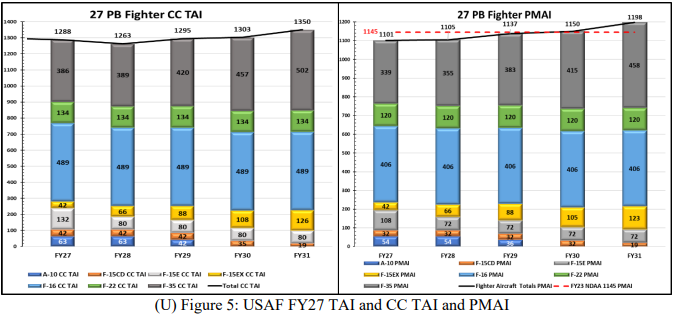
The report contends that PMAI does not accurately reflect the Air Force’s true combat capacity, since backup and attrition reserve aircraft will also be called upon in wartime — as aircraft were in Epic Fury. Additionally, the report says CC TAI more accurately reflects consequences of peer conflict, since the Iran conflict showed “sustainment challenges and losses” from more intensive combat operations.
“Combat coded total aircraft inventory is a much more kind of honest look at what I think Congress and, frankly, the American people care about, which is combat capability as opposed to the primary mission aircraft inventory,” Tabor said.
Critics of the CC TAI method assert that the accounting method can leave the Air Force shortchanged since PMAI aircraft are funded at different rates than backup and attrition reserve jets, according to Air & Space Forces Magazine.
The Air Force’s target of 1,509 jets by 2035 is measured using the CC TAI figure. Tabor said officials are still in talks with Congress about changing the metric.
“We’ve been having a lot of conversations with Congress about that language. I think that it’s a transition. It won’t be a flip of the switch that changes it, but we think we’re in a pretty good position on that,” he said.
Breaking Defense Video