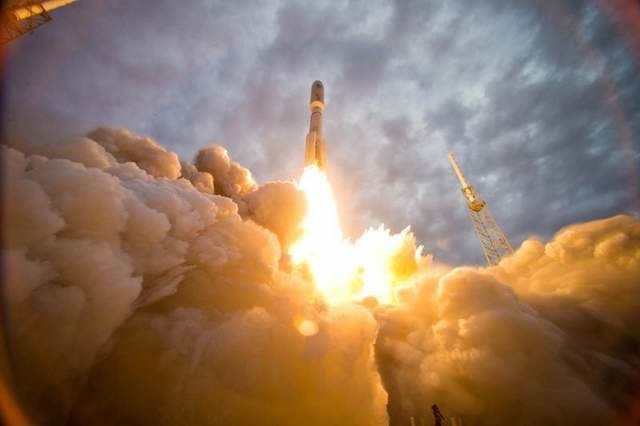
WASHINGTON: Sen. John McCain continued his crusade to stop the Pentagon from using Russia’s highly reliable and cheap RD-180 rocket engines to launch American military satellites during a Senate Armed Services Committee hearing today.
The Arizona senator and the House Majority Leader, Kevin McCarthy of California, introduced a bill today designed to overturn language in the 2016 Omnibus Spending Bill passed last month. Senators Richard Shelby and Richard Durbin inserted language into the sweeping 2,000-page spending bill that lifts the restrictions on ULA’s use of the pool of RD-180s. McCain pledged to strike back, and he is. (My early assessment is that the new bill has little chance of passage.)

“Today Russia holds many of our most precious national security satellites at risk before they ever get off the ground,” McCain said in his opening statement this morning. “Yet the Department of Defense has actively sought to undermine – with the support of United Launch Alliance (ULA) and the parochial motivations of Senator Shelby and Senator Durbin – the direction of this committee to limit that risk and end the use of the Russian made RD-180 by the end of this decade.”
McCain made the not unreasonable point that the United States’ taxpayers have been paying ULA $800 million each year on average so that ULA is ready and able to launch US military satellites, the central US space policy known as assured access to space. While the Pentagon’s top buyer, Frank Kendall, acknowledged that there is no other contract where the government pays such large amounts to keep a company in business, he also defended the EELV Launch Capability (ELC) contract. “It pays for costs associated with infrastructure. provides a stable base for ULA to plan on,” Kendall told the SASC. That supports about eight launches a year. “The ELC business is not a bad deal… It’s not a subsidy.”
McCain said the US is paying all that money and receiving very little in return, especially as ULA recently refused to bid on the GPS 3 launches. But Kendall, quietly, came back later and rebutted McCain’s charge: “It’s not nothing, as the chairman has indicated. Sorry about that.”


Securing the AI flank to provide trusted decision-making capabilities
AI tools are critical components of modern warfare, but must be protected to ensure they are reliable.
The Pentagon now wants to rely on “public-private partnerships” to guarantee assured access to space. Franke Kendall mentioned them several times. And Andrea Shalal of Reuters reported a Jan. 26 letter from Deputy Defense Secretary Bob Work saying this approach would work best and stressing that the US can’t rely on abandoning the use of the RD-180s. An RFP should be out “in the next few months,” Andrea’s story says, and the fiscal 2017 budget proposal will include funding for the partnerships.
Meanwhile, SpaceX and Blue Origin are both angling to handle such launches of large military satellites –and have McCain’s complete support — but neither company is yet ready to step in. Air Force Secretary Deborah Lee James said “it’s theoretically possible, but the devil is in the details.” Kendall was a bit more blunt: “There are people who’d like to be competitors, but they aren’t competitors yet.”
Below is a letter from the Defense Department responding to Senator McCain:
Breaking Defense Video