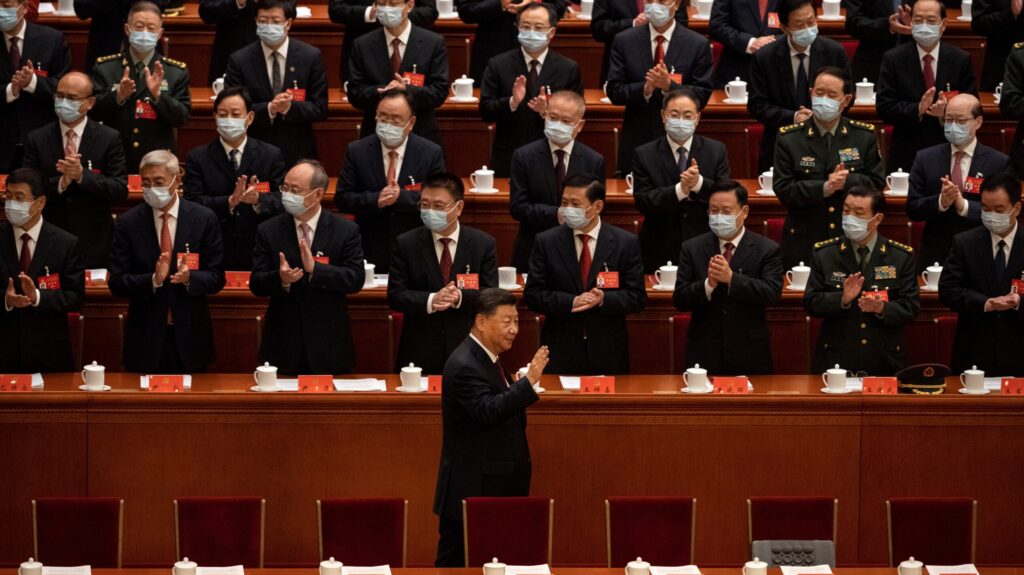
SYDNEY — A public announcement that one of the most important figures in the Chinese military is under investigation for “serious violations of discipline” — the latest in a string of moves against senior defense leadership — has “huge implications” for Beijing, analysts told Breaking Defense.
Last week, while much of the US defense establishment was enjoying the Thanksgiving holiday, Chinese state television announced Miao Hua, director of the Political Work Department at the Central Military Commission, had been suspended.
The announcement marked a departure from Beijing’s actions against two previous defense ministers, all of whom vanished from public view before it became clear they were being investigated for corruption. It’s also a departure, according to expert Dean Cheng, because Miao can be considered more senior than the defense ministers.
As Political Work Department director, Miao was “directly responsible for ensuring that the PLA [People’s Liberation Army] as a whole remains loyal to the” Chinese Communist Party (CCP), Cheng, a non-resident fellow at the Potomac Institute for Policy Studies in Washington, wrote in an email to Breaking Defense. Miao’s removal “has huge implications,” he said.
“This would DIRECTLY concern the top CCP leadership, as the PLA is a party-army, the armed wing of the CCP. If there are problems in the PWD, the implication is that the PLA may not be seen as 100% reliable,” he said, adding that Chinese President Xi Jinping has repeatedly given speeches about the importance of the military being subordinate to the will of the CCP civilian leadership.
The future of Zero Trust
Zero Trust is the Pentagon’s foundation for its modern cybersecurity strategy.
Exactly how this will all play out is unclear, Cheng and another analyst agreed. “It’s clear that the corruption investigations of the PLARF [People’s Liberation Army Rocket Force] were not a one-off, but have led to a larger and more systematic investigation across the PLA,” Meia Nouwens, a China defense expert at London’s International Institute for Strategic Studies, said in an email to Breaking Defense.
“I suspect two things matter here: Xi getting on top of corruption in service branches that are of vital importance to any PLA priority mission, and, secondly, personal connections between those investigated,” she said.
But overall, it’s the extraordinary prospect of three Chinese defense ministers being investigated for corruption, and now someone senior to the defense ministers being suspended. A day before the announcement about Miao, The Financial Times reported that China’s current defense minister, Adm. Dong Jun, was also under investigation. (A spokesperson for the Chinese military reportedly called that allegation “just shadow-chasing” without further explanation.)
Prior to Dong, former Defense Minister Li Shangfu’s removal from office was announced on Oct. 24 last year. He had not been seen in public since late August. The last Chinese foreign minister, Qin Gang, vanished from sight for weeks and was formally removed in July that year.
Before Li’s official departure, there were clear signs of turmoil in the Chinese military, with several top leaders of the Rocket Force having been ousted.
“Having three Defense Ministers investigated, and two publicly accused of corruption, does not give a sense of stability within the PLA. The reports of Miao Hua (on the CMC) also being investigated makes this more serious as his position makes him more senior,” Nouwens opined. “It also raises questions” about contacts between foreign militaries and the PLA as they usually occur through defense ministers.
Though Nouwens suggested Xi is genuinely attempting to root out corruption, Cheng said that the Chinese Communist Party has used “corruption” charges liberally as a tool against those who have displeased the leadership — for whatever reason.
“This goes to the fundamental reality that Chinese officers (and officials more broadly) may be removed on charges of corruption, but that does not mean that they are, in fact, corrupt. ‘Anti-corruption’ is a catch-all phrase that is convenient (given Xi’s ongoing anti-corruption efforts), but is not necessarily the REAL reason for an officer or official being removed,” Cheng said.
Opposition to Xi’s policies can “be a trigger for removal,” Cheng added. “The PLA has been undergoing major changes throughout the Xi era. In 2015, the PLA underwent massive reforms, including a restructuring of the services and the CMC itself. So, Miao and Dong Jun’s investigation should be examined in light of the removal of a number of PLA Rocket Force leaders including Wei Fenghe, and the removal of Li Shangfu (previous defense minister).”
Though hard information is scant, Cheng hypothesizes that the removals may be reflective of attempts by the leaders “to make changes to PLA doctrine and strategy that run counter to Xi’s thoughts and preferences. Gaining more resources, but not necessarily gaining more missions and tasks (e.g., more theater command slots) might lead to resentment at the senior level, leading in turn to purging by Xi.”
He added, “The PLA is probably overdue for a new set of doctrine. Unlike the US military, the Chinese take doctrine VERY seriously, and changes in doctrine leads to changes in acquisitions and even changes in organization.”