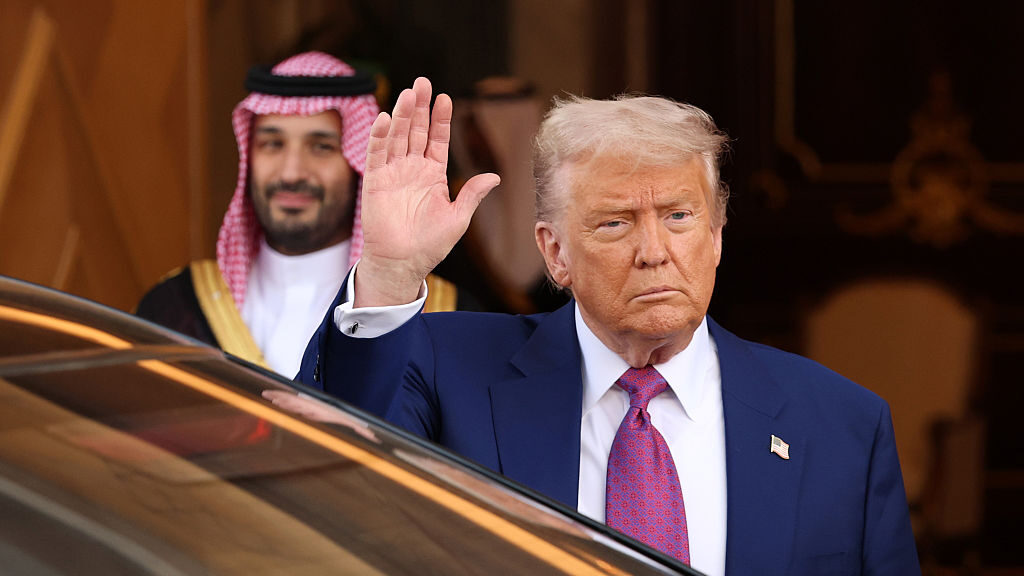
BEIRUT — The White House announced today what it called the “largest defense sales agreement in history,” a series of deals with Saudi Arabia for “state-of-the-art” warfighting equipment and training worth a total of “nearly $142 billion.”
The White House statement did not provide details on the agreements, but said they would fall into five broad categories: air force and space, air and missile defense, maritime security, land forces modernization and border security, and information and communication systems upgrades. The agreement package also includes training services to Royal Saudi Armed Forces, “including enhancement of Saudi service academies and military medical services,” according to the statement.
“Our defense relationship with the Kingdom of Saudi Arabia is stronger than ever under President [Donald] Trump’s leadership, and the package signed today, the largest defense cooperation deal in U.S. history, is a clear demonstration of our commitment to strengthening our partnership,” said a White House fact sheet that touted a total $600 billion “investment commitment” by Saudi Arabia into various US industries.
The State Department, which handles foreign military sales, referred Breaking Defense’s questions about specific deals to the White House. Representatives there did not immediately respond. But a refence in the White House fact sheet to “sales that we intend to complete” suggests arrangements have not been finalized. (During Trump’s first term, a massive defense deal with Saudi Arabia was also announced, but that included non-binding agreements and deals that had already been in the works.)
Still, David Des Roches, associate professor at the Near East South Asia Center for Security Studies, told Breaking Defense he expected the defense deals to recapitalize Saudi air defenses, “particularly Patriot air defenses, given that they just need a lot of missiles and they need new launchers.”
He added that deals might include upgraded Patriot radar, which “has been a long-standing Saudi ambition.”

Data overload threatens decisionmakers as autonomy expands
Reducing cognitive overload on warfighters while improving “time to trust” for autonomous systems is a matter of design.
Trump was expected to announce defense deals as he traveled through the Middle East, but big question marks hung over specific platforms, like the F-35 Joint Strike Fighter — a plane reportedly sought by both Saudi Arabia and the United Arab Emirates. The White House fact sheet does not mention the F-35.
“When the Trump factor is involved, we should not dismiss any possibilities. That said, I believe any potential F-35 deals will not be without challenges,” Ali Bakir, a professor at Qatar University and non-resident senior fellow at the Atlantic Council’s Scowcroft Middle East Security Initiative, said.
Des Roches said he believed that any F-35 deal is not really dependent on political will, rather suggesting that the US would be wary of exposing the plane to foreign tech — an apparent reference to the UAE’s reliance on Chinese 5G systems.
It is “dependent on safeguarding the technology that is in the F-35 particularly,” he said. “As long as there are any hostile powers that have the ability to collect electronic signature and telemetry on the F-35, which means if they have any kind of radio or communications presence in close proximity, the F-35 then they will have the ability to build up a dictionary of signatures and compromise the stealth characteristics of the F-35.”
He added that Trump will not override that concern. “The ball is with the countries that want to have the F-35, they need to decide if they want to have the F-35 or if they want to have a Chinese telemetry collecting infrastructure in their country, which is piggybacked on a commercial cell phone network.”
Overall, Bakir said prior to Trump’s trip that defense deals should be expected, as it’s always a priority in talks between the US and Gulf states.
“We can expect an emphasis on increased defense contracts, equipment, and defense-oriented relations during the visit. However, I don’t believe this visit will alter the perception in the Gulf that has developed over the past decade regarding the lack of US’s credibility as a security guarantor,” he told Breaking Defense.