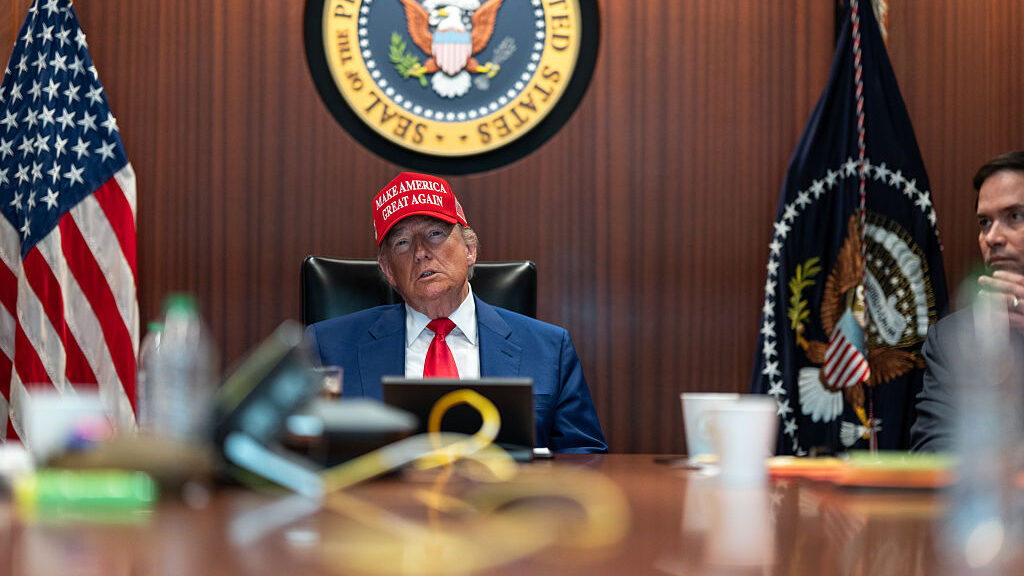
WASHINGTON — President Donald Trump today accused Iran and Israel of both violating a ceasefire agreement, hours after he had unilaterally announced a deal to lay down arms on Monday.
Trump initially declared early Monday evening that the two Middle East powers had agreed to a “Complete and Total CEASEFIRE,” a phased arrangement that he said would be beginning of the end to the current conflict.
Late Monday Iran’s foreign minister said on X that had been no ceasefire “agreement,” though he said Iran would stop attacking Israel if it did likewise. By this morning, reports indicated both sides had tentatively accepted a cessation to hostilities, until Israel said Iran had violated the ceasefire and said it would “respond forcefully” with “powerful strikes.”
The General Staff of the Iranian Armed Forces denied reports that Tehran had taken such action, according to the Tasnim News Agency, affiliated to the Iranian government.
At the White House this morning, Trump told reporters that Iran “violated” the ceasefire, “but Israel violated it too. … I’m not happy with Israel,” referring to an Israeli barrage on Iran that he said took place shortly after the deal was made. Trump also suggested a missile fired at Israel by Iran had been launched “perhaps by mistake.”
“ISRAEL. DO NOT DROP THOSE BOMBS,” the president wrote on Truth Social.


Meeting modern airpower needs with faster R&D cycles for propulsion
As aircraft shrink, threats expand, and technology accelerates, aircraft engines must iterate along with the threats.
RELATED: Operation Midnight Hammer: How the US conducted surprise strikes on Iran
As for whether the ceasefire has a chance, experts told Breaking Defense it all hangs on whether Trump is willing to enforce the ceasefire with any penalties, and if Israel, in particular, really decides to halt its attacks. (As of publication, the Israeli government said it would abide by the ceasefire.)
“As these violations happened so early we might say that this is usually the case with ceasefires. Both sides want to capitalize until the last minute and then a bit longer,” Marwa Maziad, an assistant professor of international relations at the Gildenhorn Institute for Israel Studies at University of Maryland said. “But in this case here we might actually see that Israel is continuing with other covert acts seeking that newly avowed regime change rhetoric and Iran will continue to respond, but limiting its attacks to Israel and not to US assets.”
Likewise Abdullah Al Junaid, a Bahraini military expert, suspected that if Israel had the chance to take out Iran’s supreme leader, Jerusalem would most likely take it.
“If and when [Israeli Prime Minister Benjamin] Netanyahu locates Ali Khamenei’s position, he’ll go after him. Netanyahu’s only concern is his political survival,” Al Junaid told Breaking Defense. “Netanyahu understands that the opportunity to decapitate the Iranian regime will not present itself any time soon or in the future, especially with Iran in a defenseless position and it’s proxies capacities totally degraded.”
Trump’s Phased Ceasefire Plan
Prior to latest developments, Trump had described the ceasefire deal on Truth Social on Monday as a phased approach, starting after Israel and Iran completed “in progress” missions. He appeared to say that Iran would be the first to suspend operations, followed 12 hours later by Israel, which would start the clock on a 12-hour mutual ceasefire.
“Officially, Iran will start the CEASEFIRE and, upon the 12th hour, Israel will start the CEASEFIRE and, upon the 24th Hour, an Official END to THE 12 DAY WAR will be saluted by the World,” the president wrote. “During each CEASEFIRE, the other side will remain PEACEFUL and RESPECTFUL.”
To get to a deal, a senior White House official told Breaking Defense that Trump “communicated” directly with Israeli Prime Minister Benjamin Netanyahu, while Vice President JD Vance, Secretary of State Marco Rubio and Special Envoy Steve Witkoff “communicated with the Iranians, through both direct and indirect channels.” The official said the US was “grateful” to the Qataris for “their efforts to help broker peace.”
Israel agreed to the ceasefire “as long as they are not further attacked by Iran,” the official said, and maintained that Iran was on board, “as Senior Iranian Officials have been confirming.”
An hour before Trump’s Monday evening post, Iranian Supreme Leader Ayatollah Ali Khamenei posted on X that Iran “isn’t a country that surrenders.”
Trump’s post also came just hours after missiles from Iran were launched at US military facilities in Qatar, which the Pentagon said were mostly intercepted. There were no US casualties, according to a defense official.
That attempted strike appears so far to be Iran’s most aggressive retaliation for the surprise American bombing of three nuclear sites in Iran over the weekend. That operation, which used B-2 stealth bombers flying from the continental US as well as fighter jets and submarine- and ship-launched missiles, was hailed as a resounding success by Trump and Defense Secretary Pete Hegseth.
Chairman of the Joint Chiefs of Staff Gen. Dan Caine told reporters Sunday that a post-strike battlefield assessment was ongoing to see exactly how much damage the Iranian nuclear program sustained.
“Final battle damage will take some time, but initial battle damage assessments indicate that all three sites sustained extremely severe damage and destruction,” he said, also noting that US aircraft did not appear to have been fired upon.
“Iran’s fighters did not fly, and it appears that Iran’s surface to air missile systems did not see us,” he said.
UPDATED 6/24/2025 at 9:57am ET to include expert analysis.