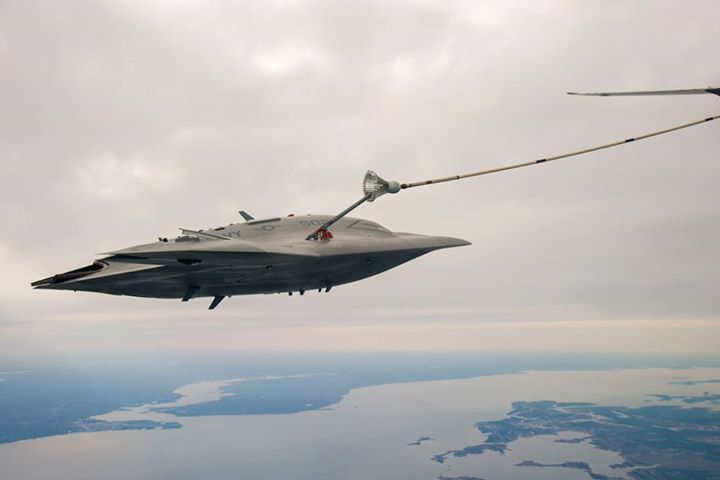
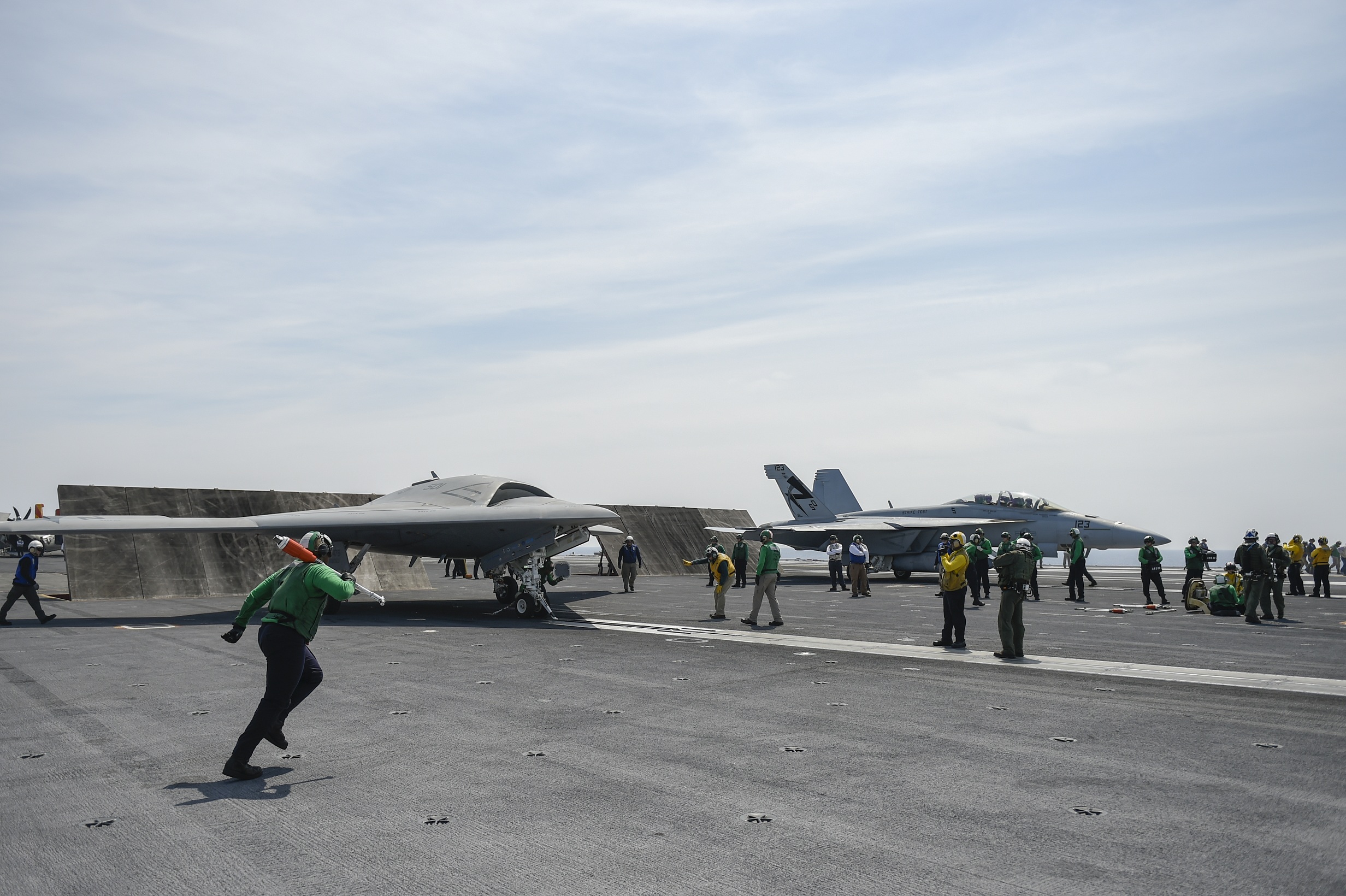
The eagle hasn’t exactly landed, but it did the next best thing. This afternoon, off the Virginia coast, the Navy’s experimental X-47B UCAS (Unmanned Combat Air System) became the first unmanned aircraft to do a “touch and go” on an aircraft carrier. That’s a major milestone for the pioneering drone, which just this Tuesday conducted… Keep reading →
x-47b
Navy Drone’s Next Test: X-47B Will Land, Sort Of; China Unveils Similar Drone
By Sydney J. Freedberg Jr. and Colin Clark[Corrected description of Navy test sequence] Unmanned aircraft are relatively easy to fly. Landing one without crashing is hard. Getting one to take off from the narrow, pitching deck of an aircraft carrier is harder still. Landing on a carrier? That’s hard enough to give human pilots nervous breakdowns. Soon, it will be the final… Keep reading →
It’s hard enough for a human pilot to take off from the cramped and pitching deck of a US Navy aircraft carrier. Today, for the first time in history, a Remotely Piloted Aircraft did it. You can bet that military leaders in Beijing and Tehran sat up and took note as the batwinged X-47B drone… Keep reading →
90 years ago, in the fall of 1922, US Navy pilots made the first landings on America’s first-ever aircraft carrier. (Okay, the British did it first). Just a few weeks from now, a Navy aircraft will make history again — except this time there won’t be a pilot. Meet the Navy’s new robotic Top Gun,… Keep reading →
WASHINGTON: The Navy’s top admiral talked up cheap ships and high tech this morning, from laser weapons to a new double-decker version of the Mobile Landing Platform vessel (pictured above). Chief of Naval Operations Adm. Jonathan Greenert said precious little about the rolling budget cuts called sequestration. He clearly preferred to emphasize a bold vision of the future rather than the current budget crisis that has forced the fleet to halve its aircraft carrier presence in the volatile Persian Gulf.
Indeed, speaking at a Newseum conference sponsored by McAleese & Associates and Credit Suisse [click here for full coverage], the CNO struck a remarkably optimistic note about the current fiscal misery: “If we get a bill at the end of this month, all of the carrier woes” — delays not just to deployments but to maintenance overhauls — “all go away,” Adm. Greenert said. “The money’s in place; we [just] need the authority to spend it.” Keep reading →
NAVAL AIR STATION PATUXENT RIVER: Landing a jet plane on an aircraft carrier is one of the hardest and most dangerous things a human being can do, with pilots’ stress levels spiking higher than in combat. Now the Navy is trying to teach a robot how to do it: The X-47B Unmanned Combat Air System, the UCAS.
“You have to think of every single contingency and work it into the software,” said Capt. Jaime Engdahl, the Navy’s UCAS program manager, at an event yesterday to roll out the X-47B for the press. The two UCAS aircraft, built by Northrop Grumman, have already gone through extensive testing at Edwards Air Force Base in California, but that was just landing and taking off from a conventional airstrip. Now both robot planes have moved out east to Patuxent River to work on “the basics of operating around the aircraft carrier,” Engdahl said. Keep reading →
X-47B Carrier Drone Passes Air Worthiness Tests; Carrier Takeoffs, Landings Next Year
By Colin ClarkWASHINGTON: The unmanned aircraft most likely to become the first to takeoff and land on aircraft carriers is moving to the next phase of testing, moving from Edwards Air Force Base to the Navy’s main operational test site at Patuxent River, Md.
The X-47B, also known as the Navy’s UCAS-D, soared higher than 15,000 feet and flew at a speed of 180 knots during more than 23 flights and 50 tests. The aircraft moved to Maryland yesterday. It also “demonstrated multiple maneuvers relevant to carrier operations, including extending and retracting a tail hook, completing an autonomous ‘touch-and-go’ landing – an aviation first – and performing landings at a high sink rate and in a heavy weight configuration,” according to a Northrop Grumman press release. Keep reading →
The U.S. Navy’s nuclear-powered aircraft carriers flight decks are some of the most chaotic and deadly real estate in the world. Teeming with scores of high-performance aircraft, wheeled vehicles and up to a thousand sailors generating up to several hundred sorties per day, flight decks “are fraught with danger,” the Naval Safety Center warned in a 2003 publication. “You can get blown down by prop wash, blown over-board by jet exhaust, run over by taxiing aircraft or sucked up and spit out by a turning engine.”
Soon the Navy may have a new danger to add to the list. The sailing branch plans to add robotic jet-powered warplanes to the carrier-deck mix starting next year. The Unmanned Combat Air System Demonstrator program, or UCAS-D, is scheduled to launch a seven-ton Northrop Grumman X-47B drone from the carrier USS Eisenhower sometime in 2013. Keep reading →
![]()
The Navy is testing the first unmanned aircraft designed to take off and land on aircraft carriers. In recent tests, Northrop Grumman’s X-47B was put through a rigorous set of tests in preparation for actual carrier landings and takeoffs, planned for 2013.
Here’s a summary of the testing at Edwards Air Force Base, Calif. Keep reading →
On Sept. 11, 2001, the U.S. military possessed just handful of robot aircraft. Today, the Air Force alone operates more than 50 drone “orbits,” each composed of four Predator or Reaper aircraft plus their ground-based control systems and human operators. Smaller Navy, Marine and Army drones number in the thousands. Keep reading →


![orthrop Grumman Corporation (NYSE: NOC) and the U.S. Navy have conducted the first fly-in arrested landing of the X-47B Unmanned Combat Air System (UCAS) demonstrator. [Northrop Grumman]](http://breakingdefense.sites.breakingmedia.com/wp-content/uploads/sites/3/2013/05/Navy-X-47B-UCAS-drone-arrestor-landing-trial-19503-1024x682.jpg)
Colin Clark
Sydney J. Freedberg, Jr.