UPDATED from Army budget briefing PENTAGON: The Army’s budget plan for 2021-2025 adds another $9 billion to its Big Six modernization priorities over last year’s forecast, with a $2.2 billion increase – 26 percent – from 2020 to 2021 alone. Another $500 million-plus goes to the Army’s Long-Range Hypersonic Missile (LRHM), the service’s return to a strategic (albeit non-nuclear) strike role for the first time since it disbanded its Pershing III ballistic missiles in the 1990s.
That’s actually a little less than the $10 billion Army Secretary Ryan McCarthy had aimed for. But it’s still remarkable given that the total Army budget fell by $2 billion, and the service’s Research, Development, & Acquisition (RDA) accounts only grew $200 million total, Army budget director Maj. Gen. Paul Chamberlain pointed out to reporters this afternoon. Those increases to the priority programs, Chamberlain said, required cuts in 80 others: 39 programs reduced or delayed, 41 terminated altogether.
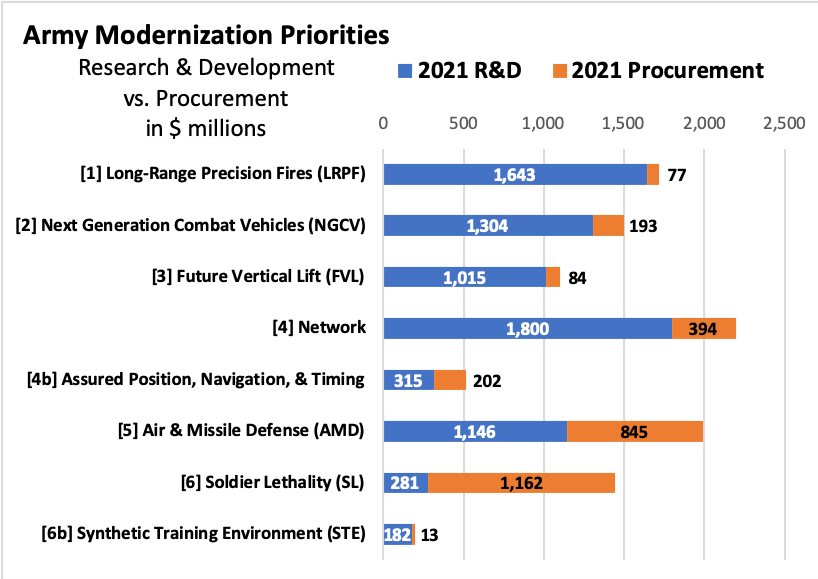
What’s more, programs are beginning to move out of research and development into procurement, with the percent of Big Six funding going for procurement up from 18 percent in 2020 to a requested 28 percent in 2021.
Two changes stand out:
On the downside: The Army’s No. 2 modernization priority, Next Generation Combat Vehicles (NGCV), was the only one to take a hit. Funding dropped 11.1 percent, from $1.7 billion in 2020 to $1.5 this year. Even accounting for that decrease, the percentage spent on actual procurement, as opposed to R&D, fell by half, from over 26 percent in ’20 to under 13 percent in ’21.


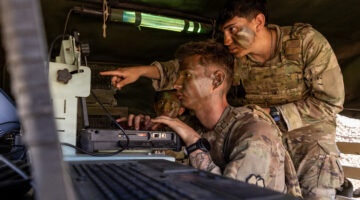
Island surge: the Army’s Next Generation Command and Control in action
Lightning Surge exercises are turning soldier feedback on NGC2 into operational software changes in days, not years.
That’s because the flagship NGCV program, the Optionally Manned Fighting Vehicle (OMFV) meant to replace the aging M2 Bradley, ran aground last fall on industry’s inability to meet the Army’s ambitious requirements. Rather than double down on failure – a bad habit of Army bureaucrats – the service made the hard call last month to reboot the entire program, even if that takes more time.
On the upside: The Army’s No. 6 priority, Soldier Lethality, proved itself last but far from least with a stunning 126 percent increase in spending from ’20 to ’21, driven by a huge increase in procurement. Last year, just 8 percent of $638 million in Soldier Lethality funding went to procurement rather than R&D; this year, over 80 percent of $1.4 billion goes to procurement.

That includes a $36 million to buy Next Generation Squad Weapons (NGSW) to replace the 5.56 mm M16/M4 family – the first procurement funding for NGSW as it moves out of R&D. But the big move into actual building something revolutionary is the acquisition of the first 40,219 Integrated Visual Augmentation Systems (IVAS), a militarized version of the Microsoft HoloLens augmented-reality goggles that will superimpose tactical data on the wearer’s field of vision, from navigational pointers towards objectives to cross-hairs for aiming their rifle. IVAS will even provide intelligence imagery to artificial intelligence algorithms that automatically detect high-priority targets.
Other Army priorities grew, albeit not as dramatically – but any growth is remarkable in a year with such a small increase in the overall defense budget.
- The service’s top modernization priority, Long-Range Precision Fires (LRPF) – new precision-guided artillery and missiles – grew almost 20 percent from 2020, to $1.7 billion. But the relative portion spent on actual procurement dropped, from 22 percent to 13 percent, with an increasing share of spending going to long-term R&D. That reflects reductions in upgrades to existing missiles (e.g. the ATACMS Service Life Extension Program) as the Army emphasizes development of all-new weapons now in testing.
- Future Vertical Lift (FVL) aircraft, the No. 3 priority (after LRPF and NGCV), grew almost 37 percent, to just over $1 billion, as the service accelerates competitions to build a new Future Attack Reconnaissance Aircraft (FARA) to replace the retired OH-58 Kiowa scout helicopter and a Future Long-Range Assault Aircraft (FLRAA) to replace the Reagan-era UH-60 Black Hawk.
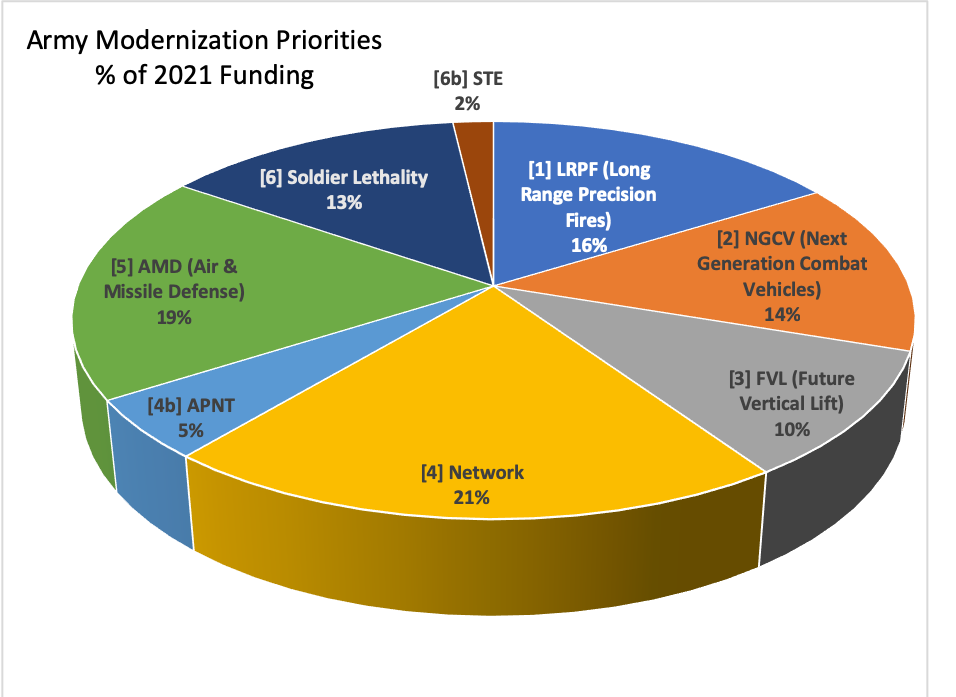
- The Army’s new battlefield command and control Network, the No. 4 modernization priority, continues to absorb the largest share of the Big Six budget, consuming almost $2.2 billion, or 21 percent of all the Big Six put together. That’s only a 3.4 percent increase over last year, but the first new network kit – Capability Set ’21 – will go to operational units in the 2021 fiscal year. A spinoff of the network effort, Assured Precision Navigation & Timing (APNT) for GPS-denied warzones, grew by a remarkable 43 percent, to $517 million, but that’s a separate budget item from the Network proper.
- Air & Missile Defense (AMD), while nominally only the No. 5 priority, grows a dramatic 62 percent, to just below $2 billion, with the percent spent on procurement as opposed to R&D nearly doubling from 22 percent to 42 percent. That reflects the service’s rush to field Maneuver Short-Range Air Defense (MSHORAD) weapons on 8×8 Stryker armored vehicles.
- Finally, a separately budgeted spin-off of Soldier Lethality, the Synthetic Training Environment (STE) – virtual reality and augmented reality simulations – grew by a relatively modest 5.4 percent, mostly in R&D, whose share of spending actually increased.