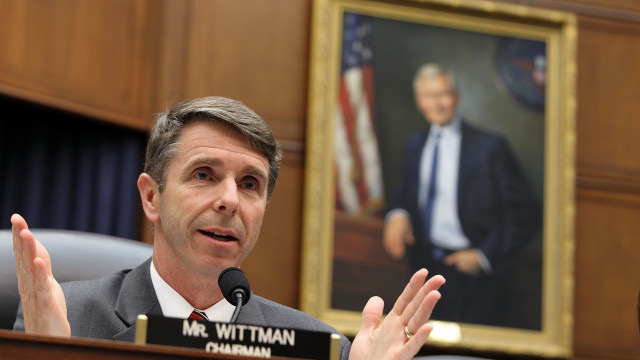
WASHINGTON: Longtime seapower advocate Rep. Rob Wittman’s new leadership role on the House Armed Services Committee will place the veteran lawmaker at the center of major debates over Pentagon funding and a series of hard choices over Navy’s looming modernization bill.
While Republicans remain in the minority in the House, the influential panel’s top Republican, Rep. Mike Rogers, named Wittman vice ranking member Thursday as the Hill prepares for the Biden administration’s 2022 budget and accompanying reviews of the Navy’s shipbuilding plan and the military’s global force posture, with major implications for how the force is arrayed overseas.
Wittman, who serves as the ranking member on the seapower and projection forces subcommittee, “will be an invaluable addition to our leadership team,” Rogers said.
The armed services committees of the newly installed 117th Congress will tackle a list of weighty issues while balancing the fallout from a bitter election season that saw rioters storm the Capitol building to interrupt the vote to certify the Electoral College votes to affirm President Joe Biden’s victory. The sharp bipartisan split in the country and on the Hill will likely color everything this Congress does.
In an interview Thursday, Wittman remained hopeful about the ability of the HASC to rise above the din. “I think HASC will continue the great tradition of bipartisanship,” Wittman said. “I know my conversations with [Seapower Chairman] Joe Courtney and [HASC Chairman] Adam Smith have all been about what we’re going to do together going forward, and yes there’s a higher degree of tension back and forth between the two parties, but we have always been able to transcend that in the HASC. In my conversations to this point I don’t see anything that’s going to change that.”
In January, Wittman joined HASC Ranking Member Mike Rogers in voting against certifying Electoral College votes in states Biden won, despite no evidence there were substantial voting irregularities. Tweeting two days before a violent, Trump-supporting mob stormed the building and killed a Capitol Police officer, Wittman said “I am in full support of objecting to electors in order to debate and examine of election results in states where Constitutional questions have been raised.” He later accepted the electoral victory of President Biden and Vice President Kamala Harris, saying he had no intention of trying to overturn the election.


In contested seas, autonomy must anticipate, not just navigate
As missions stretch farther and comms grow less reliable, predictive software could become the edge that keeps missions afloat.
The new Congress has just a few weeks to settle in before they will have to wrestle with the 2022 federal budget, which will likely stand as the Biden administration’s first declaration on the national security issues that will require buy-in from both parties in Congress.
“We understand going forward it’s going to be about maintaining budget levels,” Wittman said. “I don’t think there’s going to be any increases in the budget, but maintaining budget levels in order to do the things necessary” to fund the Pentagon’s modernization, particularly in the new shipbuilding plan the Pentagon will submit with the budget this spring.
The fights over funding within the Pentagon will likely be hard — Chairman of the Joint Chiefs Gen. Mark Milley predicted budget “bloodletting” — but many, including Wittman, say changes to how the Pentagon splits funds between the services need to happen to counter the growing Chinese military might in the Pacific.
“In order to do the things necessary in the shipbuilding plan you’re going to have to find additional resources to put into the [shipbuilding] account,” Wittman said. The Navy is working to scrape up more internal savings by retiring some of its oldest ships — if Congress allows — but the other services will likely have to be bill payers, as well.
Milley threw his weight behind the Navy’s receiving the lion’s share of Pentagon funding in the future in order to ramp up its presence in the Indo-Pacific, something Witttman supports. The discussion about the one-third/one-third/one-third funding formula which has generally guided Pentagon spending is very much in play, and Wittman questioned whether that is applicable today.
“Even General Milley said we probably ought to rethink that because if you’re going to have a necessary presence in the Indo-Pacific it’s going to take additional resources for the Navy/Marine Corps team, and that’s not in any way shape or form critical of the Air Force or the Army, it’s just the reality of what we have to do.”
Those decisions at the White House and Pentagon, and the debates they’ll stir on the Hill, will surely lead to debate on the Senate and House’s armed services committees, where and all fall under the shadow of the chaos of January, where the peaceful transfer of power to the Biden administration was under attack.
In December, Wittman also joined House Republicans in sending an amicus brief to the Supreme Court supporting an effort in Texas to overturn the Biden victory. That case was swiftly rejected by the court. “This was not about overturning the election, I knew my vote wasn’t going to do that,” Wittman said in the days after the insurrectionist riot and his vote, but said he was concerned about the unconstitutionality of how the vote was administered.
Similarly, Rogers cited “far too many instances of alleged voter fraud that have called the legitimacy of the election results into question,” adding elections “should be free, fair and transparent. The 2020 election was not.”
There has been no credible evidence of voter suppression or other voting irregularities provided before or after the Jan. 6 vote despite the lawmakers objections, though Wittman later issued a statement wishing Biden and Harris “the blessings of good health and sound judgement as our nation navigates these unprecedented times.”