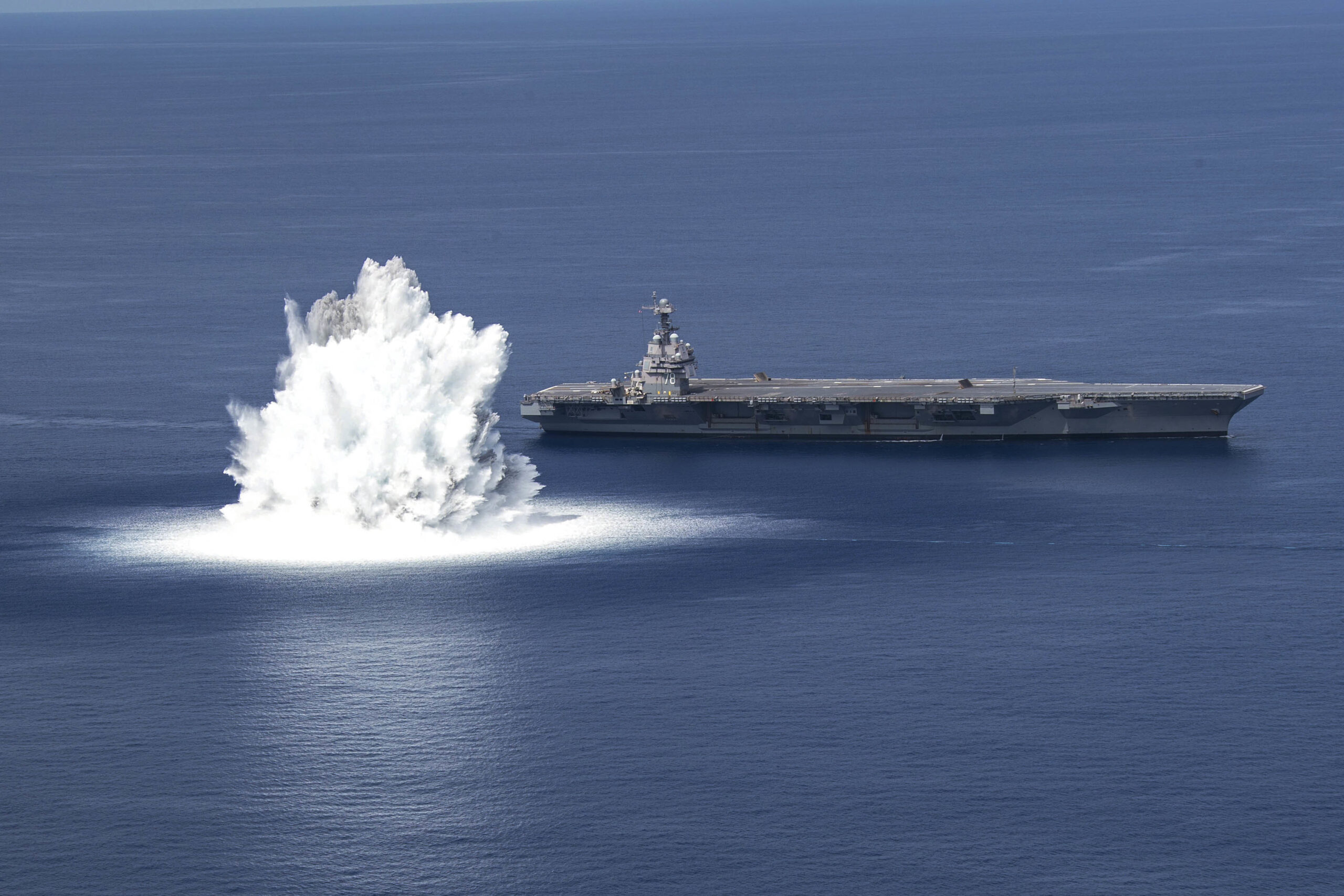
WASHINGTON: The aircraft carrier Gerald R. Ford (CVN-78) on Sunday successfully withstood a 40,000-pound explosive charge going off underwater nearby, the final step of its shock trial — and the last major test event prior to the warship’s 2022 deployment date.
“We are close to done with the major test events here,” Rear Adm. James Downey, program executive officer for carriers, told reporters on Monday during a telephone roundtable. Downey was aboard the Ford during the test event off the coast of Florida this weekend. The test was preceded by similar trials that took place on June 18 and July 16.
The past four months of testing represented the first shock trials performed on an US Navy aircraft carrier in decades, designed to evaluate how both the ship and its crew respond to live ordnance. The Ford will stay at sea while it evaluates any damage that was not apparent immediately after Sunday’s explosion, and will then make its way back to Virginia for maintenance.
Capt. Paul Lanzilotta, Ford’s commanding officer, who spoke to reporters alongside Downey Monday morning, said there were no serious injuries to personnel during the test event and that while some subsystems were damaged by the impact, additional repairs due to the blast were scheduled into the ship’s upcoming availability.
“We had zero catastrophic failures on the ship, zero situations where we had flooding. Zero fires,” he said.
He added that none of the damage the crew has seen so far are likely to delay the ship’s schedule, which has it continuing on to combat systems testing followed by sea trials and a final test and evaluation period before its first deployment in 2022.
Networked for the fight: Army aviation’s next advantage
As operating environments grow more complex, Link 16 provides instantaneous, mission-wide connectivity to ensure no aircraft flies alone.
Following the initial impact, Lanzilotta said the crew were able to start receiving some aircraft onto the ship such as helicopters, as well as maneuver planes around the flight deck; however, the shock trial did not include launching or recovering fixed-wing aircraft immediately before or after the explosion.
The shock trials’ completion represents a major milestone for the Navy in moving the ship closer to joining operations in the rest of the fleet. The ship’s history of troubles with its advanced weapons elevators and other new technologies have made it a punching bag for frustrated lawmakers wanting to grow the fleet. Those issues have prompted lawmakers in recent legislation to require certain ground-based testing that some of the most problematic technologies on the Ford ultimately avoided.
Completing a historic event like Full Ship Shock Trials gets #Warship78 Sailors hype!
Hit that heart when you feel hype for the @USNavy and the Wolverines of @Warship_78 while watching this video!#NavyReadiness #ShockProven @NAVSEA @COMNAVAIRLANT11 pic.twitter.com/OrjNVGkkV2
— USS Gerald R. Ford (CVN 78) (@CVN78_GRFord) August 9, 2021