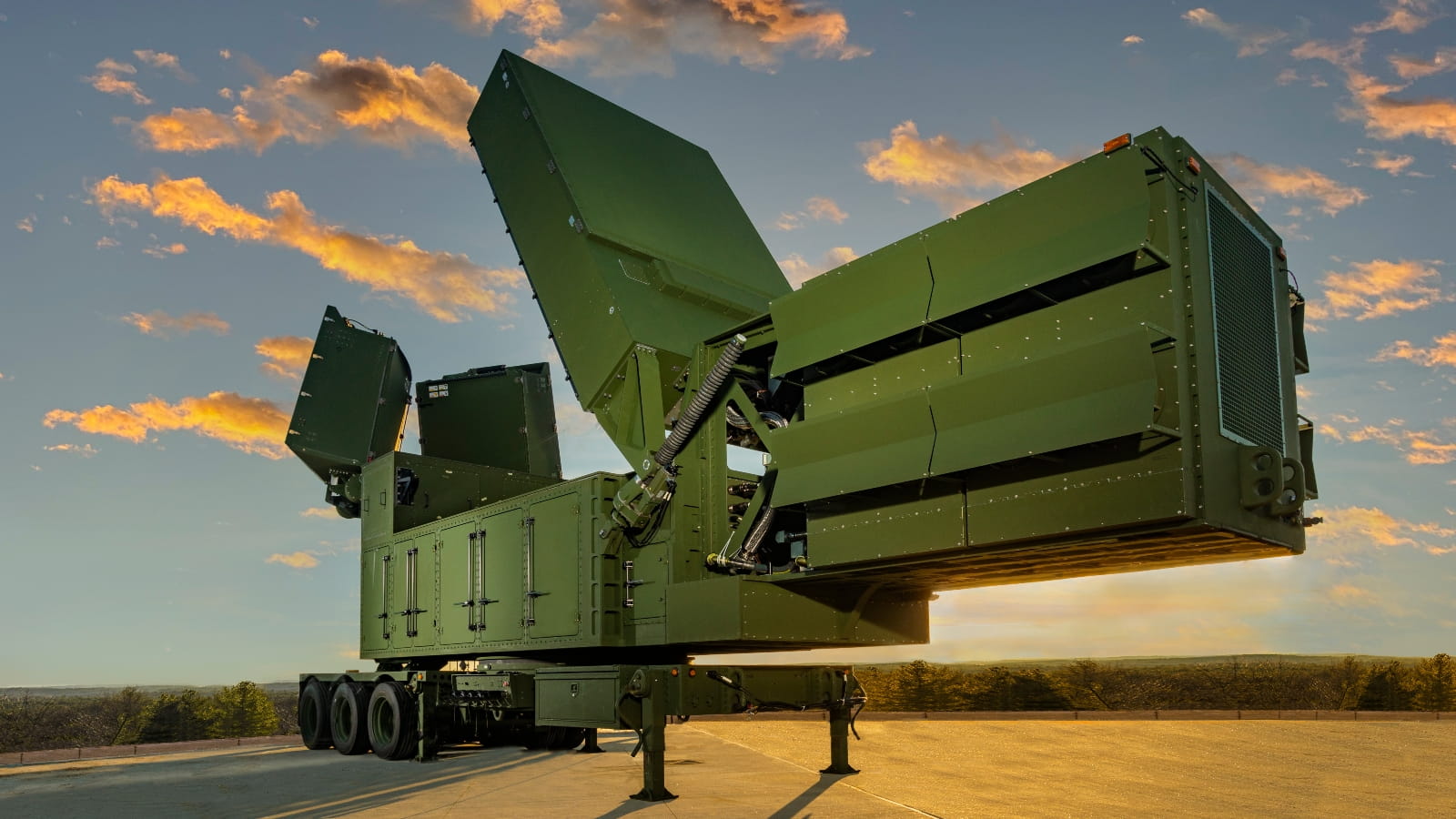
After only 36 months since contract award, Raytheon Missiles & Defense is poised to deliver six Lower Tier Air & Missile Defense Sensor (LTAMDS) radars to the Army in 2023. LTAMDS is a 360-degree active electronically scanned array radar powered by gallium nitride, a circuit material that strengthens the radar signal and enhances its sensitivity.
In this Q&A with Bob Kelley, director for US Requirements and Capabilities at Raytheon Missiles & Defense: we discuss how the threat scenario has evolved to include simultaneous attacks from all direction; the testing program for LTAMDS; and a new medium-range battlefield radar that’s part of the GhostEye family.

Breaking Defense: What is the threat scenario that LTAMDS addresses?
Kelley: With today’s aerial threats, we’re seeing significant increases in range, velocity, and maneuverability. We often talk about ballistic missiles but It’s rare that something flies a ballistic trajectory anymore. They’re mostly non-ballistic trajectories where they maneuver in flight, with that maneuver designed to defeat radar sets on the battlefield.
We’re also seeing potential adversaries practicing and having an ability to bring together multiple different types of threats, near simultaneously at the same target from 360 degrees. In September 2019, for example, there was a near-simultaneous, 360-degree attack on a Saudi oil refinery with a combination of cruise missiles and unmanned aerial vehicles. That oil refinery had air defense coverage, but it did not have 360-degree air-defense coverage.
Today, the battlefield is no longer linear. It’s not bad guys over there, good guys over here, because potential enemies can attack from any direction due to their ability to program and maneuver different threats that range from unmanned aerial vehicles, fifth-generation fighters, rotary wing aircraft, cruise missiles, and ballistic and non-ballistic missiles. It’s become a very complex battlefield for defending against air threats.
Breaking Defense: How do you then create 360 degrees of coverage?
Kelley: LTAMDS has three fixed arrays: a large front array and two aft arrays that have overlapping coverage so we have a full 360-degree coverage.
Our motto is “Nothing goes unseen.” That’s because we’re simultaneously searching, tracking, classifying, discriminating, identifying, and providing interceptor support in 360 degrees.
Breaking Defense: LTAMDS is one piece of the kill chain. How are you integrated with the interceptor and the rest of the kill chain?
Kelley: We’re integrated through the U.S. Army’s Integrated Air and Missile Defense Battle Command System, or IBCS. The launchers are integrated into that system, and so is the radar. The radar will detect, classify, discriminate, identify, and then present that information to an operator who’s working in a command-and-control node. The operator uses that information to make a decision on friend or foe, threat or not threat, and engage or not engage. Once those decisions are made, the radar will support the interceptor during its fly out and all the way until it makes its engagement.
I’ll add that LTAMDS is the first component that was being specifically developed for the IBCS system. LTMADS will be a native IBCS system. There are other systems out there like Patriot and Sentinel radar that are being adapted to operate on the IBCS network, but LTAMDS is specifically designed for the IBCS network’s command and control system.
Breaking Defense: Earlier this year, the first LTAMDS arrived at the U.S. Army’s White Sands Missile Range for testing. This is the first of six radars planned for delivery to the Army and marked the beginning of a series of tests to prove LTAMDS performance and functionality in an operational environment. Bring me up to date on the test program.
Kelley: The first radar that we sent to White Sands Missile Range was only the primary array and has since been brought back after we completed our range testing objectives for this year. It’s now being fitted with the two aft arrays for full 360-degree coverage. Our test regimen on that particular radar will start again in January 2023.
Right now, we’ve got five other radars completed and they’re all in various degrees of testing. We have an ability to do simultaneous and parallel testing. We have two sites at our Andover, Massachusetts, facility for indoor testing and another facility in New England where we can open-air radiate, where we can use tracks from targets of opportunity, if you will.
In 2023, we will continue testing, including out at White Sands with the U.S. Army. Parallel testing will continue at our two facilities, with the ultimate goal of having an early operational capability in December 2023.
Breaking Defense: One of the advantages of LTAMDS is that it reduces the workload on operators. How so?
Kelley: We’ve taken 40 years of Patriot experience and worked with soldiers to understand what their challenges were and what was difficult for them. As a result, we’ve made a lot of improvements in maintenance, for example. LTAMDS will be a far easier radar to maintain compared to other radars that are on the battlefield today.
When we started to develop this radar and it came time to make design decisions, we did so with soldiers in mind and what we learned about their ability to operate and maintain this radar. LTAMDS is a smart radar; it will do tasks that a soldier used to have to do. It will understand its environment, and optimize itself for that environment.
Breaking Defense: LTAMDS is an AESA radar. What are the commonalities between it and Raytheon’s other AESA radars like APG-82 for the F-15 and SPY-6 for naval vessels? How have those commonalities reduced risk?
Kelley: A key element of our AESA technology comes from our U.S. government certified foundry located in Andover where we produce high-power, high-efficiency gallium nitride RF chips that go into our AESA radars.
They’re incredibly efficient, and with each radar we learn how to improve upon that efficiency. A basic radar, for example, has a fixed amount of input power. What you want is to get as much of that input power translated into RF energy going out the front of the radar, or in the case of LTAMDS 360 degrees out of the radar, to get maximum performance. That’s how it gets high sensitivity and longer ranges. Each time with a new radar we’re learning and getting to be even more efficient.
I would say, too, that while all those radars are different and don’t have the same specific mission, there are some similarities in their missions. So there’s benefit in the software development side of the house and in lessons learned from one radar to the next.
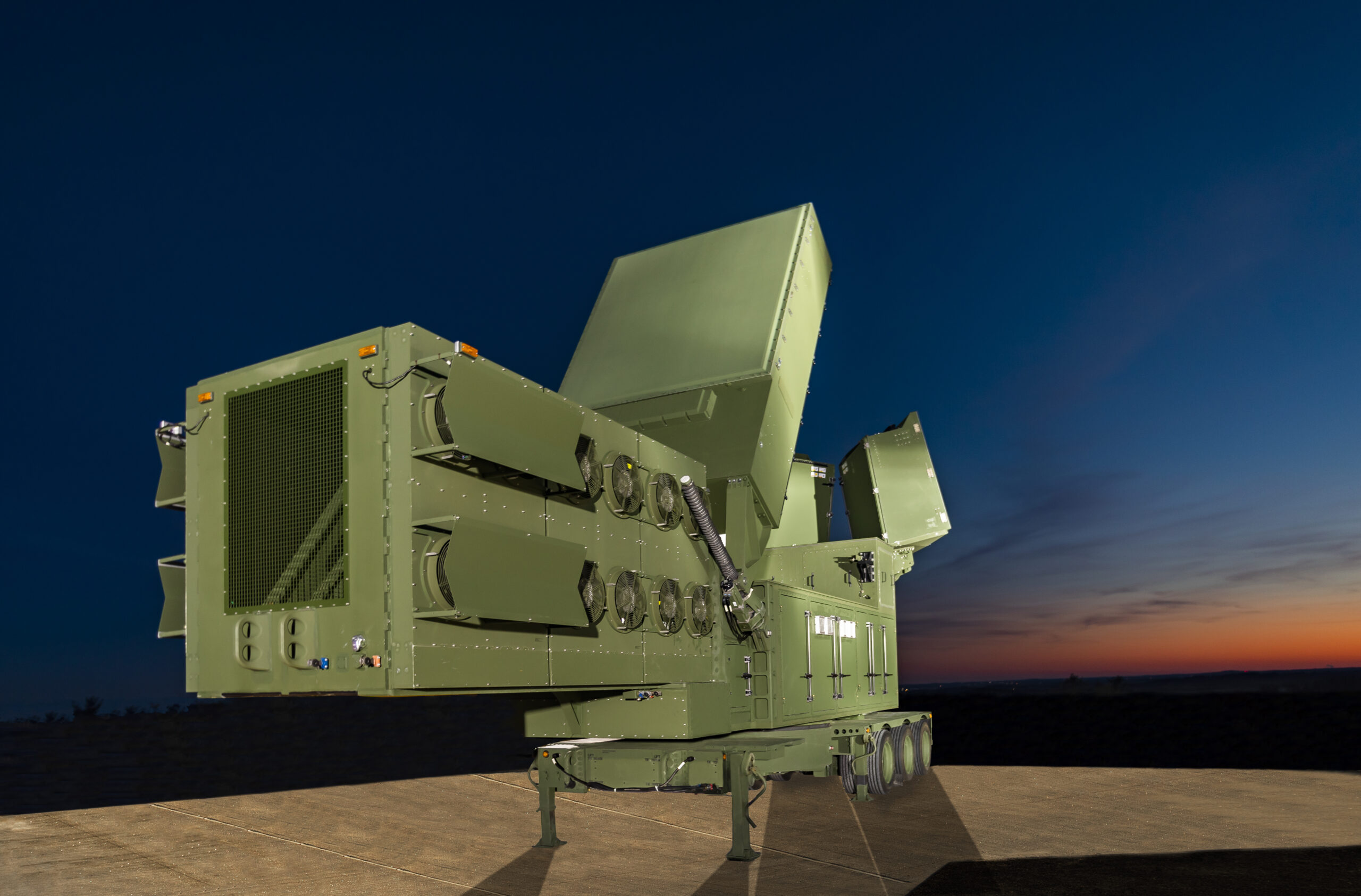
Breaking Defense: LTAMDS is the first sensor in a family of radars Raytheon is calling GhostEye. Leveraging the advancements of GaN technology and commonality with LTAMDS, Raytheon has separately developed GhostEye MR, a medium-range battlefield radar, for the National Advanced Surface-to-Air Missile System (NASAMS) mission. Tell me about this program and what’s planned for the family.
Kelley: LTAMDS is actually the first radar in the GhostEye family of radars. There’s tremendous international interest in LTAMDS. More than a dozen our allies have requested some form of information, or pricing availability, or classified briefings on the LTAMDS system.
GhostEye MR is based essentially on the same technology as LTAMDS. In fact, it’s designed with one of the aft arrays from a LTAMDS but in a rotating radar that provides tremendous range that is virtually the same that you’re getting out of a single LTAMDS array.
We view GhostEye MR as a radar for the future of NASAMS. NASAMS is a weapon system that we develop in partnership with Kongsberg from Norway. We have developed a prototype called GhostEye MR, and have done a significant amount of testing with it. Performance is exceptional, and we participated in a U.S. government test activity at Yuma, Arizona, earlier this year.
GhostEye MR is not a potential future radar on the drawing board. It exists now and is being tested in our open-air testing facilities right next to LTMADS. It was very important, as you mentioned, to introduce that same GaN technology to this radar for the NASAMS system. I would add, though, that this radar is not necessarily limited to the NASAMS system. It’s a very capable radar for medium range air defense, in general.
Breaking Defense: Final thoughts?
Kelley: The LTAMDS story is a story of rapid prototyping. As we are sitting here today in October, just 36 months after contract award, we have five radars up and in testing right now, and we’ll have a sixth by January.
The only way that we are able to do that is through the tremendous collaboration and transparency between the United States government and Raytheon. They have people at our facilities, we have people at their facilities. We’ve done soldier touchpoints where we have brought soldiers up to the northeast and had them interact with the LTAMDS radars to get their feedback and help us make the radar even more soldier friendly going forward.
We’re excited about this. This is a capability that is absolutely needed on the battlefield today. We’re looking forward, again, to working side by side with the U.S. government to deliver this capability in just a little over a year from now in December 2023.
AUSA 2022

 Gallery