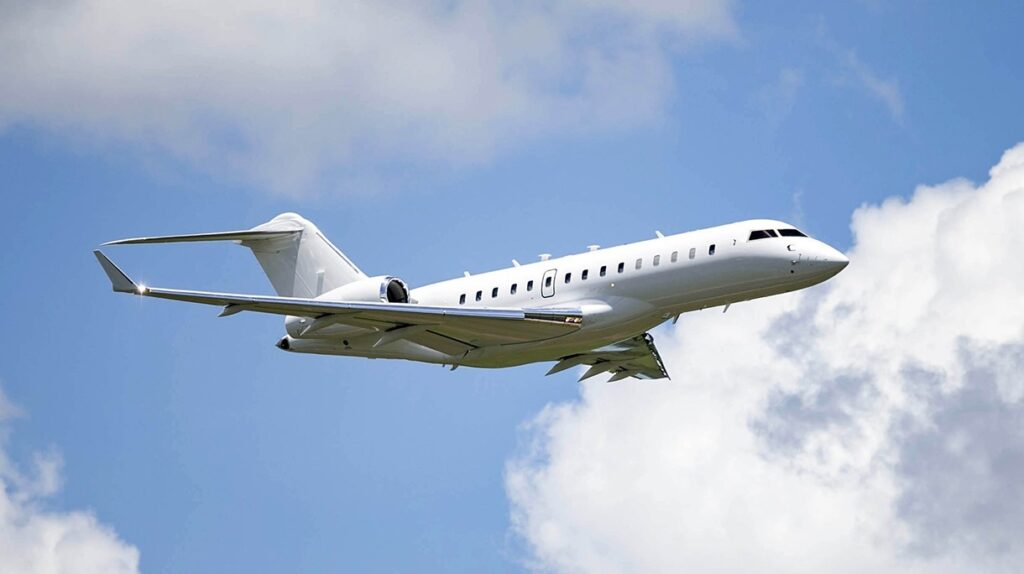
WASHINGTON — A recent Army request for information for up to 11 business jets to be used for the service’s High Altitude Detection and Exploitation System (HADES) program is a “good signal,” according to a service spokesperson, but doesn’t necessarily mean the program’s “full steam ahead.”
The RFI, published Jan. 22, states that the jet must operate between 41,000 and 51,000 feet above sea level and be able to carry a payload of at least 14,000 pounds while flying 12 hours or more without refueling. It further noted that the Army has a future objective of up to 14 aircraft for the HADES program. This notice comes eight months after Breaking Defense reported that the Army was considering cutting the the HADES fleet from 12 aircraft down to six in line with the sprawling Army Transformation Initiative.
Today, however, a separate Army spokesperson told Breaking Defense that the current plan is for the service to acquire six production aircraft and three prototypes for the HADES program. Currently, the government has provided three Bombardier Global 6500 jets to SNC for HADES prototypes and SNC purchased another which it aims to turn into a non-prototype.
“The RFI is tied to the Indefinite Delivery, Indefinite Quantity (IDIQ) contract ceiling i.e., total aircraft that could be purchased under the contract,” the spokesperson said. “The contract ceiling provides flexibility for the Army to provide additional HADES deep sensing capability as dictated by future threat levels and funding.”
Though the number of aircraft in the RFI and the number shared by the Army spokesperson are at odds with each other, this is not necessarily unusual as the RFI signals that the service may not need 14 total spy planes.
Further, Andrew Evans, the director for the Strategy & Transformation Office inside the Army’s Deputy Chief of Staff for Intelligence shop (G-2), told Breaking Defense this week that the Army isn’t so focused on a concrete number of aircraft for the HADES program, but rather the advancements it will bring to the service’s intelligence, surveillance and reconnaissance (ISR) suite of capabilities.
“In a landscape defined by rapid technological shifts, a fixed number is a static target devoid of the realities of the operating environment. With HADES, we are prioritizing investments in open architectures to ensure this acquisition generates value for the Army regardless of whether it’s 4 systems or 400 systems,” Evans said.


A leap in drone range and payloads come from a battery with different chemistry
Lithium-metal batteries are one way to break the weight and endurance limits of today’s unmanned systems.
“Our procurement objective remains directly tethered to the emerging threat, warfighter demand, and senior leader decisions about how broadly we must proliferate this capability to address the demands of the 2026 NDS [National Defense Strategy].”
Though SNC has previously been handed three Bombardiers for prototypes and bought one for a non-prototype, the recent RFI is not a sole-source notice — meaning, in theory, the Army would be open to other jet providers for the HADES program.
The RFI states the Army is looking for the aircraft to be in production through 2032 and anticipates there will be a 10-year ordering period.
Responses to the RFI are due Feb. 12.
UPDATED 1/30/2026 at 2:00 p.m. EST to clarify that the government provided the three Bombardier 6500 jets which will be turned into HADES prototypes.
Breaking Defense Video