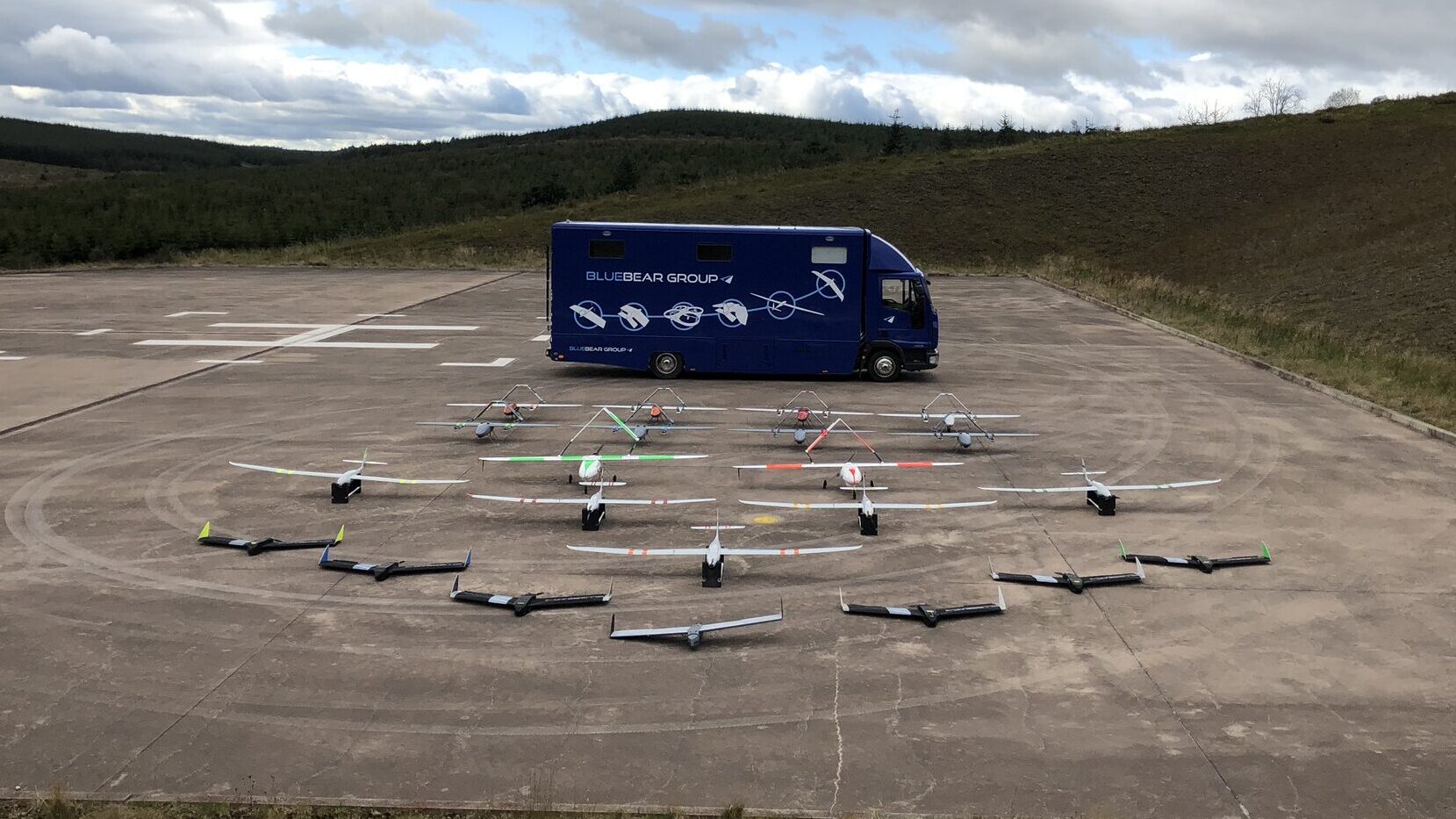
BELFAST — Swedish manufacturer Saab has taken a decisive step toward growing the company’s artificial intelligence portfolio by acquiring British robotics and autonomous systems supplier BlueBear for an undisclosed fee.
BlueBear mainly manufactures AI-enabled autonomous swarm systems for defense and security markets, recently taking part in an AUKUS AI and autonomy technology trial hosted in Wilshire, southwest England.
The startup said in a Thursday statement that it made a turnover of £8 million ($10.1 million) in 2022 and currently employs 65 personnel at a site outside Bedford, England.
Dean Rosenfield, group managing director at Saab UK, told media during a virtual press briefing today that the acquisition was part of a “deliberate strategy” to grow and expand business in Britain, while also fitting in with a wider merger and acquisition plan focused on growth across Saab’s key markets of the US, Australia and Germany.
He noted the value of the acquisition was of a “confidential nature” and could not be shared.
Yoge Patel, CEO of BlueBear, told reporters that the company had “for a little while” been looking for a partner that could take care of a wide range of products covering avionics, command and control systems, while continuing to “move fast on integrating new payloads and systems onto third party aircraft.”

Interoperability becomes the price of entry for next-gen warfighting tech
AI, autonomous systems, cyber, and EW converge as industry targets faster battlefield effects.
Rosenfield said that, as a priority, Saab would begin consulting with “technical experts” from within the company to determine how to “first deploy” AI technology from BlueBear. He specifically referenced Saab’s maritime 9LV combat management system, mentioning that it offers a “great opportunity” for integration with BlueBear technology.
There will also be an “opportunity” to eventually evaluate such technologies to determine how they could be applied to Saab’s Gripen multirole fighter jet operating alongside adjunct or autonomous aircraft, according to Rosenfield, though he did not share a timeline for the assessment.
“Having tangible, proven technology that allows you to combine the big [air] vehicle with a collection of smaller vehicles, gives you that force mix that one is looking for,” added Patel. “There’s quite a lot of work to do I’d say internationally in terms of understanding where the value lies in that, but a good part of the world is now moving in that direction.”
On AUKUS, Rosenfield said Pillar 2 offers “great opportunity” and added that there is currently “engagement” happening between industry and the UK MoD on the effort itself. Pillar 2 covers so called “advanced capabilities” and is divided into eight workstreams including AI, hypersonic missiles and quantum technologies.
“We know that the US is doing likewise and Australia kicked off quite recently from my understanding,” he said of Pillar 2 developments.
Despite not being involved in the main AUKUS program to develop a new class of nuclear powered submarines to replace Collins class conventional subs operated by the Royal Australian Navy, Saab has expressed an interest in delivering a potential interim sub fleet if needed, to stave off a capability gap between the Collins out of service date and entry to service of the new vessels, according to Naval Technology.
[hubspot-form portalid=’2097098′ formid=’5b7a7013-dd8f-4af1-950e-1c6aa0f253c1′]