
WASHINGTON — Half of the Navy ships the Marine Corps would use to make amphibious assaults are in “poor condition,” and some of the vessels have been unavailable for operational or training use for years at a time, according to a pointed new watchdog report.
“Amphibious warfare ships are critical for Marine Corps missions, but the Navy has struggled to ensure they are available for operations and training,” reads a new report from the Government Accountability Report, published today.
The Navy is required by law to maintain a fleet of at least 31 amphibious vessels; it currently counts 32. But the report found that as of March this year, nine of the Navy’s 10 dock landing ships were in “poor material condition,” as were five of the seven amphibious assault ships and two of the 13 amphibious transport docks. The Navy’s two amphibious assault ships were both in “satisfactory material condition.”
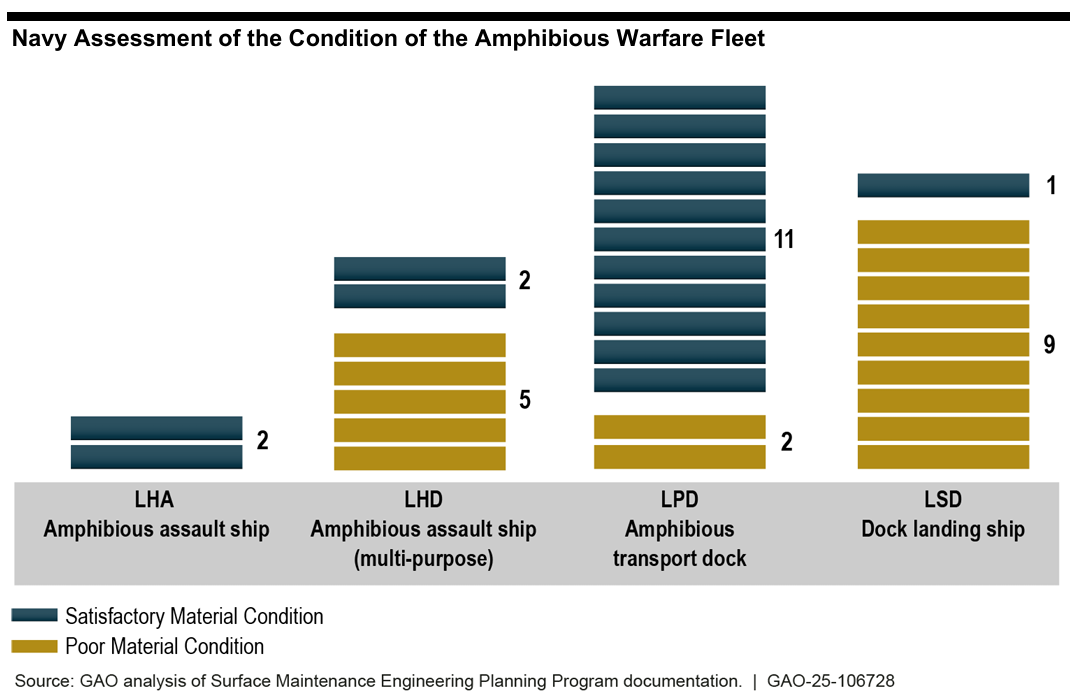
The report notes several factors that contributed to the problem, including “challenges with spare parts.” But a summary of the report also noted that in order to “save money, the Navy proposed early retirement for some ships and cancelled critical maintenance on them. But the Navy is still relying on these ships — which haven’t been well-maintained — while it waits for new ones to be built. As a result, it will be hard to continue meeting the 31-ship requirement.”
Amphib readiness has been a topic of much discussion, as service leaders and lawmakers have scuffled over just how many of the ships the Marine Corps really needs, and how relevant they are to modern combat operations.


Powering the future: Securing America with domestically made microelectronics
Onshoring and investment in military-specific semiconductors anchor a cornerstone of the defense industrial base.
OP ED: To cool the war over amphibs, the Navy and Marines need a clearer justification
By this summer the Navy and Marine Corps leadership had “locked shields” in defense of the fleet, and in July the heads of both organizations announced they had jointly signed off on new guidelines that were meant to “ensure consistency and uniformity in Navy and Marine Corps amphibious force planning, assessment, and operational mission execution.” (The GAO report also pinged the services for disagreeing with each other “on the number of ships that should be available at any given time to conduct operations and training.”)
As for the GAO report, in the end the oversight body makes four recommendations, three of which dealt with still better defining readiness terminology as well as establishing clear timelines and performance goals related to assessing and improving readiness. The Navy concurred with all of those.
RELATED: Short on amphibs for Turkey and Sudan, the Marines grapple with crisis response ethos
The Navy partially concurred with the GAO recommendation that the Navy update its amphibious ship depot maintenance policy “to clarify that, absent operational needs, the Navy should not cancel depot maintenance for amphibious ships proposed for divestment that have yet to reach the end of their expected service life.”
In that case, the Navy said it’s currently “prohibited by law” from modifying vessels destined for the boneyard, and waivers to do so have a narrow timeline. “However, the statute permits normal Hull, Mechanical, and Electrical (HM&E) work within the five-year window prior to a ship being removed from service. The Navy will schedule this work, including depot-level repair as necessary, to maintain the ship in operational condition.” It also noted the Navy Secretary may grant waivers for that statute in the “national security interests” of the US.