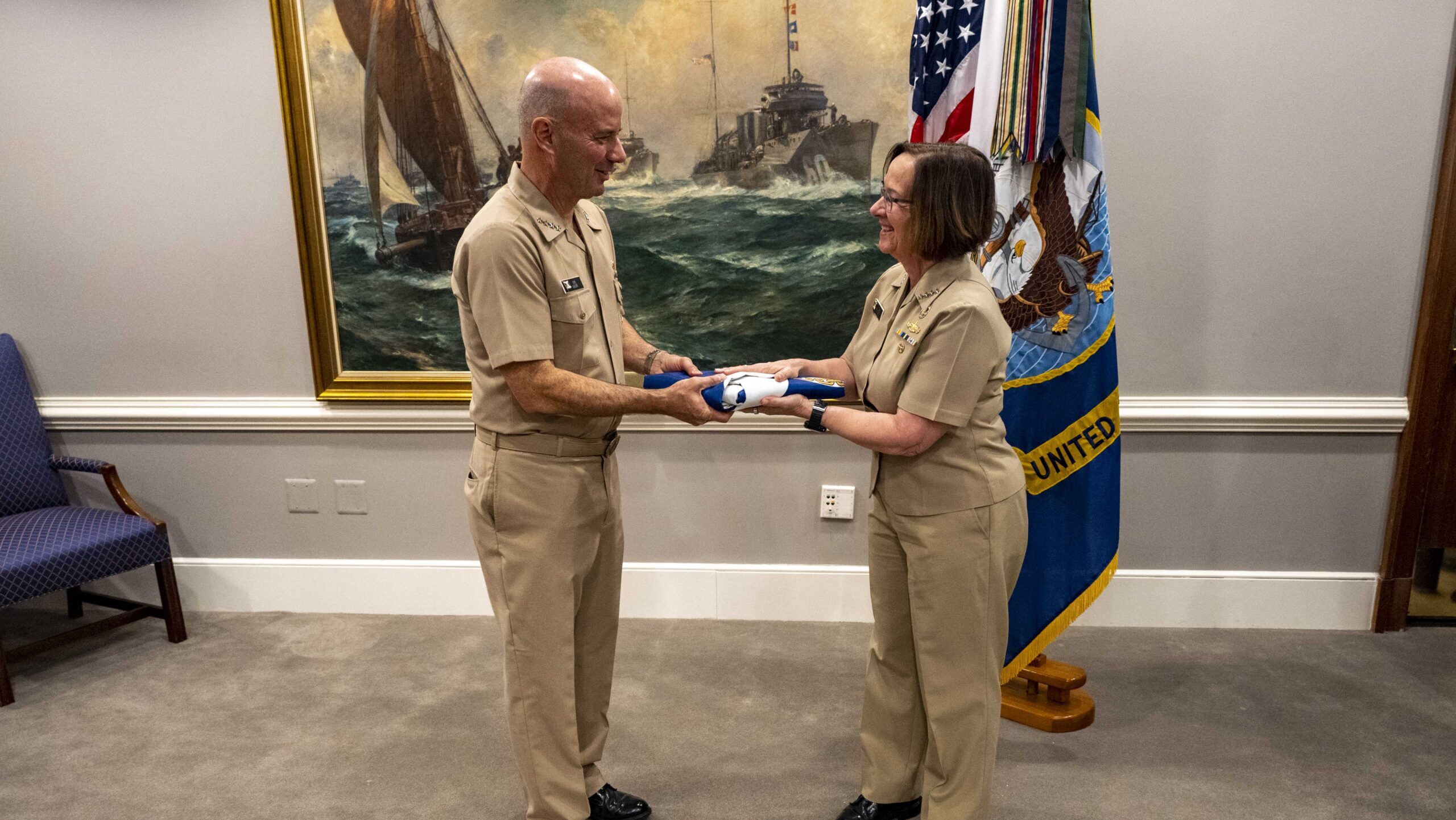
WASHINGTON — Walking in the Pentagon’s river entrance, a visitor is greeted by a series of photographs on the walls featuring the top uniformed member of the military services. But for the last 91 days, in the spot where a photo of the chief of naval operations should be, has been a black piece of paper — marking the absence of a Senate-confirmed senior Navy officer.
Earlier this month, the Navy hit an ignominious milestone: The longest stretch in the service’s history it has been without a confirmed chief of naval operations. And with the Trump administration yet to name a nominee, former Navy officials, lawmakers and experts are sounding the alarm.
“We do need a presidential nominated and Senate-confirmed CNO in place,” said Steven Wills, a naval historian and associate at the Center for Maritime Strategy. “CNO provides the course that all other Navy flags follow … They set force design priorities, make key budget decisions and set the tone for the entire service.”
“It’s not good,” Wills said flatly, “to be operating without a CNO.”
The Navy has been without a confirmed CNO since Feb. 21, when Defense Secretary Pete Hegseth fired Adm. Lisa Franchetti. She had served in the role since late 2023, after herself serving as acting CNO for several months.
In the aftermath of Franchetti’s ouster, Adm. James Kilby, the vice chief of naval operations, has taken her place as the acting CNO.


Data overload threatens decisionmakers as autonomy expands
Reducing cognitive overload on warfighters while improving “time to trust” for autonomous systems is a matter of design.
But even with Kilby in place, Wills and others said major strategic or programmatic decisions will likely be postponed with no empowered, confirmed CNO to back them up. At an individual level, the strain on Kilby — simultaneously serving as chief and vice chief — is immense, and that feeling will ripple down the chain of command as everyone else picks up the slack left at the top.
“Even when those seats are filled by talented individuals in an acting capacity, these vacancies are a momentum-killer for getting things done. Even the best acting leaders are reluctant to make tough calls on hard issues,” Erik Raven, former under secretary of the Navy, told Breaking Defense.
Key lawmakers acknowledged the situation is suboptimal.
Sen. Tim Kaine, the top Democrat on the Senate Armed Services seapower subcommittee, told Breaking Defense he was “nervous” about the lack of a CNO.
“There’s some positive things going on [like] the White House shipbuilding office” as well as a focus on shipbuilding from the White House, Deputy Defense Secretary Steve Feinberg and Navy Secretary John Phelan, Kaine said. “But still, a lot of pieces are not in place.”
A spokesperson for the Navy referred questions for this report to the White House, where representatives for the National Security Council did not respond by press time. A spokesperson for Kilby did not respond by press time.

‘A Bit Lost At Sea’
One of the biggest hurdles for the Navy, or any service, when it lacks a Senate-confirmed chief is it paralyzes decision making, analysts and former officials said.
Raven said the reluctance to act at the top creates a domino effect down the chain of command. To cope with the strain of doing two jobs at once, the acting service chief must delegate tasks to subordinate officers, who then do the same as they become overburdened with new responsibilities. Those officers also become reluctant to act when asked to make decisions that are historically above their paygrade.
“The faster you can get butts in seats, the more ready the Pentagon is to tackle a dangerous world,” said Raven.
Raven should know. He was the Navy’s second-most senior civilian in 2023 when Sen. Tommy Tuberville, R-Ala., put a blanket hold on military officer promotions in protest over the Biden administration’s policies concerning abortion. Tuberville’s hold lasted 10 months and affected 447 individual general and flag officers across the Pentagon, according to a recently published Government Accountability Office report.
Acting service chiefs used to be much more of a novelty in the Pentagon.
Wills, the naval historian, said that prior to 2023, the longest period a Navy admiral held the title “acting CNO” was in the mid-1990s when Adm. Michael Boorda died by suicide, leaving his vice chief, Adm. Jay Johnson to become acting CNO for 78 days.
That distinction was eclipsed when Adm. Michael Gilday retired on Aug. 14, 2023, and Franchetti became the acting CNO for 80 days, until she was confirmed and subsequently sworn in on Nov. 2.
“When Adm. Franchetti was the vice chief, and acting as CNO, she was hesitant to roll out a plan for the Navy under her term of leadership,” Wills added. “No acting CNO can do that.”
Exacerbating the situation for the Navy right now is the amount of rapid changes pushed by the administration and the other services across the Defense Department. This includes an 8 percent realignment of the fiscal 2026 budget directed by Hegseth aimed at transferring funding from low-performing programs to efforts more in line with Trump administration priorities.
It also comes as the Army cancels a list of modernization programs and reduces its formations as part of its ongoing transformation initiative, and as Air Force leaders push for a larger slice of the budget pie.
“The Navy is at an extreme disadvantage in the multiple budget battles that it is fighting without senior military leadership,” said Stacie Pettyjohn, a senior fellow at the Center for a New American Security. “This is particularly true given that the Secretary of the Navy does not have prior experience with the service or the department.”
Pettyjohn acknowledged that the White House and National Security Council have publicly supported increased shipbuilding, but noted that Hegseth previously laid out 17 priority budget areas all of which will “have to fight for resources in what is essentially a flat budget request.”
A Senate-confirmed CNO is also necessary to weigh in authoritatively on decisions concerning modernization where their voice will potentially impact the Navy’s fleet for years to come.
“Without it the Navy is likely a bit lost at sea and could lose more time and opportunities, while China’s Navy continues to grow apace,” Pettyjohn added.
In mid-April, Politico reported that Adm. Daryl Caudle, the Navy’s head of Fleet Forces Command, had emerged as the frontrunner for the CNO nod, citing five sources with knowledge of the issue. But a month later, no official nomination has been made.
Sen. Angus King, I-Maine, told Breaking Defense he was “absolutely” concerned about the lack of permanent uniformed leadership at the Navy’s helm.
“We’re in a very perilous moment. And we should have all hands on deck,” he said.
SASC Chairman Roger Wicker, R-Miss., declined to say if he was worried about the state of affairs, but hinted that the Trump administration could be close to announcing a CNO nominee.
“I’m hoping we have some news soon,” he said.