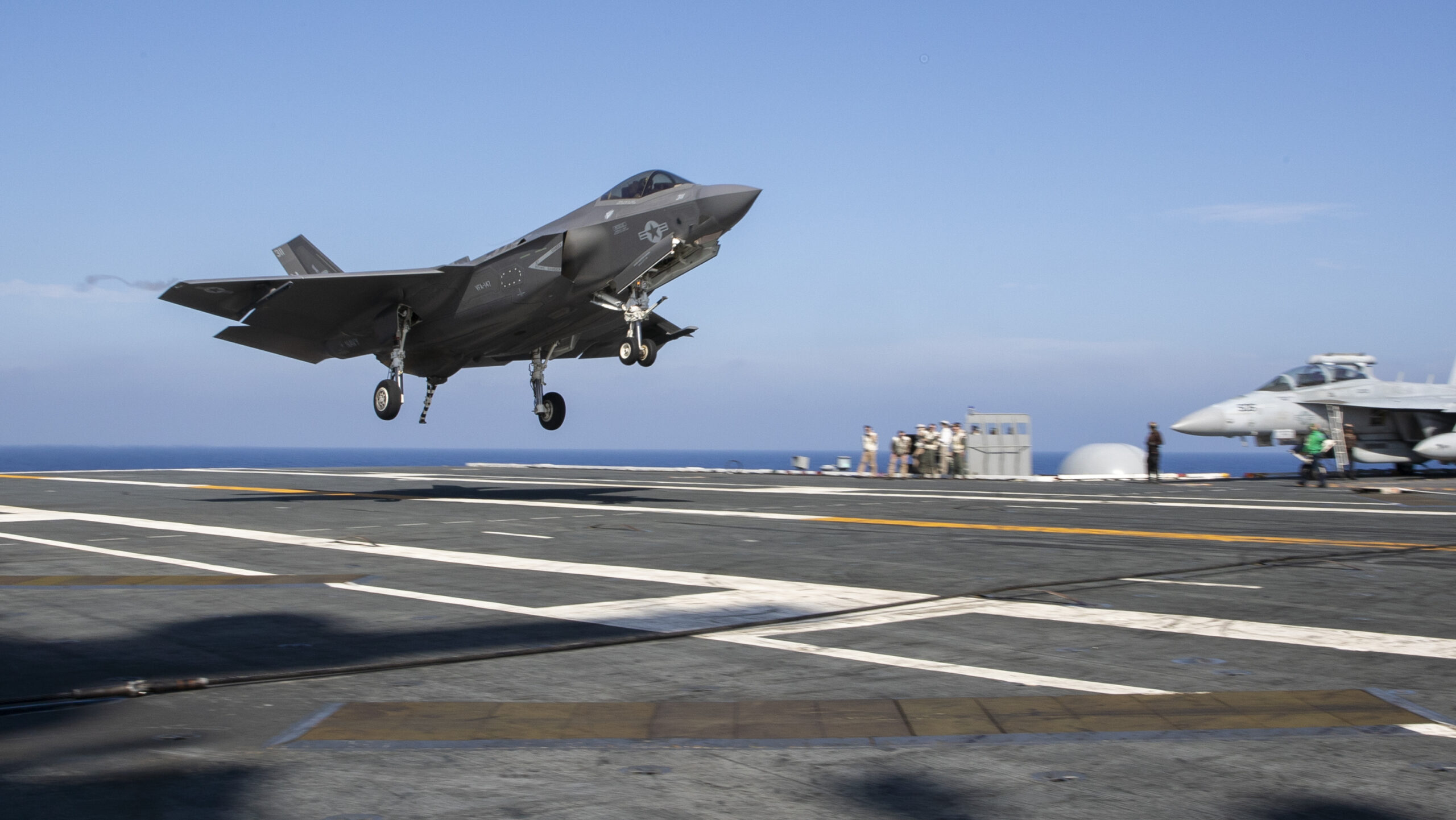
BELFAST — US Naval Air Systems Command (NAVAIR) is set to “negotiate and award” Leonardo UK an active expendable decoy (AED) contract for 3,000 to 6,000 of the airborne countermeasures to equip F-35 and F-18 fighter jets, according to a presolicitation notice from the agency.
Published last month, the document says that the contract, slated for November 2026, “is planned to contain a base year with up to four option years and is intended to satisfy requirements for Fiscal Year (FY) 2027 through FY2031.” Spare impulse cartridges and other related equipment will also be included in the deal.
Leonardo is referred to as the “only contractor” in a position to “complete all requirements” associated with a related Sources Sought Notice. This likely means the manufacturer’s BriteCloud 218 decoy will be ordered. Leonardo UK declined to comment.
Neither BriteCloud nor the US designation of the system — AN/ALQ-260(V)1 — is directly mentioned in the latest notice, but the main requirement of the acquisition centers around an AED complete with a 2x1x8 inch form factor, mirroring BriteCloud’s 218 design.
NAVAIR plans on acquiring an estimated 3,000 AEDs annually, for an initial two years, before doubling the quantity for “follow on years,” as per sources sought documentation. Production is expected to begin with 300 units per month.
In advance of the presolicitation decision, Leonardo had to meet an AED “mission load programmable” requirement, alongside offering a radiofrequency countermeasure Technology Readiness Level 9 (TRL-9) solution.


Keeping sensitive information safe in a new AI era
Why edge and endpoint security can’t be an afterthought.
Company literature states that BriteCloud features “latest-generation DRFM [Digital Radio Frequency Memory] jamming technology” and is “designed to disrupt incoming missiles’ RF tracking systems.” It can be launched from countermeasure dispensers.
According to a March 2025 news release from the Defense Visual Information Distribution Service, BriteCloud was expended by an undisclosed F-35 squadron, attached to the Navy’s Carrier Air Wing (CVW) 2, for the “first time” under the leadership of former CVW 2 commander Capt. Timothy Myers. VFA-97 is the only F-35C squadron connected to CVW 2.
The BriteCloud family has previously been tested with or deployed on a range of other aircraft like the Eurofighter Typhoon, F-16, Gripen, MQ-9 and Tornado.
In 2022 the Air National Guard issued a “fielding recommendation” for the 218 version.