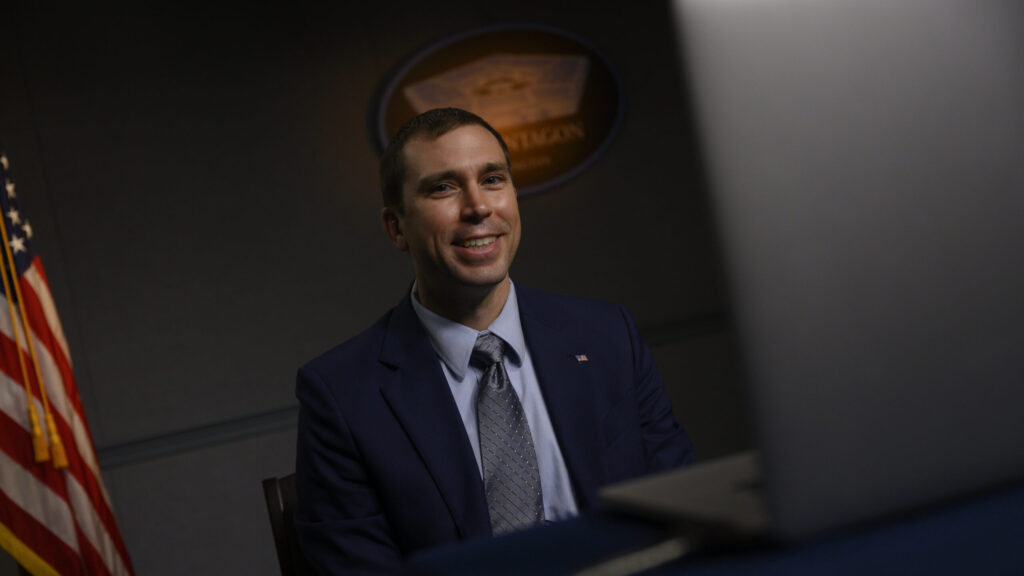
WASHINGTON — Derek Tournear, who has headed the Space Development Agency (SDA) almost since its inception, is leaving the agency for academia — telling Breaking Defense in an exclusive interview he’s making the move “at a really good point in the agency.”
“I’ve been with SDA now for over six years. When I first started in this role, I told my wife it would be for two, three years tops. So six years seems to be a good time to call it,” he said. “The agency has matured from from a startup to now a full operational agency.”
Tournear joined SDA as the first permanent director in October 2019, replacing Fred Kennedy who had stood up the agency as part of the Defense Department’s Office of Research and Engineering. Kennedy quit in June 2019 after only four months in the job.
During the wide-ranging interview, Tournear spoke at length about his successor, his tenure at SDA, and what he sees as the agency’s contributions to the Pentagon’s space mission — as well as revealing at least one thing he’d do over if he could.
He will be replaced at least in the near-term by Gurpartap “GP” Sandhoo, the current SDA deputy, who will become acting director.
“He is extremely well suited. We brought him in December, because he has a very lengthy background in active duty, both in the Marines and the Navy, so that he really understands how the capabilities that SDA will provide will be used by the war fighter in battle,” Tournear said.
Sandhoo further has “a long history of being able to field new capabilities in space, as he had had a dozen years at Naval Research Laboratory and ended up running their their space center,” he added.


AGVs vs. UGVs: A new class of ground autonomy takes the field
One commander, many robots: Fully autonomous ground vehicles are reshaping the battlefield.
Sandhoo first joined SDA as a senior advisor, and was named deputy director in July after the departure of Ryan Frigm.
As for Tournear’s future, he said he will be taking up a position at Auburn University in Alabama, although working from their local office here. Auburn, he noted, is looking to up its game in space technology development and research.
“The want to get more involved in in space innovation and being able to build an ecosystem around space as an education facility and a research house. And so I’m going to be leading that for them,” he said. “When that kind of fell into my lap, it was difficult to say no to, because that’s too exciting.”
Tournear’s Highlights: Link 16, Tracking Missiles, Laser Comms
Looking back at his time helming SDA, Tournear touted SDA’s demonstration proving that Link 16 could be used by satellites to transmit targeting data to weapons platforms in the air, on land and at sea as the agency’s biggest technological success.
“That is a huge accomplishment, because what that has done is it has proven that we can [connect with] legacy, fielded systems with no change to the user equipment — so, these are the systems that the US and all of our allies use to fight,” he explained.
“Space will now enable us to make Link 16, which was a regional communication network, global, which is a huge deal because it allows all of the combatant commanders to utilize this communication network that they already know how to use, they already trained with, they already practiced with our allies,” he added.
Tournear said the second major SDA tech accomplishment was proving that satellites based in low Earth orbit (LEO) could successfully detect and track missiles — a mission traditionally assigned to large satellites in higher orbits. He noted that as SDA was gearing up its Tracking Layer constellation, there were a number of skeptics within the Defense Department’s research and engineering community about whether this would work given the physics involved.
“At a lower orbit when [your satellite is] screaming across the Earth, the missiles are screaming across the Earth, and the background is moving right relative to your satellite pretty drastically. They said it’s going to be impossible,” Tournear said.
But SDA was able to prove that it is possible, he said, based in large part on modeling and simulation work done previously by the Missile Defense Agency (MDA) under its Hypersonic and Ballistic Tracking Space Sensor (HBTSS) program.
Finally, Tournear said SDA’s progress in developing laser communications systems that serve as the foundational “enablers” of SDA’s Proliferated Warfighter Space Architecture’s mesh network design.
While a number of companies have demonstrated optical intersatellite links, he said SDA was able to successfully achieve laser communications “with very affordable, low size, weight and power optical terminals” and “from different spacecraft manufacturers.“
Most recently on the laser comms front, the agency announced on Sept. 2 its first successful demonstration of laser communications between a satellite and an aircraft in flight.
“The successful proof-of-concept demonstration took place in July between a General Atomics Electromagnetics optical communications terminal that was mounted to an aircraft and a commercial satellite operated by Kepler Communications in an orbit around 311 miles (500 kilometers) above Earth,” the announcement said.
This “was something we tried to demonstrate for the last three years, we were finally successful at it, and that was using these same affordable, commoditized SDA compliant … optical comms terminals,” Tournear said. “That’s a big deal too, because I think that is, that is what opens up a lot of missions in the future.”
Regrets, I’ve had a few …
Asked what his biggest regret was about his tenure, Tournear joked: “Oh … we don’t have time to get into all my regrets.”
Nevertheless, he said that looking back, he wished that he and the agency had more rapidly accepted the shift of SDA from DoD Research and Engineering to, in essence, the Space Force — as a free-standing acquisition shop under the Air Force assistant secretary for space acquisition and integration, and with a direct line to Space Force chief Gen. Chance Saltzman.
“One of the things that I was extremely apprehensive about was the fold of SDA into the Space Force. We actually fought that for quite some time,” he said. “[I]f I had to do it over again, I actually would not have fought that, and I would have embraced it more. Because the Space Force is not the Air Force, and the Space Force culture was much more accepting of the SDA mindset.”
Tournear was optimistic about SDA’s future, despite a recent review calling into question the agency’s independent processes, and the current uncertainty about its plans for a third iteration, called Tranche 3, of Transport Layer data relay satellites.
As first reported by Breaking Defense, the Department of the Air Force (DAF) in late January ordered an independent review of whether SDA’s “organizational performance and acquisition approach” is meeting the needs of warfighters, including its independence from the Space Force’s primary acquisition organization, Space Systems Command.
The review came in the wake of a Jan. 16 DAF decision to place Tournear on administrative leave for undisclosed reasons, which Breaking Defense first learned was related to a contracting dispute. He was reinstated in April following an investigation about which DAF declined to provide details.
Tournear said that the review has been completed and by and large “validated” SDA’s acquisition model and processes.
“The main point of that review was to come out and say, ‘Look, SDA is doing this stuff the correct way,'” he said.
The review put forward eight recommendations, Tournear added, “almost all” of which were “already being incorporated” as “good ideas” for improving the agency’s processes. Among those, he stressed, were recommendations that SDA be “better supported” with additional personnel and “more consistent” funding.
Only one recommendation — a call for the establishment of a top-level Board of Directors — was rejected by the agency.
Tranche 3 And The Mysterious MILNET
As for Transport Layer Tranche 3, Tournear suggested that in his view it would go forward, alongside the Space Force’s mysterious MILNET communications network that only recently emerged from the shadows.
DoD and DAF have been considering possibly replacing Tranche 3 with MILNET, which is based on SpaceX’s Starshield terminals and being acquired via the National Reconnaissance Office. Such a move would in effect kill the Transport Layer, which is one of SDA’s raisons d’etre. Tournear suggested it would be better to get both flying.
“MILNET and the Transport Layer serve two different functions. All of that is part of data transport, and it’s all needed. And so in the future, as that plays out, there are some synergies between the two,” Tournear said.
He explained that the Space Force “is committed to building out a transport layer that does tactical communication, which is what the SDA Transport Layer has been focused on, and that is Link 16 tactical communication directly to special platforms that rely on low bandwidth but extremely low latency communications.”
And that is something that Starlink/Starshield satellites cannot do, Tournear said, stressing that “Link 16 from space is only the SDA Transport Layer.” (SpaceX did not respond to a query about the issue.)
On the other hand, Tournear said that MILNET will bring something to the table that is needed: the ability to “move large amounts of data across the backbone and move large amounts of data in and out of theater.”
Further, he stressed, SDA has been focused on the “Android model” of “open architecture, architecture, open standards, and has competition for anyone to build the hardware and plug in.”
As for MILNET, Tournear said the key question is whether it is instead more similar to the “iPhone model,” under which one vendor “controls everything and has a network, and that is easier to build, obviously, and easier to integrate, because it’s all controlled by one, but then you lose a lot of the free market dynamics.”
(MILNET, at least at the moment, is being pursued under a sole-source contract with SpaceX; and SpaceX uses its own proprietary standard for Starlink/Starshield intersatellite laser links rather than SDA’s open standard.)
“Is that the way in the future? I don’t believe that,” Tournear said.
As for advice to his successor, Tournear said the key is to “continue to stay focused on the warfighter.
“The battleground is not in space. The battleground is on Earth, and space just needs to make sure that the soldiers, sailors, airmen and Marines that are on the ground get the capabilities they need to be able to conduct the fight in an efficient manner,” he said.
Breaking Defense Video