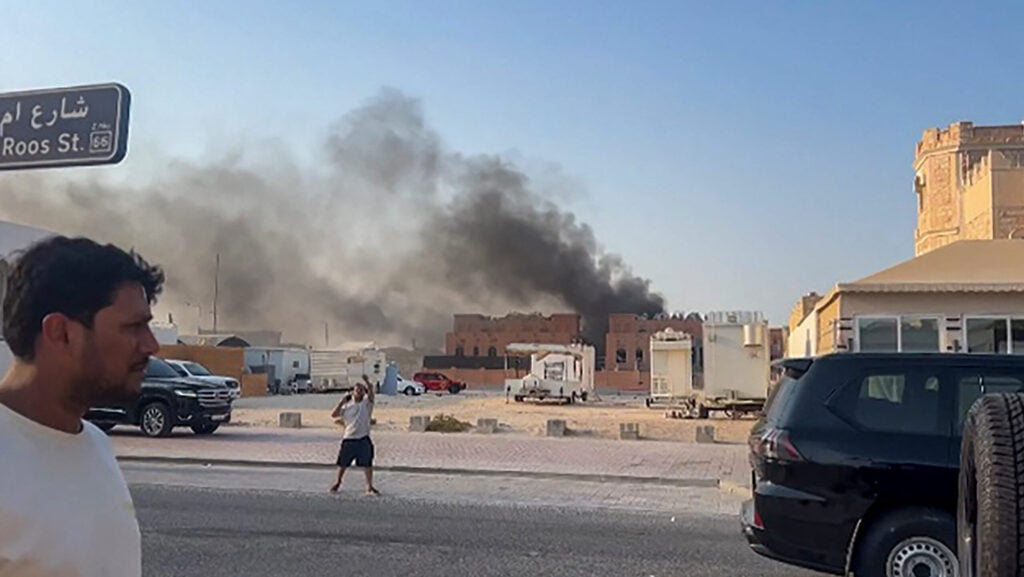
BEIRUT — As the dust settles in the Qatari capital of Doha following an airstrike by Israel against Hamas figures on Tuesday, experts told Breaking Defense that the deadly incident was an escalation by Jerusalem and will have a longer term effect of delaying progress in the normalization of relations between Israel and other Gulf nations.
Israel’s attack was its first airstrike on a Gulf state and targeted Hamas leadership in Doha while they were reportedly considering a US-led ceasefire proposal for the Israel and Palestine conflict. Qatar is now the first and only Gulf state to have been attacked by both Israel and Iran in the same year, after Tehran targeted an American military base there in June.
Qatari Prime Minister and Minister of Foreign Affairs Mohammed Bin Jassem said today at a press conference that the Israeli attack is an act of “state terrorism” and that Qatar reserves “the right to respond to the Israeli assault.”
It remains to be seen exactly what that Qatari response will be, but experts told Breaking Defense the strike likely has already altered the geopolitical outlook for the near future.
“I think yesterday’s attack will delay any normalization efforts between Gulf States in particular and Israel,” Will Todman, a senior fellow at the Center for Strategic and International Studies, told Breaking Defense.
Todman, who also serves as CSIS’s chief of staff for geopolitics and foreign policy department, noted that he didn’t think Qatar and Israel were going to normalize relations “anytime soon” anyway, but the strike pushes that off further and would affect other negotiations.
US President Donald Trump, who in his first term helped broker new relations between Israel and the United Arab Emirates, Bahrain, Sudan, and Morocco under the Abraham Accords, told the media he is “very unhappy” about the strike.


A leap in drone range and payloads come from a battery with different chemistry
Lithium-metal batteries are one way to break the weight and endurance limits of today’s unmanned systems.
Saudi Arabia did not sign the Abraham Accords in 2020. Israel’s invasion of Gaza further dimmed chances of normalization, and it did not come to pass when Trump visited in May to further push normalization agreements in the Middle East.
And now, Todman said, “I think, most significantly for Saudi Arabia, this will further delay their willingness to engage in talks about normalization.”
Ryan Bohl, a senior fellow at the RANE network, agreed that the strike will complicate the situation even more.
“I think that in terms of major achievements in the Abraham Accords, this will further throw dirt on the grave of Saudi-Israeli normalization. Saudi Arabia likely sees few upsides with normalizing with this Israeli government,” he said.
A ‘Period Of Unpredicatble Security’
Beyond talk of normalization, analysts said the Israeli action could have significant destabilizing effects on the region.
Though Israel is alleged to have taken more subtle lethal action against Hamas targets in the Gulf before, Bohl said the airstrike is “significant Israeli escalation into a new arena and suggests that Israel’s traditional geographic limitations against nominally friendly countries like the Gulf Arab states does not exist.”
Kristian Alexander, a senior fellow at the United Arab Emirate-based Rabdan Security and Defence Institute, told Breaking Defense that the near future will be a “period of unpredictable security” in which other states may be “emboldened” to “take unilateral military action outside their borders, leading to a more volatile and less predictable Middle East.”
The incident also erodes trust in the US, Israel’s major military backer, the analysts said. In a post on Truth Social, Trump criticized the “unfortunate incident” and said he had assured Qatar’s leaders it wouldn’t happen again.
But Ali Bakir, a professor at Qatar University posted on X, “Essentially, this is the US striking at the very states it is supposed to protect. Now it is time for regional states to recognize the US for what it truly is: neither a partner nor an ally, and certainly not a security guarantor. Look for alternatives.”
Todman agreed, noting that Qataris are “much less confident that the presence of US forces in Qatar equates to a security guarantee from the US. Ultimately, the US did not protect Qatar against this attack, and I think that those questions about US credibility as a guarantor of security in the Gulf are only going to grow in the months and years ahead.”
Professor at the Near East South Asia Center for Security Studies David Des Roches, however, does not agree that the Israeli strike will have a major impact on US-Qatar relations.
“There will be statements of condemnation, but l think that will be the end of this Qatar US relations will remain strong,” he told Breaking Defense.
Either way, Trump said he’s tasked Secretary of State Marco Rubio to help smooth things over by finalizing a Defense Cooperation Agreement with Qatar.
Breaking Defense Video